Many newsrooms have tackled urgent social issues with majority white staff—some more successfully than others. The National Press Foundation intends to do its part to address this problem through a “Widening the Pipeline” Fellowship designed to help confront the common lament that “it’s hard to find qualified journalists of color.”
This is an all-expenses-paid fellowship, from March 2022 to February 2023. Apply by Feb. 6, 2022.
Beginning in March 2022, the once-monthly training sessions will include two in-person gatherings in Washington, D.C. (unless COVID-19 guidelines mandate that all sessions be virtual). Participants must be fully vaccinated to attend the in-person training. NPF will pay for fellows’ airfare, hotel, and most meals for the two in-person training’s. The estimated time commitment for virtual training, including prep and homework, is five hours per month.
The 2022 program will build on NPF’s Paul Miller Washington Reporting and Accountability fellowships, existing partnerships, influential alumni and volunteers to support the growth of these public service-minded reporters. The application is here.
NPF is committed to leveraging its resources and decades of training experience to help grow the pipeline of diverse journalists who will rise to positions of influence in America’s newsrooms.
Specifically, NPF will:
Recruit up to 25 young journalists for a 12-month fellowship in the leadership, in-depth reporting, data, and multimedia skills they need to hold governments and corporations accountable and to advance in their newsrooms.
Provide each fellow with individual coaching and mentoring.
Bring fellows to Washington for training, mentoring, and networking sessions with editors.
Survey fellows on promotion, retention, and job satisfaction.
John Foust has conducted training programs for thousands of newspaper advertising professionals. Many ad departments are using his training videos to save time and get quick results from in-house training. E-mail for information: john@johnfoust.com.
Samuel, the ad manager at a community paper, told me about a simple technique his sales team uses at the end of meetings with prospects and clients.
“I once read that people remember only about 25 percent of what they hear,” he said. “That’s a harsh reality because we focus our client conversations on things we think are memorable. It’s painful to walk away from a meeting knowing that the person on the other side of the desk might forget three-quarters of the discussion. Of course, we use ad examples, charts, and coverage maps to add visual elements to presentations, but they still forget a large percentage of what we talk about.
“We’ve learned that one way to deal with this problem is to summarize at the end of a meeting,” he said. “It’s an easy way to repeat the important points in a conversation. And a lot of times, we find out the other person has completely missed a key fact. A summary helps us clarify things and make presentations a little easier to remember.”
Samuel’s process has three steps:
Restate briefly. For example, a member of Samuel’s team might say,“Thank you for meeting with me today. To make sure we’re on the same page, let me recap what we’ve talked about. First, we looked at the target audience for your new Widget product, then you gave me a list of the most important features and benefits, then we talked about some special offers that could appeal to your customers.”
Notice how this brief statement hits the highlights in a logical sequence. There’s no need to go into great depth about everything which was discussed.
Confirm the information and ask for input. After the summary, it helps to nail it down by asking, “Does this cover everything?”
Even though it’s short, this is a crucial question. It is designed to give the other person permission to say they missed something which was covered – or even to say they would like to know something else. If something has been misunderstood, it’s better to find out now.
Include an action item. For instance, “My next step is to start on that market report you want and get it to you by Monday. Will that work?”
This is the time to get some kind of agreement and advance the sale. If the other person is not yet ready to finalize things and sign on the dotted line, this keeps the dialogue going in a helpful, low-key way.
“An action step can make a conversation stick in the mind,” Samuel explained. “It gives the salesperson a specific reason to get back in touch. It lets the other person know to expect a call by a certain day. When someone is waiting for information, an action step reduces the chances that an email or a voice mail message will be ignored.”
It’s all about creating memorable presentations. When advertisers and prospects remember the key points, they are more likely to buy.
(c) Copyright 2022 by John Foust. All rights reserved.
Annually, the Society of Professional Journalists presents the Mark of Excellence Awards, honoring the best in student journalism.
Entries are first judged on the regional level. First-place regional winners advance to the national competition, and most are recognized at their respective regional SPJ conference in 2022. National winners will be showcased on spj.org.
A best in show (MOEy) award will be given for the overall best entry among all national winners. The winner will be honored at the SDX Awards dinner.
Winners in the following categories are eligible for a MOEy only if they cover a single topic:
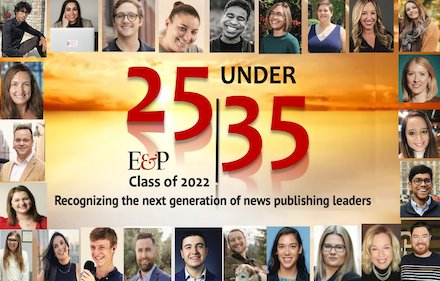
Three people from New England are included in Editor & Publisher’s exclusive story, 25 under 35, that recognizes the next generation of news publishing leaders.
All 25 young professionals have used the difficult times to innovate, perform and stand out from their peers.
The people recognized from New England are:
Erika Hale Smith, 32
Vice President, Events and Sponsorships, Boston Globe Media
Taylor Blatchford, Founder and Editor, of The Lead, is looking for students and recent graduates to guest write for The Lead. No one knows student journalism better than student journalists, and she wants to hear how you’ve solved problems, innovated, or tackled complex subjects at your student publication.
All students will be paid for their writing, thanks to The Lead’s partnership with Poynter. Blatchford is especially interested right now in pitches on these topics:
Publishing across platforms
Photo + video journalism
The most successful pitches are specific and concise. Think about lessons other student journalists can learn from your personal experience, and show your understanding of The Lead’s purpose and audience. There’s no deadline, but the sooner you pitch, the better.
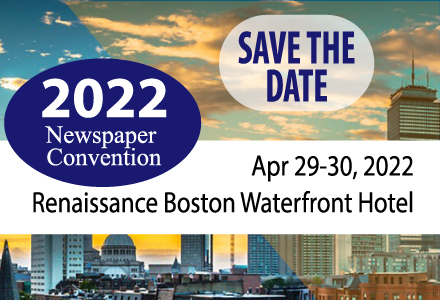
We are excited to announce the New England Newspaper Convention will be held live in Boston April 29 – 30, 2022.
We’re planning two days filled with workshops, training sessions, seminars, and panels that address the latest developments, opportunities, and obstacles that our members are confronting. Topics will cover all areas of publishing including news, advertising, digital, marketing, promotion, circulation, operations, and new technology.
Please let us know if there are topics you think are important to the industry that we should include by emailing us at: info@nenpa.com.
In addition to learning and networking, we’re looking forward to celebrating together! We will recognize the extraordinary work produced in New England when we announce the winners of the New England Better Newspaper Competition.
We’re also excited to honor those who have dedicated their lives and careers to journalism. This year we’ll celebrate the newest members of the New England Newspaper Hall of Fame, and the Academy of New England Journalists will present the Yankee Quill awards.
The March 2022 issue of Editor & Publisher will profile the “10 News Publishers That Do It Right.” The list is meant to spotlight select news operations (print, digital, broadcast, or newsletters) that have earned a notable achievement in at least one particular area, carried out a successful innovation, implemented cost-savings procedures, or developed programs that have generated revenues or increased audience.
NENPA member, Record-Journal, Meriden, Conn. was included in the 2021 story and the objective of the story is to bring ideas together and share the best and the brightest in one comprehensive feature.
Nominate your company today using the link below and you may be featured in the March edition of E&P Magazine!
The deadline for entries is Midnight (ET) Monday, January 31st, 2022.
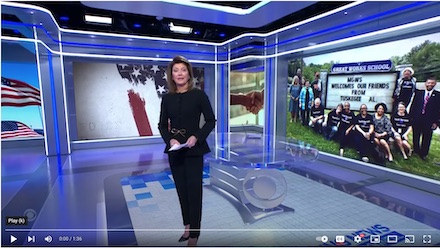
This story ran on the CBS Evening News on January 5.
Alabama’s Tuskegee News has never had a journalist like Amy Miller. She lives more than 1,000 miles from Tuskegee, and from fellow journalist Guy Trammell — with whom she shares a twice-monthly column called “Color Us Connected.”
“I had this idea … about doing a column from a White perspective and trying to match it with somebody doing it from a Black perspective,” Miller said.
Their column also runs in the newspaper covering Miller’s community in South Berwick, Maine.
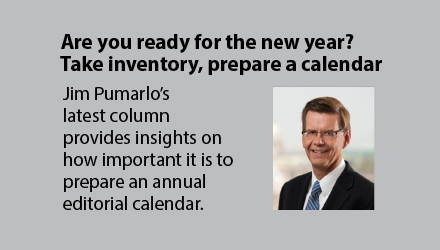
Jim Pumarlo is the former editor of the Red Wing (Minn.) Republican Eagle. He writes, speaks, and provides training on community newsroom success strategies. He is the author of “Journalism Primer: A Guide to Community News Coverage,” “Votes and Quotes: A Guide to Outstanding Election Coverage” and “Bad News and Good Judgment: A Guide to Reporting on Sensitive Issues in Small-Town Newspapers.” He can be reached at www.pumarlo.com and welcomes comments and questions at jim@pumarlo.com.
It’s standard procedure at many newspapers to chronicle headlines in year-end editions. The continuing social and economic impact of COVID-19 is certain to capture a lion’s share of attention in most communities. Other noteworthy events can include the passing of key individuals; the success, or maybe failure, of a civic project; milestones in sports achievements, election results, or key community benchmarks.
That begs the question: Are you ready for 2022? All newsrooms should prepare an editorial calendar and review it regularly. Yes, we are already weeks into the new year, but it’s not too late to develop a plan of action.
Many of the things you cover spanning hard news and features are the same year after year. Use the opportunity to explore new ideas and approaches for coverage. When is the last time you’ve really examined reports on local government budgets, a community’s citizen of the year or United Way kickoff, the start of another school year or high school sports season, a civic fundraiser, the months-long election season?
Think across the spectrum of your community as you prepare a calendar. Here are three areas.
Public affairs always demand attention beginning with meetings of local government bodies. Do you preview the important agenda items? Do you go beyond the votes and explain the impact of actions in real and understandable terms? Think outside meetings. Trace the process of how a recommendation reaches an elected body. Government bodies spend weeks, even months, preparing budgets before adoption. Capital improvement projects are previewed – sometimes including a tour. A school board seeks feedback on a variety of fronts before deciding whether to close and/or consolidate schools.
Also, consider stories that warrant special coverage. Has a longtime public official announced that this will be his or her last term? In that regard, look at the private sector, too. Is a company’s founder retiring, selling the firm? Are single issues dominating a government body or communitywide debate?
Sports present a staple of stories: the preview, the continuum of the regular season, the playoffs. Team performance can present challenges and opportunities. How do you keep readers interested if a team suffers through a losing season, possibly not even winning a single game? In contrast, what stories can be pursued if a team is headed for a championship season, maybe even going undefeated?
Again, brainstorm stories that may warrant special coverage. Is an athlete on the verge of achieving a scoring milestone? Might a coach notch a noteworthy victory? Is this the last season for a school in a sports conference due to league realignment? Has a team suffered a revolving door of coaches in recent years?
Civic clubs are the fabric of communities. The number of groups and the range of contributions mean editors are routinely approached with requests for coverage. The “asks” range from the Lions Club annual brat feed fund-raiser to volunteer of the year recognition to a candidate forum sponsored by the League of Women Voters. It’s impossible to produce a story and photo for each event. Communicate with organizations early and discuss the two elements of publicity: promotion and actual coverage. An even better idea is to produce guidelines that can be distributed to publicity chairs.
Some items warrant special coverage here as well. Is a club celebrating a significant anniversary? Is a local officer rising through the ranks in an affiliated state or national organization? Does a fund-raiser or other project have extra significance for a community?
Planning a calendar can be overwhelming. These are but three areas in your entire menu of news. So take a slow approach. Explore and outline your editorial calendar for the everyday regimen of news.
Then identify one new area where you’d like to bolster coverage. Announce it in a column, and set up a process for soliciting community feedback. Develop a plan of action and present it to readers.
Every newsroom is stretched for time and resources as you strive to produce stories that people like to read and stories that people should read. The pandemic continues to demand regular attention, making your tasks even more challenging. Any additional time you give to planning your calendar is a win-win-win scenario for your newspaper, your readers, and your community.

 Many newsrooms have tackled urgent social issues with majority white staff—some more successfully than others. The National Press Foundation intends to do its part to address this problem through a “Widening the Pipeline” Fellowship designed to help confront the common lament that “it’s hard to find qualified journalists of color.”


 The March 2022 issue of Editor & Publisher will profile the “10 News Publishers That Do It Right.” The list is meant to spotlight select news operations (print, digital, broadcast, or newsletters) that have earned a notable achievement in at least one particular area, carried out a successful innovation, implemented cost-savings procedures, or developed programs that have generated revenues or increased audience.