


New England Newspaper & Press Association

The New England Newspaper & Press Association (NENPA) is the professional trade organization for newspapers in the six New England states: Massachusetts, Connecticut, New Hampshire, Vermont, Maine and Rhode Island.

NENPA is proud to represent and serve more than 450 daily, weekly and specialty newspapers throughout the six-state region.

NENPA is the principal advocate for newspapers in New England, helping them to successfully fulfill their mission to engage and inform the public while navigating and ultimately thriving in today’s evolving media landscape.


Latest eBulletin

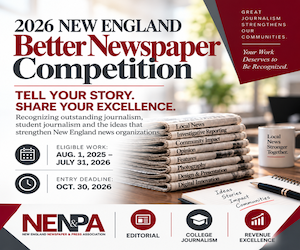
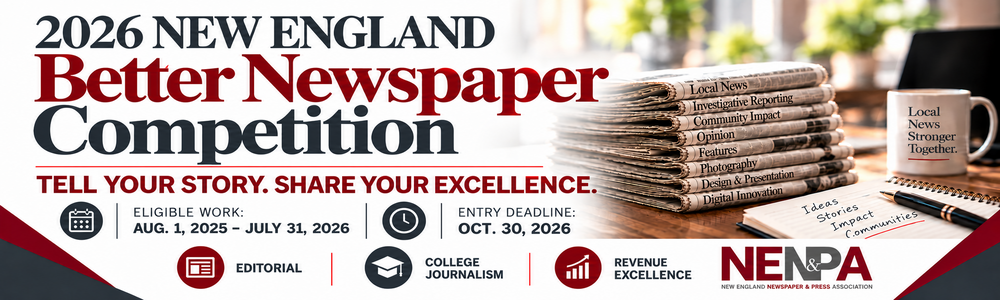
NENPA Fall Awards Program Opens Next Weekend

NENPA's Fall Awards Program will officially open for entries next weekend, recognizing outstanding journalism, editorial leadership, community service, investigative reporting, First Amendment advocacy, and newsroom impact across New England. The annual program honors both individuals...

Boston Globe Accepting Entries for 2026 Will McDonough Sports Writing Contest Through May 27

The Boston Globe is now administering the annual Will McDonough Sports Writing Contest, a long-running New England competition previously managed by The Sports Museum for more than 20 years. The contest is free to...

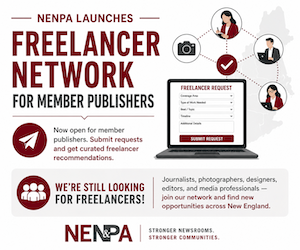
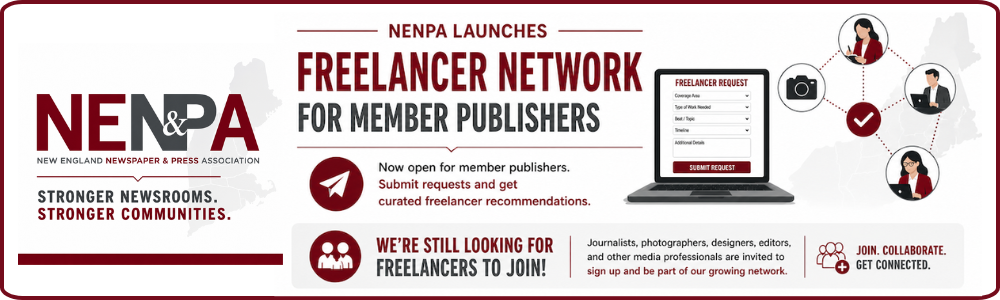
NENPA Launches Freelancer Network for Member Publishers

The New England Newspaper & Press Association has officially launched its new Freelancer Network, a developing initiative designed to help connect NENPA member publishers with freelance journalists, writers, photographers, designers, and other newsroom professionals...

NENPA Freelancer Network to Launch May 15 as New Member Benefit

The New England Newspaper & Press Association (NENPA) will officially launch the NENPA Freelancer Network on May 15 as a new member benefit designed to help connect freelance journalists with publishers and news organizations...

UPCOMING WEBINARS AND EVENTS

May
26
Tue
Psychological safety as a tool for collaboration
May 26 @ 1:00 pm – 2:00 pm

How internal team culture shapes trust, engagement and collaboration with your community

Psychological safety is often framed as a mental health or workplace well-being concept, and it is, but its real impact shows in how teams collaborate and how organizations build trust with their communities.

Local news organizations are working to better engage younger and more diverse audiences, but new products or reporting alone aren’t enough. Creating psychologically safe spaces is essential for encouraging honest dialogue.

In this interactive and self-reflective session, API’s senior vice president, Sam Ragland, will guide participants through exploring how psychological safety shows up within their teams — and how it directly impacts their ability to build meaningful relationships with the communities they serve.

Through practical frameworks and real-time reflection, you’ll examine your own leadership behaviors, meeting dynamics and decision-making practices to identify what fosters (or hinders) trust, belonging and collaboration.

You’ll leave with:

  • A clearer understanding of how internal team culture shapes community engagement
  • Tools to recognize and reduce social threats in your work
  • Practical ways to create more inclusive and collaborative environments

To support journalists and their well-being during Mental Health Awareness Month, API has offered this free, interactive webinar since May 2024. If you attended this session last year and found it helpful, please encourage your colleagues and friends in news to join this year.

May
28
Thu
AI-Driven CRM strategies for publishers
May 28 @ 12:00 pm – 1:00 pm

Publishers are under growing pressure from every direction: advertiser churn, subscriber losses, disappearing third-party cookies, fragmented audience data and increasing demands for personalization from both readers and advertisers. At the same time, many media organizations are still relying on disconnected systems that make it harder to track relationships, forecast revenue and identify growth opportunities.

Register brlow for this upcoming E&P webinar, where experts from Workbooks CRM will explore how AI-driven CRM platforms are helping publishers unify audience, advertising and subscription data into one smarter, more actionable system. Learn how media companies are using automation, predictive insights and first-party data to improve retention, strengthen advertiser relationships, simplify sales workflows and drive more sustainable revenue growth.

Attendees will learn:

  • How AI-driven CRM tools can identify at-risk subscribers and advertisers before they leave
  • Why publishers are using AI-powered personalization to improve engagement, conversions and loyalty
  • What media companies should do now to strengthen first-party data strategies as third-party cookies disappear
  • How publishers are managing subscriptions, advertising, events and audience relationships inside one unified platform
  • Ways AI-powered forecasting and automation can help sales teams uncover new revenue opportunities faster
Jun
4
Thu
Housing Journalism for Everyone
Jun 4 @ 1:00 pm – 2:00 pm

Housing intersects with nearly every major story journalists cover today—from elections and education to health, climate, business, and public safety. Yet many reporters believe housing is a specialized beat or feel unprepared to cover it responsibly.

This session, led by Princeton’s Eviction Lab, is designed for journalists of all beats and experience levels. Whether you’re a breaking news reporter, investigative journalist, data reporter, audience engagement journalist, or editor, we’ll show why housing deserves your attention—and how to cover it well without necessarily becoming a full-time housing reporter.

In this panel, attendees will learn:

  • What’s happening nationally in housing and homelessness, including recent shifts in policy, affordability, and displacement—and how these trends connect to electoral politics and local governance.
  • Four to five essential data tools every journalist should know to report on housing, eviction, rent, and homelessness, with a practical introduction to accessible resources and datasets.
  • How to find housing stories in any community, including tips for identifying newsworthy angles beyond press releases and official statements.
  • Ethical sourcing practices, with guidance on interviewing tenants and unhoused people in ways that minimize harm and avoid stigma.
  • Examples of strong housing journalism, highlighting work that has driven accountability, influenced policy, or changed public understanding.
  • Attendees will leave with concrete tools, story ideas, and a clearer sense of how housing reporting can strengthen their core beat—no matter what they usually cover.

Share: