Page 49

Radically Rural Community Journalism Track Focuses On the Challenges Journalists Face

This is a message from Terrence Williams, President, Keene Sentinel about Radically Rural 2022.

Dear NENPA colleagues,

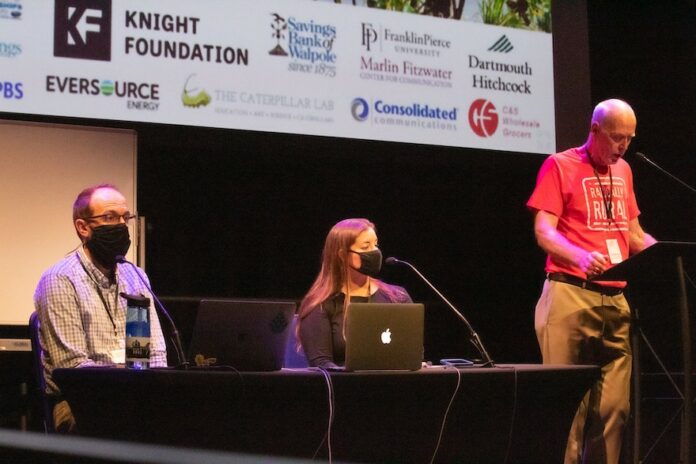
I’m writing to all my friends in NENPA with an invitation to attend Radically Rural’s Community Journalism program this year; it will be staged in person in Keene, N.H., and online on Sept. 21 and 22.

Discounts are available to NENPA members. This year’s programming focuses on the challenges journalists face covering splintered communities and the issues that divide us.

Sept. 21 I 1:30 p.m. – 3:00 p.m.
Covering the Divide
An exploration of how news organizations can better serve communities that are split over politics, the pandemic, guns, policing, voting, and more.
Moderator – Jim Iovino is Ogden Newspaper’s Visiting Professor of Media Innovation at West Virginia University. He runs the Reed College of Media’s NewStart Newspaper Ownership Initiative, a program that focuses on recruiting, training, and supporting the next generation of community newspaper owners and publishers.
Panelists – Tony Baranowski, publisher, and Sara Konrad Baranowski, editor, the Iowa Falls Times Citizen, Iowa. Peter Huoppi, director, multimedia, The Day, New London, CT, and co-producer of the documentary, “Those People.”

Sept. 21 I 3:30 p.m. – 5:00 p.m.
Better Judgment
How innovative newsrooms are changing their coverage of cops, courts, climate, and other intersections of justice to provide fairer, more equitable news reporting.
Moderator – Cierra Hinton, publisher, Scalawag. Hinton has an undying love and passion for the complicated South, which she brings to Scalawag where she oversees operations and planning. According to its mission, through journalism and storytelling, Scalawag works in solidarity with oppressed communities in the South to disrupt and shift the narratives that keep power and wealth in the hands of the few.
Panelists – Paul Cuno-Booth, freelance journalist and reporter on several alternative justice projects in New Hampshire. Molly Born, West Virginia multimedia producer and educator, now documenting West Virginia’s history and future.

Sept. 22 I 2:00 p.m. – 3:30 p.m.
Crazy Good: 50 ideas to make you a better journalist
Jeremy Caplan, director of teaching and learning at City University of New York Newmark Graduate School of Journalism. Caplan teaches classes, workshops, and webinars on entrepreneurial and digital journalism. He is a former Ford Fellow in Entrepreneurial Journalism at the Poynter Institute, a Wiegers Fellow at Columbia Business School, where he earned his MBA, and Knight-Bagehot Fellow at Columbia Journalism School, where he earned a master’s degree in journalism.

NENPA members, before July 1, can register to attend Radically Rural for $129 in person – a savings of $30; or $49 online, a savings of $20. Use the promo code NENPA for a member-only discount.

Radically Rural is a partnership between The Keene Sentinel and the Hannah Grimes Center for Entrepreneurship. The summit features tracks in community journalism, arts, and culture, lands, community, downtowns, clean energy, healthcare, and entrepreneurship.

For more information on the Radically Rural Summit and to purchase tickets, visit the event’s website at www.radicallyrural.org.

Sincerely,

Terrence L. Williams
President & COO

Share:

Apply to NPF Fellowship and Learn About the New Age for Aging

By 2034, for the first time ever, the United States will be home to more older adults than children. One in five people will be over 65 years old. Although American life expectancy dropped during the pandemic, millions more older Americans are working and living active lives for far longer.

For journalists, covering the 65-plus set no longer means focusing on assisted living and failing health. Still, older adults are often undervalued by society and underrepresented in media coverage and images due to a range of factors – including outdated stereotypes and biases.

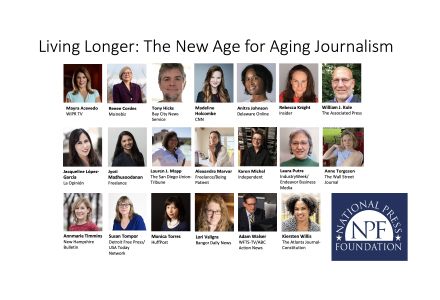
To help journalists cover the realities of older adulthood and federal aging policy in 2022 and beyond, the National Press Foundation will offer an all-expenses-paid three-day fellowship, Living Longer: A New Age of Aging, in Washington D.C., Sept. 18-20, 2022.

The application deadline is June 20.

This competitive fellowship is open to U.S.-based reporters and editors working in print, television, radio, or online media. We greatly value diversity in all our programs and applicants from across the nation are encouraged to apply. The foundation will cover airfare, hotel, transportation to the airport, and most meals.

Applicants must submit a letter from their supervisors saying they will be permitted to attend all sessions.  At the request of other parties, during the program, fellows must be willing to use the CLEAR Heath Pass to verify that they have received COVID-19 vaccinations. (The app’s privacy policies are here.) We will follow District of Columbia public health guidance and masking or rapid-testing may also be required.

This fellowship is sponsored by AARP. National Press Foundation is solely responsible for programming and content.

Learn more and apply

Share:

Gannett Announces Strategic Organizational Restructuring

MCLEAN, Va.– Gannett Co., Inc. announced on June 1 a strategic organizational restructuring with the creation of two new U.S. operating business units, Gannett Media and Digital Marketing Solutions (DMS), which will be led by Maribel Perez Wadsworth and Kris Barton as Presidents of each business respectively. The evolved corporate structure is designed to align Gannett’s subject matter expertise and resources with favorable growth opportunities.

“This reorganization ensures our consumer and B2B businesses are strategically optimized for our next stage of growth with incredibly experienced leadership at the helm while championing our culture of inclusion and driving our long-term goals for sustainable revenue and cash flow growth,” said Michael Reed, Gannett Chairman and Chief Executive Officer. “Improving the efficiency of our operations will enable the acceleration of Gannett’s digital future as a data and technology subscription-led business.”

As President of Gannett Media, Wadsworth will oversee an expansive organization that prioritizes content, news, business-to-business (B2B) and commitment to subscribers while continuing to accelerate Gannett’s digital subscriber growth. She and her team will focus on the subscriber journey, ensuring customer satisfaction and attracting new audiences by optimizing the legacy business to drive print stabilization and digital growth for the media organization with a digital-first lens on all efforts.

As President of Digital Marketing Solutions, Barton brings a unique mix of business, design and technical acumen to the position. He is dedicated to growing DMS offerings as a differentiated marketing platform. He and his team will further the transformation of the DMS business to ensure loyalty from existing customers who value the platform while attracting new customers to engage with the available digital solutions. This includes building a complementary business model with streamlined, do-it-yourself SaaS offerings for new customer segments.

Read the full press release

Share:

Pew reexamines local newspaper fact sheet

The transition to digital news consumption has hit the newspaper industry hard in recent years. Some national publications have managed to weather the storm in part by attracting digital subscribers, but many local newspapers have been forced to shutter their doors permanently, especially during the coronavirus pandemic.

To gain a clearer picture of how locally focused U.S. newspapers have fared in the digital age, Pew Research Center researchers reexamined data included in the Center’s State of the News Media newspapers fact sheet, excluding four publications that reach a large national audience. (Three of these four newspapers reach national audiences in addition to their respective local audiences.) These four publications – The New York Times, The Washington Post, The Wall Street Journal and USA Today – account for a large share of circulation in the newspaper industry and as such overshadow their locally-focused counterparts in the data. Specifically, this analysis looks at economic data from publicly traded newspaper companies’ financial statements (2011-2020 for digital advertising revenue and 2013-2020 for total revenues), circulation data from Alliance for Audited Media (2015-2020), and digital audience data from Comscore (2014-2020). This addendum supplements the State of the News Media newspapers fact sheet, which presents the analysis at the overall industry level.

Read more

Share:

VTDigger Founder Anne Galloway Steps Down

File: Jeb Wallace-Brodeur

VTDigger.org founder Anne Galloway has stepped down as executive director of the state’s largest online news outlet. She will remain with the nonprofit as an editor at large, Galloway announced Monday in a letter to readers, focusing on reporting projects.

“It’s now time to let VTDigger thrive on its own,” she wrote.

Senior editor Jim Welch has been named interim executive director while VTDigger conducts a national search for its next leader, members of the Vermont Journalism Trust board of trustees wrote in a parallel announcement. The trustees’ letter said Galloway, 57, was departing her role “to pursue other creative ventures.” She “leaves the hardworking Digger team in a position of strength to continue their vital work,” their letter reads. The trust is VTDigger’s parent organization.

By Derek Brouwer Seven Days Read More

Share:

Amid crisis and collaboration, a plan to sustain local news in New Hampshire emerges

MANCHESTER – At a time when information flows more freely than ever, the local news industry finds itself at a crossroads. 

The advertising and subscription model that held up the industry for so long has consistently been chipped away over the past two decades. The financial challenges have only accelerated over the past few years with the pandemic, and more recently with new pressures from inflation. Across the nation and here in New Hampshire, that’s meant far fewer reporters to dig into local and statewide issues. And in some communities, it’s meant no reporter or news publication at all.

Report for America, a national service organization that helps local newsrooms add to their reporting staffs, says the slow decline of the local journalism business model has a far-reaching impact.

“We’re facing a colossal collapse in local news across the country,” said Lauren McKown, senior vice president of development for Report for America and The Ground Truth Project. “A crisis in local news is a crisis in democracy.”

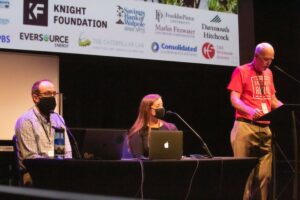
McKown was speaking last week at the New Hampshire News Philanthropy Summit at the New Hampshire Institute for Politics at St. Anselm College. The event brought together about 70 journalists, business leaders and philanthropic funders to begin the discussion on how local news, trustworthy information, civic engagement and community need to align.

The event served as the next step in the New Hampshire news industry’s recent efforts to bring more reporting and more journalists to the state with innovative partnerships and a newfound spirit of collaboration.

“I believe developing new ways to fund journalism will be key to ensuring its sustainability,” said Steve Leone, vice president of Newspapers of New England and publisher of the Concord Monitor, where two of the staff’s five news reporting positions are currently 100% funded by nonprofit support and community donors.

That’s part of the turnaround story in New Hampshire, where many news organizations are forging partnerships with community donors in order to sustain local journalism into the future and underwrite in-depth coverage of important issues facing our communities and the state.

“Leaders in business, philanthropy, higher education, and journalism have a responsibility to come together to help solve this,” said Melanie Plenda, director of the Granite State News Collaborative, a statewide nonprofit of about 20 media organizations. “And we’ve already started that work. Media outlets across the state that used to compete with each other for ads and eyeballs are now actually co-reporting and sharing articles with each other for distribution, all so that our communities have more of what they need.” 

“This is about recreating a piece of the fabric of democracy and community,” said Laura Simoes, executive director of the Nackey S. Loeb School of Communications, which co-sponsored the event with the Concord Monitor and the Granite State News Collaborative. “We get to chart a new course and find fixes to problems that involve all of us.”

Many of the funders in attendance agreed, though they also admit they’re among the early adopters in believing that philanthropy has a role to play in supporting local newsrooms. Katie Merrow, vice president of community impact at New Hampshire Charitable Foundation, sees local journalism as a critical piece to promoting community health.

 “We’re just continuing our mission,” said Merrow. “It’s a natural extension of the way we work in community….  None of us has the scale to fix all these problems. Journalism is high leverage because it gives people information and understanding to act and act now,” she said. 

Merrow also pointed out that the system of local journalism, although very challenged, continues to have deep penetration across the state and it’s critical to keep it going.

“If we let it die and then have to rebuild it. That will take far more resources,” she said.  

An industry in crisis

The story of American journalism is best told in numbers. 

Surveys indicate that 75 percent of local readers and news consumers believe their local news organizations are doing well, said Leah Todd Lin at the Solutions Journalism Network. But national journalism studies tell a far different story. 

According to research led by Penelope Abernathy at the University of North Carolina, there are 225 counties in the United States that do not have a local newspaper. Half the counties in America have just one, and it’s usually a weekly publication. New England has 10 counties with only one paper and three with no publication at all. This barren landscape has led to the rise of the term “news desert.” 

A look at the national “news desert” map shows a patchwork of communities that have little to no news coverage. These are predominantly in rural areas because they don’t have the local economies capable of supporting a paper through advertising. So community members get less news. That, studies say, also means municipal spending generally increases because no journalist is at the public meetings to report the news. In these areas, a town’s borrowing costs can also go up and voting turnout can also suffer.   

According to national research on the crisis in local news by Report for America founder Steve Waldman, approximately $1 billion to $3 billion is needed each year to build and sustain the nation’s news system. This sounds like a daunting sum, said McKown at Report for America, but research shows that Americans collectively donate about $450 billion a year. A funding shift of 0.2 to 0.25% is needed to support local news.

A sampling of solutions

At a time of industry upheaval, consolidation and widespread newsroom closures, philanthropy is emerging as a way to bring critical issues to readers. 

The Loeb School, a Manchester-based non-profit dedicated to preserving freedom of speech and freedom of the press, connects nonprofit and for-profit newsrooms to grants – including for solutions journalism projects such as “What’s Working” at the Union Leader, which focuses on workforce, employment and economic issues confronting the state, communities and business; the Monadnock Region Health Reporting Lab at the Keene Sentinel; and “The Sunshine Project” and “Voices” at the Laconia Daily Sun.

“A lot of us have built (grant funding) into our business model,” said Mike Cote, managing editor for news and business at the Union Leader and New Hampshire Sunday News, which has six full-time news reporters for local and statewide coverage. “The hardest part is keeping the momentum going. A lot of people don’t realize how small our newsrooms have become.”

Because of the reach and success of “What’s Working,” the Union Leader is seeking and linking sources to continue funding. 

“The number of journalists we have lost in the last 15 years is astounding,” said Leone at the Monitor about New Hampshire journalism. That underscores the need for outside support to supply local coverage.

Funding from Report for America and the New Hampshire Charitable Foundation enabled the Monitor to hire a full-time education reporter who started in 2020, and St. Paul’s School will begin support for that position in June, according to Leone. A full-time health reporter was funded through May 2022 by Report For America, Concord Hospital, Granite VNA, Concord Imaging, Riverbend Community Mental Health Center and NAMI NH, and the paper is building a new round of support to relaunch the coverage later this year, he said.  Next month a new Report for America position focused on disparity issues will be funded jointly by RFA, Northeast Delta Dental and Merrimack County Savings Bank.

Funding through local and national grants and major and individual donors has enabled the Granite State News Collaborative, with an army of freelancers and partners in roughly 20 New Hampshire news outlets, to generate approximately 650 in-depth, investigative, solutions-focused stories since March 2020, said Plenda.

The pandemic and the current political climate boosted the demand for trustworthy coverage, journalism experts and funders agreed. 

We’re “unified in our mission to provide good, rigorously reported and vetted journalism,” Plenda said, including through recent grant-funded projects on race and equity and restorative justice. “I see us competing with the loudest and most repetitive voices, whether on CNN or social media. People see local news as less polarized and more trusted.  We’re doing our part to get good information to people.” 

“People are used to finding any information they need with a click of a button, and many don’t discern between a real news source and a blog or someone’s opinion, which is a threat to democracy,” said Julie Hirshan Hart, co-editor of the Laconia Daily Sun, where solutions journalism projects “Voices” and “The Sunshine Project” have spotlighted public health, mental health, social issues, civic discourse and the experience of youth during the pandemic. “We’ve seen that grant funding can help us fill the gaps and create a sustainability plan so we can keep delivering quality, real journalism to our community and the state,” she said. 

It’s important to find funders with “unity of purpose ”and to align reporting with community needs that are important, said Terrence Williams, CEO of the Keene Sentinel, the country’s fifth-oldest continuously running newspaper, founded in 1799. Local problems with health care access, cost and depth-of-care were revealed in community listening sessions, which sparked the creation of the Health Lab and defined its coverage mission. 

The Sentinel recently hired a statehouse reporter through crowd funding. Two more philanthropy-supported reporters are starting at the end of May at the online and print news outlet, which serves readers in western Hillsborough and Cheshire counties and southeastern Vermont, Williams said. 

“Solutions journalism is, by definition, not just looking at a problem, but finding who’s doing things that are working,” said Cote at the Union Leader. Without funders, “It’s harder for New Hampshire community newspapers to delegate a reporter to a topic for a year.” With outside support, the journalism remains independent, he explained. “In five years, there’s never been an issue with influencing coverage in any way.” 

Eyes on NH

The goal for local media now is to attract renewable contributions from a wide range of sources, including community and business leaders such as doctors, lawyers, local car dealerships, drug stores and manufacturers, as well as foundations, grant funders, large corporations, health care systems and individuals.  

News philanthropy offers non-profits and for-profits a way to strategically extend their impact and reach, the speakers said.

“The Endowment started its media partnerships through underwritten coverage on specific issues,” said Karen Ager, director of communications for the Endowment for Health. “Over time, we realized we couldn’t fund every good idea coming out of NH newsrooms, so our current strategy includes capacity support to sustain the practice of solutions journalism statewide.” 

These solutions are forming the foundation for long-term sustainability in New Hampshire, said Leah Todd Lin of the Solutions Journalism Network.

“I’m based in Lebanon, but my work is national. So I really have the chance to talk to a lot of newsrooms, a lot of news leaders and a lot of funders, people who are interested in supporting local news all over the country,” Todd Lin said. “And so my message to people out of the state of New Hampshire is always: ‘look at what New Hampshire is doing.’…And when I’m in the state, like today, my message is: ‘I hope you you know what you have here and how special it is.’ ”

McKown and Report for America have also picked up on the approaches being taken in the state, touting the mix of newsroom collaboration, philanthropy and business partnerships.

“You have all the ingredients here to have a strong future for your state. Local (news) is really at the heart of this,” said McKown. 

This article was written by Roberta Baker and shared by The Granite State News Collaborative. For more information visit collaborativenh.org.

DOWNLOAD SUMMIT SUMMARY WITH KEY POINTS AND LINKS

Full Event Recording:

Share:

A good idea is worth the wait

John Foust
John Foust has conducted training programs for thousands of newspaper advertising professionals. Many ad departments are using his training videos to save time and get quick results from in-house training. E-mail for information: john@johnfoust.com.

When I was a kid and jumped to conclusions about something, my father often said, “Hold your horses, son.” That’s an old saying that means, “Whoa! Stop and think carefully before making a decision.” Dad had a lot of wisdom. He knew that one of the most important lessons he could teach me from an early age was to think before taking action. 

There’s talk these days about “deferring judgment” when discussing ideas or hearing the opinions of others. That’s another way of saying “hold your horses.” The concept of delaying judgment has been around for a long time. In fact, it was popularized in the advertising industry by Alex Osborn, a co-founder of the BBDO ad agency. Osborn incorporated judgment deferral in his rules for creativity because he understood the value of encouraging judgment-free discussions of just-proposed ideas. In his writings, he labeled his system as “brainstorming,” a term that has evolved into a general description of creative thinking. 

It takes patience to defer judgment. We’ve all been in meetings where ideas bounce around the room. Somebody mentions the first glimmer of an ad idea, and before you know it, someone else says, “No, let’s consider this other idea.” As a result, the first idea dies on the spot – and the discussion narrows in focus, often with the most outgoing person in the room taking center stage. That’s not good for authentic brainstorming. And it’s not good for the person whose idea was just suppressed. 

At this stage in the process, the objective is to gather as many ideas as possible. Encourage ideas to flow, so people can build on each other’s creative thinking. Be patient and listen. 

Consider Melanie, an ad salesperson who was confronted with a client who wanted to run a big headline that boasted, “We’re the popular choice” – an empty claim with no evidence to back it up. “I cringed when I heard that,” she told me, “but I didn’t interrupt his train of thought. I told myself to approach his idea as the beginning of the conversation, not something to take a stand against. So I asked questions and listened for possibilities. Along the way, he mentioned that he had recently received compliments about his store’s customer service. As he talked, I realized that testimonials could make the concept of popularity come to life. He liked that idea, and we ended up with a campaign which featured a quote from a different loyal customer in each ad – along with that person’s photo.” 

Melanie’s advertiser was happy with the outcome but more important, her approach strengthened their marketing partnership. There wasn’t any magic involved. It was simply a matter of deferring judgment and soaking up as much information as possible. The advertiser’s original idea – as weak as it was – got the ball rolling in the right direction. 

The point of all this is to slow down. When you hold your horses a little longer, a better idea may gallop into the picture. 

(c) Copyright 2022 by John Foust. All rights reserved.

Share:

NEFAC Provides Expert Speakers for University of Massachusetts Journalism Workshops

The New England First Amendment Coalition is providing workshop instructors to the University of Massachusetts Amherst as part of the group’s First Amendment and the Free Press program.

NEFAC launched the program in 2018 to help educate the public about the role journalism plays in the country. The program brings reporters, academics, and legal scholars onto campuses and into the region’s classrooms and community centers.

With NEFAC’s support, those below will participate in the university’s “Digital Media & Journalism: Shared Narratives,” a series of workshops and discussions for young Pakistani journalists. The workshops are part of the Civic Initiative at the University of Massachusetts Donahue Institute.

Gregory V. Sullivan | Sullivan has served as general counsel for the Union Leader Corporation for the past 40 years. He has represented Union Leader and many other media organizations regarding First Amendment issues in federal and state courts.

Felice J. Freyer | Freyer covers health policy and public health for The Boston Globe. She joined the Globe in 2014 after years as the medical writer for The Providence Journal, where she was awarded the “Master Reporter” award from the New England Association of Newspaper Editors.

Annie Ropeik | Ropeik is the environment and climate change reporter for Spectrum News Maine. She previously spent about a decade as a public radio journalist, reporting from NPR member stations in New Hampshire, Indiana, Delaware, and Alaska’s Aleutian Islands.

Since its launch, NEFAC’s First Amendment and Free Press program has provided more than 150 presentations, workshops, and lectures. Please email justin@nefac.org with your presentation needs.

Learn more

Share:

Use your special insight to recommend election choices

Jim Pumarlo is former editor of the Red Wing (Minn.) Republican Eagle. He writes, speaks and provides training on community newsroom success strategies. He is the author of “Journalism Primer: A Guide to Community News Coverage,” “Votes and Quotes: A Guide to Outstanding Election Coverage” and “Bad News and Good Judgment: A Guide to Reporting on Sensitive Issues in Small-Town Newspapers.” He can be reached at www.pumarlo.com and welcomes comments and questions at jim@pumarlo.com.

Coverage of public affairs – recording the actions and inactions of governing bodies from local to federal levels – demands attention from newsrooms year-round. And for good reason. Elected officials regularly debate and craft public policies that affect citizens’ everyday lives.

Newsrooms provide readers a ringside seat, and often a behind-the-scenes view, into the decision-making process. 

So why are newspapers increasingly hesitant to recommend individuals for elective office, especially those officials serving on local city councils, county boards, and school boards? 

Regular readers of my column know my passion for vibrant editorial pages. I firmly believe that vibrant editorials are at the heart of vibrant communities. It’s time to once again encourage newsrooms to take that final step in their election coverage: Endorse those individuals you believe will best represent and advance the interests of your community. I consider endorsements among the highest calling in a newspaper’s role as a government watchdog.

The general election is months away. Now is a perfect time to start the internal discussion to design and implement a methodical and logical process for offering endorsements. It’s easier than you may think.

I’m always perplexed by editors and publishers who shy away from recommending ballot choices, especially those newspapers that regularly take strong stances on advising decision-makers on a particular course of action. For one community, it might be a city council’s deliberations on whether to offer tax incentives for big-box retail development. For another, it’s a school board debating whether to close a school and reconfiguring grade levels. On a state legislative level, editors routinely weigh in on tax, health care, public safety, social justice, transportation, and myriad other public policies.

If the newspaper as a community institution advocates for or against a position taken by an elected body, why not advance equally strong convictions about the people who ultimately will make those decisions?

Newspapers that excel in elections coverage offer a continuum of reports beginning with candidate announcements. Reporters quiz individuals on a variety of issues, then follow with a critical eye their actions once in office. Do candidates stay true to course, or do unexpected circumstances prompt a change of heart in their votes? In a nutshell, the newspaper is a clearinghouse of information and has particular insight into the candidates and the dynamics behind their votes. So why not share that perspective with readers?

Many newspapers find it relatively painless to weigh in on the strengths and shortcomings of, say, national or federal candidates, even candidates seeking elective office at a state or provincial level. It’s quite the opposite when recommending individuals for the local school board or city or municipal government. Yet these races are the most important for community newspapers to address in news profiles and endorsements.

Endorsements in local races clearly are the most challenging, often complicated by personal relationships that candidates may have with the publisher or other key staff members. Here’s one blueprint to navigate a path that may appear to be filled with minefields.

As a first step, brainstorm the priority concerns in each race. Solicit ideas from your entire newspaper family as well as key community members. These issues will be the basis for candidate interviews, and their responses will provide a framework for endorsements.

Then evaluate candidate answers on specific public policies and how they align with community interests. Focus on the facts and avoid straying into personalities.

If you’re still hesitant to endorse, consider this strategy. Frame the editorial outlining what the newspaper identifies as the key issues in a race – and where you stand on these points for the betterment of your community. Then encourage readers to vote for the candidates who are in sync with those stances. You have not identified specific candidates, but your message allows readers to connect the dots.

As always, allow readers the opportunity to deliberate your recommendations. Readers still may challenge your practice of “telling us who to vote for” – their words. But they will be doubly upset if you don’t give them the chance to debate the reasons behind your endorsements.

Letters are the lifeblood of an editorial page. Nothing is more satisfying than an editor opening up the newspaper to a lively exchange of opinions. Take steps now to ensure that your voice is part of the conversation this election season.

Share: