Newspapers of New England, Inc., a family-owned news organization with publications serving readers in Massachusetts, New Hampshire and Vermont, recently announced a series of leadership changes.
Current NNE president and CEO Aaron Julien will move into the role of chairman. He replaces longtime NNE chairman John Kuhns, who is retiring. Chuck Goodrich will assume Julien’s role. Meanwhile, Dan McClory is being promoted from chief financial officer to chief operating officer of NNE. McClory will maintain his role as publisher of the Valley News.
“By adjusting responsibilities and spreading the work out, we can spend more time and attention on finding new funding solutions while also managing daily operations – without increasing management staffing,” Julien wrote in a company-wide message. ”This past year has been our toughest ever, but the fact is we’re in good shape thanks to your hard work, as well as the difficult choices we made to ensure our long-term success.”
Goodrich has spent 35 years in the newspaper industry, primarily at dailies and weeklies in Massachusetts and New Hampshire. He served as president and CEO for a division of Community Newspaper Company in Massachusetts and was a longtime publisher and senior executive for its successor companies. “I”m excited to join the talented team at NNE and look forward to building on what has been accomplished,” he said.
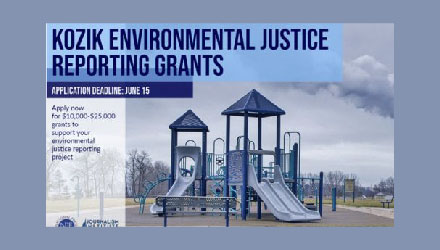
Grants ranging from $10,000 to $25,000 will be awarded to support journalism in any medium that centers environmental justice and environmental racism in the United States. This could include coverage of the disproportionate harms to disadvantaged communities from pollution, the effects of climate change, or other relevant topics.
Applications are open now and will be accepted until June 15. Details and contest rules are found below. The application form is here. Work supported by these grants should be published or broadcast in a U.S. news outlet by Dec. 31, 2021.
“As the climate crisis worsens, journalists have a special duty to tell the stories of the people who will be most affected – and we now know the human suffering will not be equally shared,” said Sonni Efron, President and CEO of the National Press Foundation.
“These grants are intended to increase coverage of environmental justice and afford access to a wider range of journalists who want to address the disproportionate effects of environmental challenges on communities of color and other vulnerable populations,” said Julie Moos, Executive Director of the National Press Club Journalism Institute.
The Kozik Grants are funded by a 1991 gift from the late Dr. Robert Kozik in honor of his deceased son.
The grant applications will be judged by distinguished journalists or former journalists who have produced notable work in exposing environmental racism and its consequences, including Antonia Juhasz, Yanick Rice Lamb and Harriet Washington. NPF and NPCJI thank them for their guidance and support for this project.
Through our annual journalism awards, the National Press Club seeks to recognize and honor professional journalists who produced outstanding work in 2020 for the public, either independently or as employees of editorially independent news entities. In all cases, judges will give weight to demonstration of individual enterprise, fairness, accuracy and objectivity.
Content produced for house organs, pamphlets, theses or reports will not be considered, nor will advocacy outlets of interest groups such as trade associations, consumer organizations or government agencies.
Entries may be submitted by either journalists or their employers. Non-traditional entrants are free to explain in supporting materials how they meet these journalistic criteria and should submit a statement explaining their editorial independence.
There is an entry fee of $75 per submission – NPC member entry fees are waived with login. (Note: If you’ve logged in but it appears you’ve been logged out when you reach this page, please hit the “refresh” button on your web browser.)
EXTENDED DEADLINE: May 17, 2021
Categories: Consumer Journalism Award, Washington Regional Reporting Award, Arthur Rowse Award For Press Criticism, Edwin M. Hood Award For Diplomatic Correspondence, Newsletter Journalism Award, Joan M. Friedenberg Online Journalism Award, Sandy Hume Memorial Award For Excellence In Political Journalism, Joseph D. Ryle Award For Excellence In Writing On The Problems Of Geriatrics, Angele Gingras Humor Award, Ann Cottrell Free Animal Reporting Award, Michael A. Dornheim Award, Lee Walczak Award For Political Analysis, Breaking News, News Photography
Kirk likes to work directly with his ad clients on their creative strategies. “Making a sale is just the first step in the journey,” he said. “It’s a big part of my job to make sure my clients stand out from their competitors on the page and on the screen. When I work with several advertisers who are in the same type of business, it’s a special challenge to create a different ad personality for each one of them.”
John Foust has conducted training programs for thousands of newspaper advertising professionals. Many ad departments are using his training videos to save time and get quick results from in-house training. E-mail for information: john@johnfoust.com
Generally speaking, there are two types of advertising. There are image ads that are designed to give consumers a good feeling about the advertiser (for example, “Your safety is our biggest concern”). And there are response ads that are designed to move readers to take action (“Buy one, get one free”).
Kirk is on target in his comments about personality. Whether image or response – whether print or digital – every ad has some kind of personality. Instead of leaving that important advertising ingredient to chance, he is determined to help them develop ad personalities that appeal to their respective target audiences.
Let’s take a look at a few of the tools which can contribute to an ad’s personality – the type of personality that a client wants to project:
1. Typography. When we speak, it’s not just what we say, it’s how we say it that communicates a message. It’s the same on the newspaper page or the digital screen, so much so that typography has been called “the voice of print.”
From a bold, sans serif headline for a construction equipment distributor to a lighter serif headline for an upscale clothing store, type fonts can create important first impressions.
2. Photographs vs. Illustrations. To depict realism, use a photograph. Photos are usually more true-to-life than drawings. Even if a photo has been touched up, consumers are willing to accept it as a reasonable representation of the subject matter.
Although some illustrations can be as realistic as photographs (consider close-cropped, photo-like depictions of tires), most illustrations leave more to the imagination than that. There are a number of choices, including pen and ink, gray tones, charcoal, watercolors and cartoons.
3. Products vs. people. Three possible options are: products by themselves, people by themselves or people using the products. In other words, an ad can depict a widget, people (in posed or candid shots), or a person using a widget.
4. Copy style. Some advertisers present information in a straight-forward pattern that reads something like this: “(1) feature-benefit, (2) feature-benefit, (3) feature-benefit, (4) buy today.” Others like to tell – or imply – a story. For example: “Imagine getting yard work done quickly, so you’ll have the rest of the day for fun.”
“There are lots of creative options and combinations that give us ways to customize ads for our clients,” Kirk said. “Even if they sell the best products in the world, nobody will read their ads unless they attract attention on the page. That’s why the sale is only the beginning of the process.”
(c) Copyright 2021 by John Foust. All rights reserved.
PITTSFIELD, Mass. — Fredric Rutberg, president of New England Newspapers Inc., announced on May 4 that it is selling its Vermont publications to Vermont News and Media, LLC. Vermont News and Media, LLC, was formed by Paul Belogour of Brattleboro, Vermont, to assume ownership of these properties. The ownership transition will take place on May 14.
Reformer sold to a firm led by southern Vermont software entrepreneur Paul Belogour
The publications being sold are the Brattleboro Reformer, the Bennington Banner, the Manchester Journal, and UpCountry Magazine. The Reformer and the Banner are daily newspapers published six days a week and printed on five days. The Manchester Journal is a weekly publication, while UpCountry is a bi-monthly magazine.
According to Rutberg, “In 2016, our goal was to restore The Berkshire Eagle to local ownership and control, and with that ownership came our Vermont properties. So, when Vermont News and Media expressed interest, we saw it as an opportunity to bring local Vermont ownership to those publications. The sale will allow us to devote all of our energy and resources to The Berkshire Eagle.”
Hans Morris, New England Newspapers Inc.’s chairman, said, “Paul Belogour is an impressive software entrepreneur, and over the past several years Paul has also made major investments in the Brattleboro/Guilford area. These include the Vermont Innovation Box, which will sponsor other entrepreneurs to develop products and technology to support Vermont agriculture. He clearly has the love of quality local journalism, and the skills and resources to ensure the essential role of the Reformer, the Banner and the Journal will thrive in these communities.”
Vermont News and Media, LLC, will hire all of the New England Newspapers Inc.’s Vermont current employees. Also, as part of the sale, The Berkshire Eagle will continue to print the Vermont papers for at least the next five years. As a result, the production facility in Pittsfield will remain unchanged with no impact on employment in the Berkshires.
Published in Brattleboro Reformer May 4, 2021 Read more
Last summer’s Grassroots Editor still sits in my stack of journalism publications. The edition announced the Golden Quill winners in annual competition sponsored by the International Society of Weekly Newspaper Editors.
Jim Pumarlo is former editor of the Red Wing (Minn.) Republican Eagle. He writes, speaks and provides training on community newsroom success strategies. He is author of “Journalism Primer: A Guide to Community News Coverage,” “Votes and Quotes: A Guide to Outstanding Election Coverage” and “Bad News and Good Judgment: A Guide to Reporting on Sensitive Issues in Small-Town Newspapers.” He can be reached at www.pumarlo.com and welcomes comments and questions at jim@pumarlo.com.
I have a passion for vibrant, local editorials. I believe energized, local editorials are at the foundation of energized communities. The Golden Quill recognizes the top 12 editorials written among nondailies.
The competition is a reminder that many newspapers – even the smallest – still wave the banner of local editorials. They are a bright note amid a disappointing landscape of more and more newspapers giving less attention to their editorial consciences.
Among last year’s honorees:
Overall winner Brian Wilson at the Star News in Medford, Wis., addressed the death of a mentally ill man who was killed after shooting at and injuring a police officer during a standoff. “Legislative leadership cares more about playing political games than in having a grown-up discussion about firearms and lack of mental health care,” he wrote. “ … No action will be perfect, but action needs to take place in order to prevent the next tragedy.”
Marcia Martinek at the Herald Democrat in Leadville, Colo., gave accolades to a deputy who brought to light official misconduct in the sheriff’s department that was reinforced by a grand jury investigation. “For several years, we’ve been writing stories about how various law enforcement officers in Leadville and Lake County have run amok,” she wrote. “… So what a relief it is to be able to talk about a law enforcement officer who did the right thing.”
Dan Wehmer at the Webster County Citizen in Seymour, Mo., articulated in detail why residents should support a levy increase for the school district. “Over the past two decades, this newspaper has never endorsed a tax increase of any type,” he wrote. “Our tax-bump tally is zero. Until today.”
The editorials represent the best in community journalism. Many newsrooms devote immense resources to coverage of local public affairs. Yet they often fall short in the final step: advancing the exchange of opinions through local editorials.
It’s pretty easy to weigh in on national issues. Yes, you’ll have your detractors. But the response from readers – even those strongly opposed – will likely be less animated than if you take issue with the local human rights or economic development commission or criticize a decision by the school board.
Courageous publishers and editors take those stances, regardless of potential repercussions. That does not mean advancing positions with reckless abandon. Editorials, especially those certain to generate strong reaction, should be thoroughly researched and carefully crafted.
Here is one set of principles to guide editorial writing:
Don’t portray yourself as an ivory tower: Editorials should not be positioned as the “correct” opinion or the final word on a subject. Editorials should present a well-reasoned argument and conclusion.
Welcome rebuttals: Newspapers should readily publish contrary opinions.
Be consistent in stances: Editorials should be unwavering in promoting common themes. Newspapers often are labeled – and criticized – for promoting a conservative or liberal agenda. But newspapers that regularly flip-flop on issues will lose their credibility. At the same time, be open to revisiting an issue and changing an editorial perspective if circumstances change.
Offer kudos, too: Don’t hesitate to write complimentary editorials. Your credibility will take a hit – and communication with key individuals will be hindered – if certain bodies are always on the receiving end of an editorial rant.
Think local: Editorials should be localized in the same manner as news stories are.
Write with substance: Effective editorials, by definition, should leave an impression. In contrast, nondescript editorials are easily forgotten.
I fondly remember my late wife, who I often used as a sounding board. She’d admit, on occasion, that the aggressive local editorials could be uncomfortable among our circle of friends. We once were walking downtown about to cross paths with a local official who we had taken to task in our coverage. I could almost hear her saying, “Can we turn around?”
But, as I would remind her, many subjects received their editorial due at one time or another: Democrats and Republicans, downtown and strip mall merchants, business and labor leaders, school administrators and coaches. We’d never leave the house if we wanted to shy away from potential confrontations.
She knew that, too, and was my biggest booster. She admired and respected the fact that we took strong stances on local issues as an institution in the community. She’d suggest ideas, too. As you sit down to write an editorial, keep that at the forefront: Strive for the same admiration and respect from your community, and you’ll have the foundation for a strong editorial.
In truth, writing the editorial is almost the easiest part. You should introduce the subject, present the pros and cons, and reach a conclusion. The challenge is getting the ideas, then approaching a topic with facts and self-confidence. It’s not as foreboding as you might think if you devote attention to your editorial page on a regular basis and create an editorial mind-set.
The Golden Quill winners should inspire us all to strive for that editorial excellence.
Join RevLab for Events Bootcamp, a free, in-depth training program designed for newsrooms with little to no events experience. Over the course of seven weeks, this online program helps you develop an events action plan tailored to your organization’s editorial, audience, and revenue objectives.
Events Bootcamp will run from May 17 – July 1, 2021, followed by a final session in late July. Apply now
Taught by a team of experienced journalism event producers and drawing heavily on The Texas Tribune’s own best-in-class events program, the course combines group instruction with peer-to-peer learning and individual coaching. Participants will leave the program with a plan for producing in-person and online events.
Each publisher that completes the program receives a $2,500 stipend to apply to any aspect of its events program. Events Bootcamp is limited to 25 publishers, and teams are encouraged to apply.
The time commitment during the seven-week program is approximately six hours per week. Each week includes two hours of synchronous class time, one hour of working with your coach, and two to three hours of reading, research, and planning on your own. Because space is limited, please do not apply if you cannot meet the time requirements.
Applications are due by May 2, and selected participants will be notified by May 7.Apply now!
Revenue Lab is a grant-funded research and training center that helps publishers expand their revenue-generating capabilities. RevLab is based within The Texas Tribune and funded in part by the Facebook Journalism Project.
On April 20, the Facebook Journalism Project announced 30 news organizations that will be joining their Accelerator programs for reader revenue in North America.
Including the Record-Journal (Connecticut), an independent, family-owned company anchored by its daily and Sunday newspaper, plus a group of weekly, community newspapers that cover Central Connecticut.
Participants were selected from nearly 300 applications by Facebook staff, Local Media Association staff and Accelerator coaches based on a demonstrated impact on their community, commitment to the program’s requirements and their readiness to pursue their biggest business opportunities.
The Committee to Protect Journalists (CPJ), in collaboration with the News Leaders Association (NLA), launched the U.S. Press Freedom Accountability Project in light of the unprecedented attacks on journalists around the United States. The initiative will support reporting on press freedom violations and accountability.
The U.S. Press Freedom Accountability Project, funded by CPJ, is providing grants between $2,000 and $5,000 for newsrooms reporting on threats to journalists in the U.S., with a priority to pieces that can be published in one to three months. CPJ and NLA seek applications from newsrooms across the country. News organizations can apply, with submissions accepted on a rolling basis. Applicants are encouraged to apply as early as possible. A panel of experts organized by NLA and CPJ will review applications.