Page 138

Tiptoeing through the minefields inherent at community newspapers

By Gianna Barberia,
Bulletin Correspondent

“We’ll be sharing our war stories,” Earl Brechlin, editor of the Mount Desert Islander of Bar Harbor, Maine, said to a laughing audience.

Brechlin was not describing the war on terror or even President Donald Trump’s newly declared “running war with the media.”

Brechlin was describing the ongoing and often tedious struggles between community newspapers and their communities.

Brechlin spoke on a panel with Paul Miller, executive editor of the Keene (N.H.) Sentinel, and Rod Doherty, former executive editor of Foster’s Daily Democrat of Dover, N.H., at the New England Newspaper and Press Association winter convention.

The panel discussion, which took place at the Boston Marriott Long Wharf hotel Saturday, Feb. 25, was titled “Heart and backbone of community journalism.” About 70 people attended.

The discussion focused on major difficulties community newspapers consistently face, with the biggest involving keeping and maintaining relationships and attempts to bribe journalists.

Doherty, now retired, described a story from his early newspaper days when he interviewed a chef at a vocational school. Doherty said the chef later opened a restaurant near the newspaper where Doherty was a reporter and which he and his colleagues frequented. Doherty became friends with the chef; the chef occasionally bought him beers and provided him with Patriots tickets, Doherty said. The chef eventually made a special request of Doherty, he said.

“He said, ‘I’m running for city council, and I need you to write good stories for me to help me get elected,’” Doherty recalled.

Doherty said that, at the time, he was confused and told the chef that he could not do that, and the chef replied: “What did you think all those beers and tickets were for?”

“It was enlightening,” Doherty said. “I was being bribed, and I didn’t even know it!”

Brechlin described his own attempted bribery story, in which he was offered tickets to travel to Key West in exchange for a good review.

“Certainly, you can’t take that,” Brechlin said.

Although the audience chuckled at the anecdotes, the three panelists reminded the audience that you can never accept gifts or services from any news sources, because it is a conflict of interest.

“You can’t afford to make a mistake,” Doherty said.

Bribes are not the only dilemma community journalists face, however.

Many journalists struggle with maintaining friendships and relationships while doing their job.

After the local fire chief proposed hiring two additional firefighters, the Keene Sentinel looked into firefighter salaries, finding that many firefighters made large chunks of money in overtime pay, Miller said. As a result, the Keene Sentinel decided to publish the salaries of all of the firefighters in the county, a decision Miller said he found personally hard because of his relationships within the department.

“I had two really close friends in the fire department staff,” Miller said. “When that story came out and was published, let’s just say we didn’t have any friends in the fire department.”

Doherty said he had few friends when he was a reporter, and that he found it hard not to strain relationships through his work, even with those closest to him.

“My son was in the police log; I didn’t cut it. My wife was in an accident; we ran the story,” Doherty said. “Was it pleasant? No.”

Doherty said those doing newspaper work are journalists first, and that you need to relay that to those with whom you are friendly.

Miller said: “You just have to know that there’s the potential down the road to hold (your friends) accountable for something.”

Brechlin said: “News and readers come first. Then, you can worry about patching up relationships.”

Although the atmosphere at the panel discussion was mostly lighthearted, many audience members voiced serious concerns.

One woman said that because she reports in the town where she grew up, she finds it hard to be taken seriously as a reporter by officials who have known her and her family for years.

“Publish their salaries and then they’ll take you seriously,” Brechlin joked.

The panelists said journalists need to command authority and respect.

“They need to know you’re a person who would hold people accountable,” Miller said. “Your primary job is serving the people.”

Miller concluded the workshop by giving the audience some advice and assurance: “Don’t underestimate the power of the newspaper, no matter your circulation.”

MANAGEMENT

2017-New-England-Newspaper-Convention-logo

‘You just have to know that there’s the potential down the road to hold (your friends) accountable for something.’

—Paul Miller, Executive editor
Keene (N.H.) Sentinel

‘News and readers come first. Then, you can worry about patching up relationships.’

—Earl Brechlin, Editor
Mount Desert Islander, Bar Harbor, Maine

‘It was enlightening. I was being bribed, and I didn’t even know it!’

—Rod Doherty, Former executive editor
Foster’s Daily Democrat, Dover, N.H.

‘Dont’ underestimate the power of the newspaper, no matter your circulation.’

—Paul Miller

Part of the audience of about 70 people at the convention session on ‘Heart and backbone of community journalism.’
Share:

Henninger’s cardinal sin of news design: Being dull

By Ryan Grewal,
Bulletin Correspondent

‘Violate any of my other advice before you be dull. If you’re dull, you’re signing your own death warrant. You’re telling people, “Don’t bother next time.”‘

—Ed Henninger, Director
Henninger Consulting, Rock Hill, S.C.

Although small publications often deal with issues more pressing than font choices or negative space, Ed Henninger, an independent newspaper design consultant, advised them to have aspirations beyond their modest circulation and find inspiration in the timeless designs of iconic magazines and newspapers.

“Look to the greats,” Henninger said. “I look to Elle Magazine if I want to get inspiration for typography, visuals, photos or just overall design.”

Henninger, director of Henninger Consulting in Rock Hill, S.C., outlined his guidelines for designing with limited resources in a spirited presentation titled “Designing your niche publications,” held Friday, Feb. 24, at the New England Newspaper and Press Association winter convention.

One of the most important elements of design for print publications is the nameplate, Henninger said.

“Create a great nameplate,” he said. “Not an ‘eh’ nameplate, not just one that’ll do, not one that has to go through a committee of nine people, seven of whom are visually brain-dead.”

Henninger displayed examples of the nameplates of local niche publications, including Hartford (Conn.) Magazine, Marblehead (Mass.) Magazine, and Worcester (Mass.) Magazine. Designers and editors from some niche publications, including VT Ski+Ride magazine, based in Middlebury, Vt., and Stowe (Vt.) Guide and Magazine, were in the audience of about 25 people as Henninger critiqued their designs.

Niche publications often make the mistake of abandoning good nameplates in favor of seasonal kitsch, Henninger noted.

“Don’t think ‘Oh, it’s wintertime, let’s use that snow font,'” he said. “No, no, no, no, no. We’re not going there.”

In consulting for smaller newspapers and magazines, Henninger sometimes encounters misuse of formatting software.

“If I could have a cup of coffee with the guys who create (Adobe) inDesign, I would ask them to make an administrator-level inDesign so you can’t do things like squeeze type,” he said. “I’m dealing with a client now who sent me his inDesign pages … with headlines squeezed to 65 percent.”

Henninger’s session included a lengthy discussion of typeface choices, beginning with Henninger polling the audience on what fonts they use in their publications.

“Oh, wow, I’m really not happy to hear that (you use Arial),” Henninger told an audience member. “Arial is, to me, characterless and lifeless.”

He offered suggestions for different display typefaces, including Berthold Akzidenz-Grotesk.

“It is neither an accident, nor is it grotesque,” he said. “I’ve used it a lot.”

Closing out the session by noting his many pet peeves, Henninger advised the audience to remember the little things that improve the reader’s experience.

“Steve Jobs once said, ‘Design is not about how it looks, it’s about how it works,’” Henninger said. “Putting page numbers in the same place on every page is how it works.”

His biggest grievance is with dull design. The only unforgivable sin in newspaper and magazine layout is being dull, Henninger said.

“Violate any of my other advice before you be dull,” he said. “If you’re dull, you’re signing your own death warrant. You’re telling people, ‘Don’t bother next time.’ ”

DESIGN

2017-New-England-Newspaper-Convention-logo

‘Look to the greats. I look to Elle Magazine if I want to get inspiration for typography, visuals, photos or just overall design.’

—Ed Henninger

Henninger’s animated design discussion prompted questions from his audience.
Share:

Develop sources with trust, nurture them with fairness

By Alejandro Serrano
and Nadine El-Bawab,
Bulletin Correspondent

Panelist Stephen Kurkjian, center, shares a laugh with fellow panelists Kevin Landrigan and Anne Karolyi.

For Stephen Kurkjian, a three-time Pulitzer Prize-winning investigative reporter, dealing with a source is a lot like an arm-wrestling match.

“It is important you conduct yourself with professional(ism) and graciousness,” he said at a panel discussion Saturday, Feb. 25, on “A Source Guide: How to choose, reach and max out your news sources” at the New England Newspaper and Press Association winter convention.

The match is about balance between giving and getting, Kurkjian said. Terms of engagement should be set at the beginning of the relationship, as a reporter tiptoes the line of almost being friends with a source, while carefully avoiding actually being one.

He advised being prepared before meeting with a source and making sure never to promise a source a flattering story.

Kurkjian, a retired investigative reporter for The Boston Globe, was one of four panelists. The others were Shelley Murphy, a Boston Globe reporter who shared in the Globe staff’s Pulitzer Prize for breaking-news coverage of the Boston Marathon bombings; Kevin Landrigan, a veteran, award-winning political reporter now with the New Hampshire Union Leader of Manchester; and Anne Karolyi, managing editor of the Republican-American of Waterbury, Conn., which won the top prize for large daily newspapers at the convention’s news awards ceremony that night.

The panelists used personal experiences in discussing how to work with difficult sources and cultivate lasting relationships on a beat.

Karolyi discussed the Republican-American’s policy of avoiding the use of anonymous sources. She said the only rare exceptions to the Republican-American’s policy include an overriding importance for the public to know something or if every other way of obtaining the same information on the record had been tried to no avail.

An anonymous source can be a great starting point for a reporter, but the reporter must fact-check the information, whether by obtaining a public record or obtaining the information from another source who will speak on the record, she said.

“It does make it harder,” Karolyi said. “It’s not fatal, just much more work.”

Karolyi said many journalists at the Republican-American have gone on to well-known news organizations, and those reporters have told her that being forced to work harder to back up their stories made them better reporters.

Murphy said the Globe doesn’t like unidentified or confidential sources, and neither does the public. She said, however, that sometimes a reporter must promise a source confidentiality because of the nature of a story. But generally, the only promise a reporter should make is that a story will be fair, Murphy said.

“I make sure that people know this is what I am writing,” Murphy said. “I never promise anyone a favorable story, but I promise them that it will be fair.”

Murphy cautioned those in the audience to avoid being used as a reporter.

Being a reporter is “all built on trust,” Murphy said.

Kurkjian said too that trust is integral to reporting stories fairly. A reporter must get to know the source and let the source know that the reporter cares and respects the source, and that the reporter expects that to be reciprocated by being trusted to get a story right, he said.

“That’s what the weekends are for,” he said about learning the jargon some sources use.

The more than 65 people who attended the discussion were encouraged to participate in the discussion. An audience member asked the panelists how to penetrate and cover a police department that is reluctant to provide information to the press.

Kurkjian returned to his point of trust and fairness.

“You’re the most important person in the town – not the chief,” he said.

Murphy suggested seeking out police officers “who have been disciplined because they are usually the ones who are unhappy,” and that there are always people in the police department “that want to talk; tell them that they can trust you.”

Maneuvering through different sources who are connected to a hard-to-reach source might help in getting that difficult source to talk with a reporter, said Landrigan, who in covering New Hampshire’s presidential primaries has interviewed every president since 1980.

Sometimes asking sources you are on good terms with to reach out to the difficult source might also help, he said.

Reporters should acquaint themselves with their state’s shield laws, which allow a journalist to keep confidential sources confidential. Landrigan said that when he is reporting in New Hampshire, he can promise a source confidentiality, but he can’t promise that he won’t face court action if he refuses to identify a confidential source.

Nonetheless, he said a story shouldn’t hinge on one unidentified source and that if someone’s top concern is confidentiality, then he or she isn’t very committed to releasing information and the reporter should find more sources.

The workshop shed light on the balance Kurkjian mentioned when comparing the use of sources to an arm-wrestling match.

“It is a match of wits … but always handle yourself professionally,” he said.

(A handout with 10 tips for dealing with news sources was distributed to audience members after the panel discussion ended.)

NEWS

2017-New-England-Newspaper-Convention-logo

‘It is a match of wits … but always handle yourself professionally.’ 

—Stephen Kurkjian, Retired investigative reporter
Boston Globe

‘I never promise anyone a favorable story, but I promise them that it will be fair.’ 

—Shelley Murphy, Reporter
Boston Globe

Anne Karolyi

Fellow panelists listen as Kevin Landrigan makes a point to audience members, some of whom took notes and asked questions.

Share:

How to bring sensitivity to reporting on kids in crisis

By Morgan Mapstone,
Bulletin Correspondent

Reporting on child-related crises requires being both a journalist and a human being, according to Jennifer Berry Hawes.

Hawes, projects reporter at the Post and Courier of Charleston, S.C., and winner of the 2015 Pulitzer Prize for public service, was one of three panelists at a workshop Friday, Feb. 24, titled “For the sake of the children … Reporting responsibly on kids in crisis.”

About 25 people attended the workshop at the New England Newspaper and Press Association winter convention. The discussion, moderated by John Voket, associate editor of The Newtown (Conn.) Bee, explored the challenges and solutions to reporting on kids after traumatic events.

As a reporter during a Charleston church mass shooting in 2015 that resulted in a man’s killing nine victims, Hawes has experienced the impact press coverage can have on the lives of young victims. In her eyes, kids aren’t being protected as they should be in reporting today.

“There used to be a day when stories went straight to archives,” Hawes said. “That stuff is out there forever now.”

Panelist Lisa Jones, a research associate professor of psychology at the Crimes against Children Research Center at the University of New Hampshire, discussed responses to news reports.

“When a youth is reported in an article, it is an involuntary disclosure,” Jones said.

Jones said that whenever a news story discloses information, the subject of the story gets both positive and negative responses back from the public. Jones said that, in her experience, negative responses tend to overshadow positive responses victims receive, affecting a young child throughout his or her future.

A victim’s identity sometimes is not protected in reports long after the incident occurs. Jones discussed the decision to disclose information and its continuing effect on a victim’s well-being in future reporting.

“It’s important to remember there is also decision-making needed months and years after the event,” Jones said.

Panelist Robert Franks, president and chief executive officer of Judge Baker Children’s Center in Boston, discussed the state of mind of a child after a life-altering event.

“You’re dealing with someone with a significant loss of control,” Franks said.

After life-changing trauma, victims can experience post-traumatic stress disorders. Memories of the event can be re-lived when triggered by traumatic reminders. Franks said the way journalists cover stories can contribute to those traumatic reminders.

“As journalists, we don’t think of trauma as the long-term disease it is,” Franks said. “Everyone responds differently to trauma.”

Panelists gave advice on the use of different interviewing methods to avoid harming the mindset of a victim.

Hawes said she does all of her interviews on the record, but offers an option to the person being interviewed to contact her with any concerns after the interview. That option gives authority to a victim who has lost a sense of control, she said.

“I tell the person I’m interviewing ‘If you feel uncomfortable with any of the information you give me after the interview, tell me’,” Hawes said.

She thinks that the most effective way to approach someone after a traumatic event is to talk to someone in common with the victim.

“I try to reach out to people through a trusted friend,” Hawes said. “It gives a buffer and encourages the victim to trust and cooperate.”

NEWS

2017-New-England-Newspaper-Convention-logo

‘As journalists, we don’t think of trauma as the long-term disease it is. Everyone responds differently to trauma.’

—Robert Franks, President, chief executive officer
Judge Baker Children’s Center

‘I tell the person I’m interviewing “If you feel uncomfortable with any of the information you give me after the interview, tell me.”‘

—Jennifer Berry Hawes, Projects reporter
Post and Courier, Charleston, S.C.

Lisa Jones

The audience of about 25 people listens to the panel on ‘For the sake of the children … Reporting responsibly on kids in crisis.’

Share:

Industry News – Mar 2017

Newspaper-industry-news

Mobile/Online News

Social Media News

Legal Briefs

Industry News

Share:

A ‘meticulous’ dissection of that word’s meaning

Jim Stasiowski, writing coach

Jim Stasiowski, writing

Writing coach Jim Stasiowski welcomes your questions or comments.

Call him at
(775) 354-2872
or write to:
2499 Ivory Ann Drive
Sparks, NV 89436.

If I call you “a meticulous journalist,” will you smile or slug me?

To me, “meticulous” means extremely careful, being certain each step is researched and considered thoroughly. Meticulous reporters and editors deserve raises.

The Webster’s New World College Dictionary, Fifth Edition, recognized by the Associated Press Stylebook as the authority, mostly agrees, but adds ominous nuances: “extremely or excessively careful about details; scrupulous or finicky.”

According to Webster’s, “meticulous” is derived from the Latin “meticulosus,” meaning “fearful, and “metus,” meaning “fear.”

How do we go from “fearful” to “extremely … careful about details”?

I usually focus on how to make your reporting and writing better, but I’m reading a biography of Charles Darwin – yeah, that natural-selection guy, not the pinball-machine repairman – so I’m at the moment captivated by evolution.

In 1926, Henry Watson Fowler, an Englishman whose obsession with the language must have made him an extremely cranky dinner-party guest, published the first “A Dictionary of Modern English Usage,” known now by the shorthand name “Fowler’s.”

I own a reprinted version of that first edition. The frontispiece declares the book was reprinted 17 times, the last in 1959. Two of the reprints – in 1930 and 1937 – included “corrections,” so it’s impossible to tell whether the volume I have (it once belonged to “Miss Kay Huffman,” according to her prim cursive signature) has H.W.’s original opinion of “meticulous,” but considering the vituperation in the entry, I’m going to stick with my theory that only an obsessed Englishman raised to take on faith the God-bestowed invincibility of the British Empire could be so amusingly arch:

What is the strange charm that makes this wicked word irresistible to the British journalist? … (I)t means not what the journalists make it mean, but just “frightened”; it is the word for the timid hare, or the man who is gibbering with fear … the word died out. When it was resuscitated in the nineteenth century, it was by the literary critics with a new sense for which it was not in the least needed, “scrupulous” & “punctilious” being amply sufficient … The question is whether we are going to allow the word to be imposed upon us for general use, now that the journalist of the daily papers has caught it up from the literary critic.

Although I’m sorely tempted, I shall skip my heartfelt “Harrumph!” about his scorn for “the daily papers”; instead, let’s trace how “meticulous” evolved from H.W.’s acidulous 1926 defense of the original meaning.

In 1965, Theodore M. Bernstein, onetime emperor of style at The New York Times, wrote in his book “The Careful Writer”: “The word does not mean careful or even very careful. … ‘(M)eticulous’ means timorously careful or overcareful. The misuses, arising from a desire to use the fancy word, are common.”

But a year later, “Modern American Usage,” a work attributed to Wilson Follett, rebutted the imperious Bernstein: “‘(M)eticulous’ has lost its overtone of fear and come to seem the right word for ‘exceedingly careful.’”

In 1968, S.I. Hayakawa’s “Use the Right Word: Modern Guide to Synonyms” backed Bernstein: “‘Meticulous’ suggests an almost finicky concern, often about trivial matters, based on a fear of making an error.”

But while “fear” was fading, the criticism represented by “exceedingly” in Follett and “finicky” in Hayakawa was emerging.

In a 1980 version of “American Usage and Style: The Consensus,” revered wordsmith Roy H. Copperud cited Bernstein’s interpretation that “meticulous” meant “care prompted by timidity or fear,” but then noted that dictionaries either ruled “the connotation of timidity obsolete” or simply left out that meaning.

“The consensus,” Copperud wrote, “is overwhelming that the word now means ‘painstaking, fussy,’ and may have a positive as well as a faintly disparaging sense.”

How, I must ask, can we reconcile “fussy” with “positive,” and “positive” with “faintly disparaging”?

Even the original sense dies hard, if you pay attention to the entry for “meticulous” in the 1994 edition of “Usage and Abusage”: “(P)roperly it implies excess of care and an overscrupulousness caused by timidity; but the modern favourable sense is appropriate everywhere except in the most formal writing.”

Pure pussyfooting.

By 1996, with H.W. Fowler insulated (by his 1933 death) against such apostasy, the Third Edition of Fowler’s surrendered: “(T)he word is now routinely used to mean ‘careful, punctilious, scrupulous, precise.’ It is a useful word.”

But Fowler’s’ backtracking – the same conclusions are in 2015’s Fourth Edition – wasn’t the final word. Witty, erudite Bill Bryson in 2002 published “Bryson’s Dictionary of Troublesome Words,” in which he says, “Several usage books, though fewer and fewer dictionaries, insist (meticulous) does not mean merely very careful, but rather excessively so. Correctly used, it has a pejorative tone. … (U)nless you mean to convey a negative quality, it is usually better to use ‘scrupulous,’ ‘careful,’ ‘painstaking,’ or some other synonym.”

Bryson deserves the last laugh: “Meticulous today is so often misused by respected writers … that to object is itself perhaps a somewhat meticulous act.”

Share:

At long last, the stuff of journalism

Gene Policinski First Amendment

Gene Policinski, inside the First Amendment

Gene Policinski is chief operating officer of the Newseum Institute and senior vice president of the Institute’s First Amendment Center. He can be reached at gpolicinski@newseum.org.

Follow him on Twitter:
@genefac

The resignation of National Security Adviser Michael Flynn. White House internal disputes that stall policy decisions. Even a mini-crisis involving North Korea.

At long last: the stuff of journalism.

After seeming eons of the squishiness of reporting on campaign claims and counterclaims, email investigations that went nowhere, and distractions including faux-home TV shopping pitches, late-night tweets and daytime insults, a free press is now in full operating mode in the role that the nation’s founders intended: as a watchdog on government.

The fact is that in an era when even the existence of “facts” is seriously debated, the nation’s news media is doing its job by keeping its fellow citizens informed and holding government official accountable — most recently around Flynn’s departure, with questions that echo the fabled inquiry of Watergate: “What did the President know, and when did he know it?”

About a week ago, The Washington Post reported that Flynn might have discussed the Obama administration’s sanctions against Russia with the Russian ambassador, an action that would have been inappropriate and possibly even illegal at the time it took place. The White House knew for weeks of Flynn’s compromising behavior — but with the Post report, we knew it.

The latest news is the White House’s fierce condemnation of the leaks that brought about Flynn’s resignation. The press has pushed back, calling it a move to focus blame on those who revealed Flynn’s conduct rather than the conduct itself. That anti-media message was nonetheless fully reported by the same “fake media” that Trump targeted.

And then there was North Korea’s surprise launch of an intermediate-range ICBM missile during a U.S. visit by Japan’s Prime Minister Shinzo Abe. Along with that news, reporters and photographers conveyed to Americans how their new president handled the moment — from “live” images of the terse statement of support for Japan, to the casual approach to discussing national security at a resort restaurant table, in full view of other diners.

Notice please, no mention here of “Saturday Night Live” sketches, late-night comedy monologues, social media rants gone viral or “alt-right” opinion operations. Let’s defend those as a vigorous, vital part of free speech, or even — in a stretch — as covered by the free press protections for opinion on matters of public interest. But none are Journalism with a big “J.”

No doubt this favorable view of how journalists operate on our behalf won’t be shared by the sizeable numbers of those who simply dislike or distrust the press. And Trump and Co. continue to send mixed signals about Flynn’s resignation and reporting around it: From counselor Kellyanne Conway’s “100 percent” support of Flynn, to Press Secretary Sean Spicer’s statement about an hour later that Trump demanded Flynn’s resignation because of an “eroding level of trust,” to Trump’s complaint that “fake media” conspired with rogue members of the intelligence community to get Flynn fired, followed by a rambling broadside against the media at an extended press conference.

But the fact (that word again) is that our nation’s first leaders faced a press more antagonistic than today’s mainstream media — a press that regularly dealt in “fake news” and gleefully manufactured scandals — and still went the extra mile to create unprecedented protections for what we say and write, and what we report and offer our opinions about.

By the way, that “we” is you, me and the blogger next door, as well as the national news outlets, and the local newspapers and radio stations. Once we get information — from the president or from leaks — we’re free to tell others about it. Self-governing societies require that free flow of information, versus government handouts or news blackouts.

Martin Baron, the Washington Post’s executive editor, was called on Feb. 15 at the Code Media conference in California to both explain and defend the Post’s approach to reporting on the Trump administration.

Baron’s response: “We’re not at war with the administration, we’re at work. We’re doing our jobs.”

Baron also said the news media, overall, “are too competitive with each other to behave in any way like a party … we’re not the opposition either. We’re independent.”

In addition to paying attention to what the press is reporting, we ought to be celebrating that independence — from the Post to Fox News to MSNBC’s “Morning Joe” to CNN to The Wall Street Journal to “Fox & Friends” to Breitbart News. The “marketplace of ideas” is alive in the Digital Age.

Lest this be considered unrestrained adoration of all journalism, let’s agree that there is plenty to be critical of in this wild, disruptive era of new tech, social media and upside-down finances behind most media operations. To name a few examples: the often seamy “reports” by online outlets like the former Gawker site, the decision by BuzzFeed to report unsupported allegations about President Trump, and the well-aired rumors about First Lady Melania Trump.

And there are the ongoing questions since the dawn of the Republic over media ethics, good taste, accuracy, fairness, and — to borrow a useful phrase coined by comedian Stephen Colbert — “truthiness.”
But let’s hear it today for the free press. Here’s a final fact: Right now, the news media is showing the nation what the “news” part of that name means.

Share:

Trump talk, triumphs of award winners dominate NENPA’s winter convention

By Alison Berstein,
Bulletin Correspondent

Could they be any happier? Robin Chan, at left, and Merrily Cassidy, at right, show the kind of joy repeated many times during the news awards ceremony at the New England Newspaper and Press Association’s winter convention. Both won honors as photojournalists of the year, Chan for weeklies for his work at The Hingham (Mass.) Journal and Cassidy for dailies for her work at the Cape Cod Times of Hyannis, Mass.

Donald Trump wasn’t at the New England Newspaper and Press Association winter convention, but he was much in evidence nevertheless.

Almost from its outset, the convention buzzed with an undercurrent of references — negative, but some humorous — to President Trump and his anti-press taunts. That climate surfaced even at the celebratory New England First Amendment Coalition’s awards luncheon on the convention’s first day, Friday, Feb. 24. It continued in a more full-throated way at one of the convention’s major events, Saturday, Feb. 25’s opening session — a panel discussion specifically designed to explore the press under Trump: “The next four years and the press.”

Both nights of the convention ended on the more usual and positive notes of applause, high-fives, hugs and standing ovations for the winners of awards in advertising, marketing and circulation Friday and in news Saturday.

Almost 150 guests attended the Friday evening awards, which featured 55 awards in 28 categories. On Saturday night, 375 people heard the names of 243 awards winners announced in 84 categories.

Linda Conway, NENPA’s executive director, said about 1,000 people attended the convention overall. It was held for the first time at the Boston Marriott Long Wharf hotel.

The convention featured a dozen vendors who showcased their products or services and 23 panel discussions or workshops, some of them geared to topics bearing on what a Trump administration could bode for the press and the First Amendment.

“I think there is always an interest in covering politics,” Conway said. “We did have sessions that leaned a little bit more towards that.

“What we try to do is offer different sort of tracks: editorial; business-side, geared toward increasing revenue and circulation; sessions geared toward legalities,” Conway said. “We hit the digital aspect as well – sessions on mobile. We try not to gear everything toward one specific track so that people can come from every aspect of newspapers. There’s something for everybody.”

One sign of the prevalence of interest in the subject of Trump and press: The discussion on “The next four years and the press” was the best-attended of the 23 panels or workshops, with about 140 people present.

Bill Kole, New England news editor for The Associated Press, opened that discussion, which he moderated, by recounting what Trump had done or caused just in the prior 24 hours: “blasting … the media” for using anonymous sources; news organizations, including CNN and Buzzfeed, being barred from an informal press briefing at the White House; and Time Magazine and AP boycotting that briefing in protest.

Panelist Bill Ketter, vice president of news for Montgomery, Ala.-based Community Newspaper Holdings Inc., said: “We’re going through this period here where (Trump) has a base, a very strong base. He has played up that base, that base likes firming down on the press. That’s been only a month. Think of the next four years.”

Panelist Margaret Sullivan, media columnist for The Washington Post, noted that Trump recently “railed against the overuse of anonymous sources.” She called that “weird” in light of his comments during the presidential campaign about being a fan of WikiLeaks and his urging Russian hackers to leak Hillary Clinton’s emails.

“We have to get used to standing for something, and that something is democracy,” Sullivan said. “If we as journalists and news organizations are not going to defend press rights, I don’t know who’s going to do it. I don’t think we should be presenting ourselves as the opposition party.”

The day before, Sullivan received the Stephen Hamblett First Amendment Award at the New England First Amendment Coalition awards luncheon. Also presented at the luncheon were the Antonia Orfield Citizenship Award to Donna Green of Right to Know New Hampshire, and the Michael Donoghue Freedom of Information Award to the Sun Journal of Lewiston, Maine.

During her acceptance speech, Sullivan detailed threats posed by Trump. He has blacklisted news organizations, including the Washington Post, deemed unflattering stories to be fake news, called reporters scum, and asserted that the press is the enemy of the people, she said.

“President Trump shows no understanding of the role of the press in our democracy,” Sullivan said. “I’ve lost some sleep over it, worried about the very survival of American democracy when one of its foundations, a free press, is already under attack.”

The emcee at the luncheon also noted: “The president spoke at the Conservative Political Action Conference this morning, and he was at it again, calling us enemies of the people; we make up sources, we’re very dishonest people, apparently.”

That reference to what Trump calls journalists cropped up at other convention sessions, with speakers jokingly denying that they were “enemies of the people.”

At NENPA’s annual meeting Saturday morning, Feb. 25, Michael E. Schroeder, publisher of Central Connecticut Communications, based in New Britain and whose flagship is the New Britain Herald, was elected to succeed Mark S. Murphy, editor of the Providence (R.I.) Business News, as president of NENPA’s board of directors.

John Voket, associate editor of The Newtown (Conn.) Bee, was elected as the board’s vice president; Jeff Peterson, publisher of The Sun Chronicle of Attleboro, Mass., as treasurer; Sean Burke, formerly president and group publisher of Randolph, Mass.-based GateHouse Media New England, as secretary.

James Normandin, chief operating officer of the Manchester, N.H.-based Union Leader Corp., was elected as a member of the board.

Earlier in the meeting, attended by about 15 people, Linda Conway said in her report as NENPA’s executive director that 445 people registered to attend sessions at this year’s winter convention. There were 375 guests registered for the journalism awards banquet Saturday night, Feb. 25; 145 for the Friday night ceremony for advertising, circulation and marketing awards; 275 for the New England First Amendment Coalition’s awards luncheon Friday; and 80 for the New England Newspaper Hall of Fame dinner Friday night, she said.

This year, there were 3,226 entries for the awards contests, up from 3,176 in 2016, Conway said.

About 200 people attended the New England Newspaper Fall Conference in October, down about 15 from the attendance in 2016, she said. Attendance at the Yankee Quill Awards dinner at the conference was up slightly, however, as was the number of entries in the fall conference awards contests, Conway said.

Applications for journalism scholarships granted by a NENPA affiliate organization topped 100, a record, she said. Nominations for induction into the Hall of Fame were up to their highest level too, Conway said.

Conway asked for comments about this year’s convention. The responses included references to “big turnouts” at convention sessions; praise for the effectiveness of signs directing people to convention events; and a compliment for the convention’s being “well-thought-through.”

In an interview after the convention, Conway said: “We had a great turnout for the convention. It was in line with the numbers we’ve had with the last couple of years. Everybody came out of energized and really liked the sessions … ”

The weekend’s sunny weather complemented the convention’s location on Boston Harbor.

“It was a great location, close to everything,” Conway said. “The weather cooperated so people could go outside of the hotel. We had many, many people come up and say that they loved the location.

“All of the reactions and comments have been really positive,” she said. “Everybody seemed to enjoy it. We had people from outside of the industry to help us look at our industry from a different perspective.”

Following are the key award winners for advertising, circulation, and marketing presented Friday night, Feb. 24:

Best Ad Designer, daily: Annie Sharples, The Day, New London, Conn.
Business Innovation, daily: Vineyard Gazette, Martha’s Vineyard, Mass.
Advertising General Excellence, specialty: Bay State Parent, Millbury, Mass.
Advertising General Excellence, weekly: The Vermont Standard, Woodstock, Vt.

Following are the key awards winners for news presented Saturday night, Feb. 25:

Rookie of the Year, weekly: Kymelya Sari, Seven Days, Burlington, Vt.
Rookie of the Year, daily: Elaine Ezerins, St. Albans (Vt.) Messenger
Photojournalist of the Year, weekly: Robin Chan, Hingham (Mass.) Journal
Photojournalist of the Year, daily: Merrily Cassidy, Cape Cod Times, Hyannis, Mass.
Reporter of the Year, weekly: Walter Bird Jr., Worcester (Mass.) Magazine
Reporter of the Year, daily: Doug Fraser, Cape Cod Times, Hyannis, Mass.
General Excellence, specialty publications: Boston Business Journal
General Excellence, smaller weekly: Mount Desert Islander, Bar Harbor, Maine
General Excellence, larger weekly: Seven Days, Burlington, Vt.
General Excellence, smaller daily: MetroWest Daily News, Framingham, Mass.
General Excellence, larger daily: Republican-American, Waterbury, Conn.

2017-New-England-Newspaper-Convention-logo

Elsie Lynn Parini also strutted her dance stuff as she came forward to accept an award for the Addison County Independent of Middlebury, Vt., where she is business manager.

Phillip C. Camp, publisher of The Vermont Standard of Woodstock, Vt., shows his juniors how spry he is as he steps lively to receive the Standard’s award for advertising general excellence for weeklies.

Terry Carlisle, seated, and Earl Brechlin exult at the announcement that the Mount Desert Islander of Bar Harbor, Maine, won the general excellence award for smaller weeklies. Brechlin is the Islander’s editor and Carlisle is general manager.

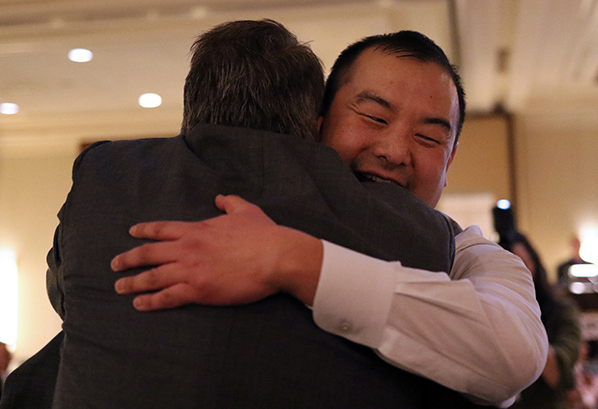
Doug Fraser of the Cape Cod Times of Hyannis, Mass., gets a congratulatory hug from Paul Pronovost, executive editor of the Times’ parent, Cape Cod Media Group, after Fraser was recognized as reporter of the year for daily newspapers.

Michael E. Schroeder, NENPA President

John Voket, NENPA Vice President

Jeff Peterson, NENPA Treasurer

James Normandin, NENPA Board Member

This trio from the Addison County Independent of Middlebury, Vt., shows its prize-winning moves as it dances to collect its $50 reward for splitting top honors in the best celebration contest at the advertising, marketing, and circulation awards ceremony at the NENPA convention Friday night, Feb. 24. They are, from right, Christy Lynn, advertising manager, Elsie Lynn Parini, business manager, and Anna Harrington, advertising co-manager.

Share:

Panel urges journalists to stand up to Trump, and for the First Amendment

By Katherine Isbell,
Bulletin Correspondent

Panelists for the convention session on “The next four years and the press” were, from left, Carolyn Lumsden, Bill Ketter, Asma Khalid, Rob Bertsche and Margaret Sullivan.

Panel moderator Bill Kole opened the discussion by recounting just what had happened 24 hours prior that showed the deteriorated relations between President Donald Trump and the press.

It’s no secret that the first month of the Trump administration was hectic, but even just the 24 hours leading up to the morning of Saturday, Feb. 25, were busy for both the administration and journalists alike.

At the start of that morning, Bill Kole, New England news editor for The Associated Press, checked his Twitter feed to be “up to the minute” and listed much of what had transpired Friday and into Saturday, including President Donald Trump’s “blasting of the media” for using anonymous sources; news organizations, including CNN and Buzzfeed, being barred from an informal press briefing at the White House; and Time Magazine and AP boycotting that same briefing in protest.

That was just a fraction of what happened in a single day, so “forget the first 30 days,” Kole said.

Kole made his comments at the outset of a panel discussion he moderated that Saturday morning on “The next four years and the press” at the New England Newspaper and Press Association winter convention. About 140 people attended the discussion.

“We have to get used to standing for something, and that something is democracy,” said panelist Margaret Sullivan, media columnist for The Washington Post. “If we as journalists and news organizations are not going to defend press rights, I don’t know who’s going to do it. I don’t think we should be presenting ourselves as the opposition party.”

A subject the panelists brought up multiple times was the public’s perception of the news media and whether the public thinks that the press has a bias, especially one against conservatives and the Republican Party.

Panelist Bill Ketter, senior vice president of news for Montgomery, Ala.-based Community Newspaper Holdings Inc., mentioned that, at his request, a reporter for a Community Newspaper Holdings newspaper asked people at the recent Conservative Political Action Conference whether they thought that press is biased, and the 15 or so people questioned said yes. But they also thought that the president was “going overboard” when he called journalists “the enemy of the American people,” Ketter said.

Perhaps part of that perceived bias comes from there being “too much opinion seeping into coverage of the president,” Ketter said.

Kole added: “Journalists have never been very popular.”

Asma Khalid, a political reporter with radio station WBUR-FM in Boston who followed the presidential campaign for NPR, voiced her concerns about the public’s perception of the media.

“I worry more … about the repercussions of a public that doesn’t trust the press,” she said.

Khalid said journalists are “remiss to think that this is only a conservative assessment.”

She mentioned a recent poll by the Institute of Politics at Harvard University in which trust in the news media to do the right thing was low even among millennials.

Another hot topic during the discussion was the use of anonymous sources.

Sullivan said Trump’s recent comments in which he “railed against the overuse of anonymous sources” were “weird” given his comments during his campaign about being a fan of WikiLeaks and his urging Russian hackers to leak Hillary Clinton’s emails.

Kole said there have been many “good, solid stories with people we can’t identify.”

Sullivan agreed. She said there are “whole subjects we couldn’t deal with without confidential sources,” such as the recent Washington Post story that led to Michael Flynn’s departure as Trump’s national security adviser that “couldn’t be done any other way.”

“We can overuse them,” Sullivan said of anonymous sources.

She told the audience about a policy that existed while she was at The New York Times that “anonymity should only be granted as a last resort.”

Panelist Carolyn Lumsden, opinion editor for The Hartford (Conn.) Courant, suggested that, to avoid overusing and misusing anonymous sources, “individual newsrooms can hold them (anonymous sources) to a pretty high standard,” which could “help over time.”

Panelist Rob Bertsche, a media and First Amendment lawyer for Prince Lobel Tye of Boston, cautioned that the use of anonymous sources opens up the possibility of reporters “being subpoenaed for their (sources’) identities.”

Other topics discussed included how the press might have “blown it” in covering and predicting the presidential election, why Trump won over voters, how journalists should behave on social media, and the parallel some people are drawing between the Trump administration and the Nixon administration in their attitudes toward the press.

Kole joked that the discussion might as well have been called “The next four years of your life” rather than “The next four years and the press.”

The panelists offered ideas on how journalists can navigate those years in a climate that isn’t particularly favorable toward their profession.

Ketter reminded those in the audience to “be fair” and to make sure that both sides of the political spectrum are covered.

Bertsche suggested ways in which journalists can protect themselves, including making sure that they have libel insurance, being aware of anti-SLAPP laws in their state, and turning to lawyers, like him, who offer information about laws protecting journalists as well as advice on issues involving libel and defamation.

Sullivan urged the audience to “not get distracted from the bigger stories” by paying too much attention to fact-checking Trump and following his Twitter account.

Khalid also cautioned that “Trump’s Twitter account can be a distraction.”

Lumsden said it is important that journalists know when to “walk away” from social media and avoid showing “too much snark” and engaging in “digital road rage.”

As the session wound to a conclusion, Ketter and Sullivan made clear the responsibility that journalists have.

Ketter said journalists “must vigorously defend the First Amendment … for the people.”

2017-New-England-Newspaper-Convention-logo

‘We have to get used to standing for something, and that something is democracy.’

—Margaret Sullivan, Media columnist,
Washington Post

‘I worry more … about the repercussions of a public that doesn’t trust the press.’

—Asma Khalid, Political reporter,
WBUR-FM, Boston

‘(Journalists) must vigorously defend the First Amendment … for the people.’

—Bill Ketter, Senior vice president of news,
Community Newspaper Holdings Inc., Montgomery, Ala.

The session about President Trump and the press drew about 140 people, the largest single audience for any of the convention’s 23 panel discussions or workshops.

Share:

When information’s in doubt, check it out or leave it out

By Sofia Bergmann,
Bulletin Correspondent

The audience gasped in disbelief.

“There were photos of busted lips and blood dripping out of their mouths. He would send people home after taking wisdom teeth out without anything to combat the blood … This guy was, is a crook.”

Judith Meyer, executive editor of the Sun Journal of Lewiston, Maine, stunned the audience with a story that emphasized the importance of honest reporting.

She was accompanied by four other panelists Friday, Feb. 24, at a New England Newspaper and Press Association winter convention discussion on “How do you know it’s true, or do you care before printing it?”

And the answer to the second question is yes.

As Meyer said: “The very best stories are the true ones.”

Meyer’s gruesome story about a dentist in Maine who was breaking people’s jaws and busting their lips without anesthesia is an example of a story that required extensive investigation before being published. After reviewing documents provided by the Maine Board of Dental Examiners, the Sun Journal was able to gather more information about the dentist.

In fact, the situation was much worse than what the original tip about the dentist had indicated. When the Sun Journal put a story about the situation online, hundreds of people shared their experiences with photo evidence of the poor treatment they had received. Without the ability to access disciplinary and licensing records, the Sun Journal would not have published the story because that concrete evidence was vital to making such serious accusations, Meyer said.

Meyer was joined by four other panelists: Karen Bordeleau, retired executive editor and senior vice president of The Providence (R.I.) Journal; Mike Donoghue, a veteran journalist and vice president of the New England First Amendment Coalition board; Peter J. Caruso Sr., an Andover, Mass., lawyer; and Jonathan M. Albano, a Boston lawyer who was portrayed in “Spotlight,” the Oscar-winning film about The Boston Globe’s Pulitzer Prize-winning series exposing sexual abuse by Roman Catholic clergy.

Some of the discussion referred to President Donald Trump’s war on the news media.

Meyer said that, as with Trump’s repeatedly accusing the press of sharing false information: “We (journalists) get beat on all the time, and we’ve got to keep our heads up, march on, and stand tall.”

Bordeleau related an example of the importance of being certain about the veracity of a story. She urged the journalists in the audience to tread lightly when dealing with accusations, especially those against public figures.

After having watched a video of two unidentified victims accusing a public official of sexual promiscuity with minors while cross-dressed in the Dominican Republic, she decided not to publish the story.

“Even though it seems so juicy … we’re not touching this because we can’t confirm it, and we never were able to confirm … We could not ding our own reputation, let alone the reputation of other journalists,” Bordeleau said.

Because the video did not contain clear evidence of what was alleged to have occurred and the subjects were unidentifiable, there was not enough proof to back up the claims made to the Journal about the public official, Bordeleau said.

“For all we know, it could have been filmed in a basement in Pawtucket,” Bordeleau said.

Caruso focused on the role the press plays as the Fourth Estate — constantly questioning, doubting, testing and interpreting what’s going on around us.

Caruso said that, having represented many journalists in court and as a former newspaperman himself, he knows firsthand how damaging a false story can be — not only to the reputation of the journalist, but to that of the publication he or she works for and to journalists as a whole.

Albano, having had similar experiences to Caruso’s in his work, re-emphasized his point.

“Believe me, no one wants to go through a libel trial. Talk to any reporter who’s experienced it; it’s the worst possible experience,” Albano said.

Albano shared an example of the gray area that can cloud the judgment of journalists.

“There was once a reporter who published an article that accurately stated that there were rumors on Wall Street that the head of a company was actually a convicted felon,” he said. “Short sellers had been circulating this unverified rumor, and it had caused the stock to go wild.”

Albano said that although it is crucial for published information to be accurate, he made the argument that “given the fact that the rumor had an independent effect on investors, maybe there should be some protection for (journalists) reporting this kind of unverified rumor.”

Donoghue, who moderated the discussion, summed up its main theme with a humorous truism familiar in newsrooms. “When your mother says she loves you, check it out.”

NEWS

2017-New-England-Newspaper-Convention-logo

‘We (journalists) get beat on all the time, and we’ve got to keep our heads up, march on, and stand tall.’

—Judith Meyer, Executive editor
Sun Journal, Lewiston, Maine

‘Believe me, no one wants to go through a libel trial. Talk to any reporter who’s experienced it; it’s the worst possible experience.’

—Jonathan M. Albano, Boston lawyer

The audience at the session on “How do you know it’s true, or do you care before printing it?” packed the meeting room where the discussion was held.
Share: