
Page 135

When information’s in doubt, check it out or leave it out

By Sofia Bergmann,
Bulletin Correspondent

The audience gasped in disbelief.
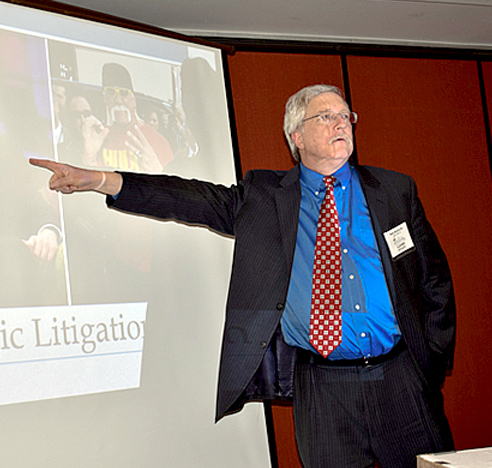
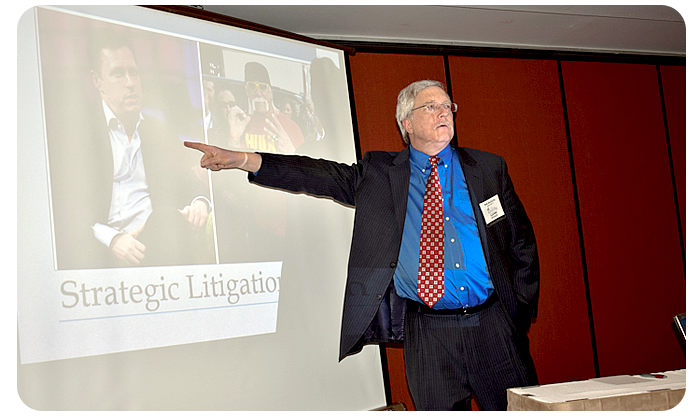
“There were photos of busted lips and blood dripping out of their mouths. He would send people home after taking wisdom teeth out without anything to combat the blood … This guy was, is a crook.”

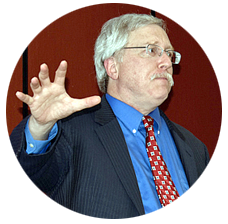
Judith Meyer, executive editor of the Sun Journal of Lewiston, Maine, stunned the audience with a story that emphasized the importance of honest reporting.

She was accompanied by four other panelists Friday, Feb. 24, at a New England Newspaper and Press Association winter convention discussion on “How do you know it’s true, or do you care before printing it?”

And the answer to the second question is yes.

As Meyer said: “The very best stories are the true ones.”

Meyer’s gruesome story about a dentist in Maine who was breaking people’s jaws and busting their lips without anesthesia is an example of a story that required extensive investigation before being published. After reviewing documents provided by the Maine Board of Dental Examiners, the Sun Journal was able to gather more information about the dentist.

In fact, the situation was much worse than what the original tip about the dentist had indicated. When the Sun Journal put a story about the situation online, hundreds of people shared their experiences with photo evidence of the poor treatment they had received. Without the ability to access disciplinary and licensing records, the Sun Journal would not have published the story because that concrete evidence was vital to making such serious accusations, Meyer said.

Meyer was joined by four other panelists: Karen Bordeleau, retired executive editor and senior vice president of The Providence (R.I.) Journal; Mike Donoghue, a veteran journalist and vice president of the New England First Amendment Coalition board; Peter J. Caruso Sr., an Andover, Mass., lawyer; and Jonathan M. Albano, a Boston lawyer who was portrayed in “Spotlight,” the Oscar-winning film about The Boston Globe’s Pulitzer Prize-winning series exposing sexual abuse by Roman Catholic clergy.

Some of the discussion referred to President Donald Trump’s war on the news media.

Meyer said that, as with Trump’s repeatedly accusing the press of sharing false information: “We (journalists) get beat on all the time, and we’ve got to keep our heads up, march on, and stand tall.”

Bordeleau related an example of the importance of being certain about the veracity of a story. She urged the journalists in the audience to tread lightly when dealing with accusations, especially those against public figures.

After having watched a video of two unidentified victims accusing a public official of sexual promiscuity with minors while cross-dressed in the Dominican Republic, she decided not to publish the story.

“Even though it seems so juicy … we’re not touching this because we can’t confirm it, and we never were able to confirm … We could not ding our own reputation, let alone the reputation of other journalists,” Bordeleau said.

Because the video did not contain clear evidence of what was alleged to have occurred and the subjects were unidentifiable, there was not enough proof to back up the claims made to the Journal about the public official, Bordeleau said.

“For all we know, it could have been filmed in a basement in Pawtucket,” Bordeleau said.

Caruso focused on the role the press plays as the Fourth Estate — constantly questioning, doubting, testing and interpreting what’s going on around us.

Caruso said that, having represented many journalists in court and as a former newspaperman himself, he knows firsthand how damaging a false story can be — not only to the reputation of the journalist, but to that of the publication he or she works for and to journalists as a whole.

Albano, having had similar experiences to Caruso’s in his work, re-emphasized his point.

“Believe me, no one wants to go through a libel trial. Talk to any reporter who’s experienced it; it’s the worst possible experience,” Albano said.

Albano shared an example of the gray area that can cloud the judgment of journalists.

“There was once a reporter who published an article that accurately stated that there were rumors on Wall Street that the head of a company was actually a convicted felon,” he said. “Short sellers had been circulating this unverified rumor, and it had caused the stock to go wild.”

Albano said that although it is crucial for published information to be accurate, he made the argument that “given the fact that the rumor had an independent effect on investors, maybe there should be some protection for (journalists) reporting this kind of unverified rumor.”

Donoghue, who moderated the discussion, summed up its main theme with a humorous truism familiar in newsrooms. “When your mother says she loves you, check it out.”

NEWS

2017-New-England-Newspaper-Convention-logo

‘We (journalists) get beat on all the time, and we’ve got to keep our heads up, march on, and stand tall.’

—Judith Meyer, Executive editor
Sun Journal, Lewiston, Maine

‘Believe me, no one wants to go through a libel trial. Talk to any reporter who’s experienced it; it’s the worst possible experience.’

—Jonathan M. Albano, Boston lawyer

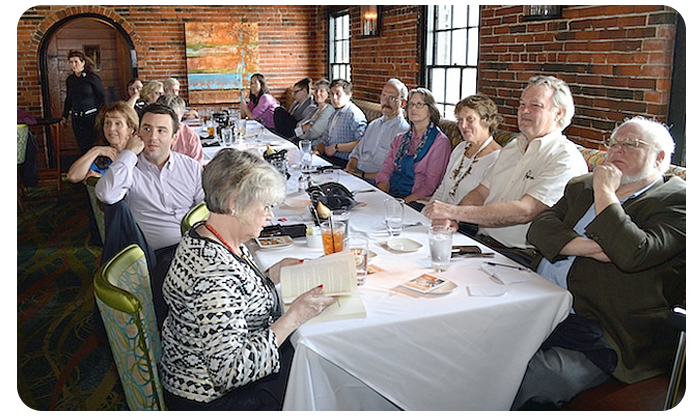
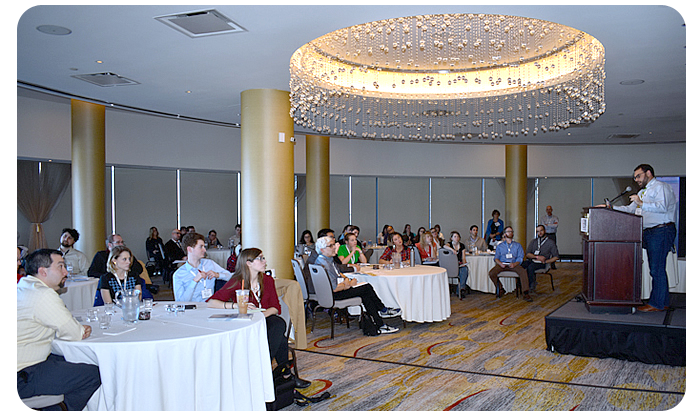
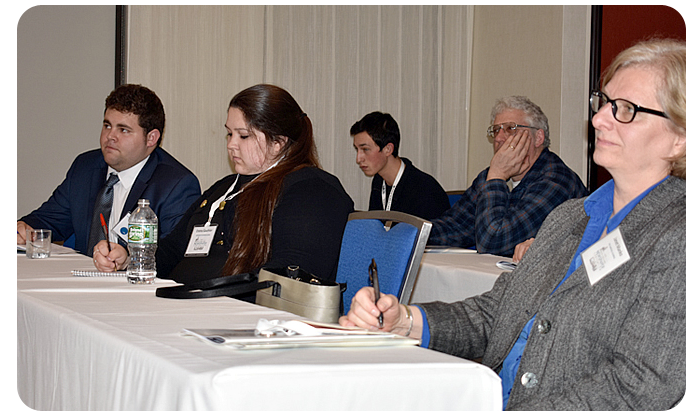
The audience at the session on “How do you know it’s true, or do you care before printing it?” packed the meeting room where the discussion was held.
Share:

Best Video – The NESNEs

Stuck in Vermont: Hanksville Mud Bog

Memorial Day Parade

Blossoming in one’s own

Bob Crelin wants you to see the stars

Stuck in Vermont: Trumpnado Hits Burlington

Otter Cliffs Crash in Acadia

Neighbor describes Holyoke building collapse

Share:

Relating data to effects on people powers impact of investigative reports

By Morgan Mapstone,
Bulletin Correspondent

The four panelists for the discussion on what contributes to winning Publick Occurrences Awards.

Managing time and data correctly is crucial to the success of an investigative story, according to Jenifer McKim, a senior investigative reporter at the New England Center for Investigative Reporting at Boston University.

McKim joined three other award winners as panelists Saturday, Feb. 25, at the New England Newspaper and Press Association winter convention for a discussion titled “Inside Publick Occurrences.”

The discussion, attended by 30 people, covered a range of challenges, including data management, faced by last year’s winners of NENPA’s Publick Occurrences Awards.

McKim discussed the inspiration behind her award-winning series on child abuse and neglected deaths in Massachusetts. To her, the most important goal for an investigative story, especially one with emotional content, is to use data in a way that will spark awareness and action in the reader.

“We didn’t want to write a sad story without people learning from it,” McKim said.

McKim warned that the time frame for investigative action can be trying, especially in cases where data takes time to uncover. McKim suggested making Excel spreadsheets of stories and interviews to properly manage what has to be done to move the story along.

Because most of the award-winning work was made up of data-heavy stories, panelists gave tips on how to turn data into a readable story.

Panelist Carlos Virgen, digital news director at The Day Publishing Co. of New London, Conn., used 19 years of accident data on Interstate 95 to create his series, I-95: Deadly, Overcrowded. To turn the large amount of data into a series, Virgen decided to connect the data with people personally affected by the highway.

“We had to identify the people affected,” Virgen said. “Otherwise the story would have been just 20 years of data.”

Other panelists agreed on the importance of humanizing the data in a story.

Panelist Alex Elvin, a reporter for the Vineyard Gazette of Martha’s Vineyard, Mass., and author of a nine-part series, Coastal Ponds under Pressure, thought that bringing a personal attachment to the data would improve the impact of the series. Elvin used data about nitrogen levels in ponds, and found that relating the failing ponds’ effects on those living around the ponds was most effective.

“We tried to keep a focus on places and people, which helped tell the story,” Elvin said.

Similarly, panelist Lynne Sullivan discussed the role that her interactions with the public had in her follow-up series on the first-ever mayoral recall election in Fall River, Mass.

Sullivan, editor in chief of The Herald News of Fall River, Mass., said she felt a strong responsibility to guide a community conversation after the recall of the elected official.

“It’s when you talk with regular people outside of the usual elected officials that people start to understand the story more,” Sullivan said.

NEWS

2017-New-England-Newspaper-Convention-logo

‘We didn’t want to write a sad story without people learning from it.’

—Jenifer McKim, Senior investigative reporter
New England Center for Investigative Reporting, Boston University

‘We had to identify the people affected. Otherwise the story would have been just 20 years of data.’

—Carlos Virgen, Digital news director
The Day Publishing Co., New London, Conn.

‘We tried to keep a focus on places and people, which helped tell the story.’

—Alex Elvin, Reporter
Vineyard Gazette, Martha’s Vineyard, Mass.

‘It’s when you talk with regular people outside of the usual elected officials that people start to understand the story more.’

—Lynne Sullivan, Editor in chief
Herald News, Fall River, Mass.

Share:

Engaging with consumers based on their reading habits

By Alison Berstein,
Bulletin Correspondent

One thing I like to do is bust myths, and young people don’t read the newspaper? That’s a myth. They don’t read to the degree (of other consumers), but they still read.’

—Gary Meo, Senior vice president, sales director of newspaper media
Nielsen Scarborough, New York City

No two people are the same. Each person has different interests, hobbies, and passions.

There is a beauty that comes with that idea.

But that idea also poses challenges for companies looking to reach their audiences effectively.

Gary Meo discussed those challenges and their solutions in his workshop on “Monetizing audiences: Demonstrating the value of your audiences for advertisers” at the New England Newspaper and Press Association winter convention.

About 30 people attended his talk Saturday, Feb. 25, at the Boston Marriott Long Wharf hotel.

Newspapers and other businesses need to understand the dynamics of the different audiences they serve, said Meo, senior vice president and sales director of newspaper media at Nielsen Scarborough, headquartered in New York City.

“Newspapers have different audiences by platform,” Meo said.

Companies target those audiences that are most likely to engage in an advertiser’s message, Meo said.

“Advertisers are interested in selling to a portion of the audience, not an entire audience,” he said.

Nielsen Scarborough is a local market analysis service. It serves companies around the country by measuring consumer behavior.

“We measure retail behavior,” Meo said. “We measure all of the local media.”

Studying and understanding consumer behavior is “the way to demonstrate the connection between their brand and your audience,” Meo said.

Meo uses what is known as audience segmentation – dividing a market into segments, each with its own needs and spending patterns.

“How do your readers measure up to the market as a whole?” he said. “This kind of person is more likely (to engage in a certain consumer behavior) compared to a general audience.”

Meo stressed the importance of understanding each segment.

Because each subpopulation of consumers has its own needs, it responds in a different way to a message, Meo said.

Meo segments a newspaper’s audience into four categories:

A little less than half of the newspaper readers in the United States are what he calls “print loyalists”, who consume the newspaper solely in print. That accounts for 4.2 million adults in New England, or 47 percent of the New England adult population, Meo said.

About 20 percent are “dual devotees,” who read the newspaper in print and on one other platform.

Sixteen percent are “digital dignitaries,” reading just on digital devices.

The final 18 percent are “digital omnivores,” who consume the news through a variety of platforms. “We like them,” Meo said. “They’re seeing your advertiser’s message multiple times.”

Meo said the printed newspaper is still a viable contender in the eyes of consumers.

“You don’t want to abandon print just yet, because it’s the largest chunk of your readers …,” he said. “Print is still a big part of our portfolio.”

“One thing I like to do is bust myths, and young people don’t read the newspaper? That’s a myth,” he continued. “They don’t read to the degree (of other consumers), but they still read.”

Meo said 78 percent of consumers engage in the paper via print and on other platforms.

“Print isn’t falling off a cliff,” he said. “It’s still a big part of your audience.”

It is definitely a big part for print loyalists, who read the newspaper only in print.

Meo said the average age in that group is 54.

“People who read the printed paper exclusively are older,” he said. “We lament that our readers are getting older, but they’re an important group.”

Consumers in that group tend to be well-to-do, and therefore are valuable to the retail industry, Meo said.

Being a fan of the printed newspaper also translates into engaging with print advertisements, Meo said.

“They interact with print advertisers, they cut the coupons,” he said.

About one in five consumers are “dual devotees,” reading the newspaper in print and on one other platform, Meo said.

That is a younger group, with an average age of 48, Meo said. Forty-nine percent are millennials, he said.

“When you introduce digital into the mix, your audience gets a lot younger,” he said.

Those consumers pursue investments and use credit cards, Meo said.

They also are valuable to the travel industry, because they are more likely to travel, Meo said.

Members of the third group, digital dignitaries, read solely on digital platforms.

“They are definitely connected. They are digital natives,” Meo said of that group, whose average age is 39.

Advertising to them requires strategy on the part of digital advertisers, Mao said.

“They do not like to be advertised to on their mobile phones,” he said. “It has to be interesting, compelling, relevant.

“It’s all about relevancy,” he said. “They see their mobile phones as their property, their space, and they don’t want advertisers encroaching on that space.”

The final group, news omnivores, engages with newspapers and other businesses on a variety of platforms.

Their average age is 43 and they are valuable to the technology industry, Meo said. Digital omnivores use technology in their cars, such as satellite radio and wireless capabilities.

Those active, highly engaged consumers provide an abundance of opportunity for advertisers to reach out, Meo said.

“If you’re running advertisements on all of your platforms, your omnivore readers are seeing those ads on those platforms,” he said.

ADVERTISING

2017-New-England-Newspaper-Convention-logo

‘Print isn’t falling off a cliff. It’s still a big part of your audience.’

—Gary Meo

‘Advertisers are interested in selling to a portion of the audience, not an entire audience.’

—Gary Meo

Share:

Increasingly popular video becomes a must for coverage

By Alejandro Serrano,
Bulletin Correspondent

Presenters Ryan Mercer and Al Getler respond to an audience member.

This year is definitely the year of video for news organizations, according to Al Getler, former publisher of The Burlington (Vt.) Free Press.

What is so convincing?

The amount of time per week that people spend watching video surpassed the amount of time people spend on social media and increased by more than a minute from 2011 to 2015, according to statistics Getler presented at a workshop at the New England Newspaper and Press Association’s winter convention.

“You have to add video to your mix,” he said.

Getler, accompanied by Ryan Mercer, visuals coach and photo and video editor at the Free Press, discussed how news organizations can integrate a video strategy into their coverage and how to get past not wanting change in a newsroom.

Mercer, a five-time Edward R. Murrow Award recipient, demonstrated how he uses his phone to live-stream a news scene – if not setting up a tripod for his phone, then attaching his phone to the top of his DSLR camera when he is on assignment – with tools, such as an iPhone, that journalists are familiar with and accessories varying in prices for different newsrooms.

Keeping video in mind when covering something enables Mercer, and the Free Press, to do Facebook Live streaming video coverage and then have a plethora of footage to cut – from the live stream and from his other cameras — into a more polished video to upload with the story or as a story itself, adding details that can’t always be captured in text.

Mercer discussed a video of an off-duty police officer who fatally shot a man last fall in Winooski, Vt. Mercer used only footage from the body camera the officer was wearing. He blurred out the actual shooting.

Mercer said that at the time questions arose about both the officer and the man shot, and that the video helped clear up some of the questions. A debate developed about whether the officer had to shoot the suspect. Friends of the suspect said he didn’t carry a weapon. Police were initially reluctant to release the video, which led to more questions than answers until it was released. The officer was off-duty and was an officer from another county, so some people were angry that he was at the scene. The video demonstrated that the officer had been called in and that the suspect approached the officer with one hand behind his back, after the officer asked him to put his hands in sight, in the instant before the shooting.
Mercer said of the editorial decision to run the video as it was, with only partial censoring: “(W)e thought (it was) really, really important to get the context and facts straight. As unpleasant as this was to watch, without seeing all that in one package you are not getting all the facts you need to properly digest all that information.”

Getler said other newsroom departments can make use of video too. Sports can capture moments of action and crowd reactions, and government meetings can be broadcast as breaking news, especially when the video features an impromptu speech by an elected official.

Video increases the amount of content people consume from a news outlet, and can tell a story in a nonlinear way, and sometimes video-first stories can lead to interesting text stories that make use of the video package, Getler said.

Getler and Mercer said one of the greatest advantages to incorporating a video strategy is the convenience and quickness with which it can give a news outlet a leg up over others. And doing so breaks newsrooms out of the habit of not risking anything.

“It helps you compete with people you otherwise wouldn’t,” Getler said. “It’s your job to own your news and break it and get out there before the competition does.”

About 20 people attended the workshop on “Adding a video strategy” Saturday, Feb. 25, in the Boston Marriott Long Wharf hotel.
(To see a video of the “Adding a video strategy” on the New England Newspaper and Press Association’s Facebook page under that title, please click here.)

VISUAL

2017-New-England-Newspaper-Convention-logo

‘You have to add video to your mix.’

—Al Getler, Former publisher,
Burlington (Vt.) Free Press

‘(Video) helps you compete with people you otherwise wouldn’t. It’s your job to own your news and break it and get out there before the competition does. ‘

—Al Getler

Share:

In simple or complex forms, data journalism adds power to stories, a defense of truth

By Bailey Knecht,
Bulletin Correspondent

‘Data journalism doesn’t always have to be about fancy visualizations or really complicated math or sort of impenetrable science. A lot of times it can be just about very simple questions.’

—Tyler Dukes, Investigative reporter
WRAL News, Raleigh, N.C.

On both the local and national news levels, data journalism can be a useful tool for reporters in combatting suppression of information and gaining credibility among readers, according to Tyler Dukes, an investigative reporter at WRAL News, a television station in Raleigh, N.C.

“I think what we’re seeing right now is essentially an unprecedented assault on our quest for the truth, and that’s something that’s elusive enough without us being called enemies of the American people,” he said. “What I think is required is for us to really try to repel this assault with every weapon at our disposal, and that includes weaving data into stories we tell every day.”

Dukes spoke to an audience of about 40 people Saturday, Feb. 25, in a presentation titled “Peril and promise: Journalism in the age of data” at the New England Newspaper and Press Association winter convention in the Boston Marriott Long Wharf hotel.

Dukes emphasized the effectiveness of data journalism, even in the most basic of forms.

“Data journalism doesn’t always have to be about fancy visualizations or really complicated math or sort of impenetrable science,” he said. “A lot of times it can be just about very simple questions.”

News organizations can employ data journalism in a variety of areas, Dukes said. He said compiling statistics about issues such as restaurant cleanliness or racial profiling in traffic stops could be powerful uses of data journalism.

He then listed the various ways journalists can go about obtaining data. They can either request it as a public record from government agencies — such as animal shelter records and public health inspections — or gather and organize it themselves — such as building permits and contracts for school superintendents.

Dukes also recommended taking advantage of the data collected and using it for multiple stories.

“If you invest in this reporting, make it live longer than one story, and make it pop up in all these other places that provide content,” he said. “You have spent the money and the resources and the bodies to come to a number, to come to a figure. Use it, and use it often.”

Analyzing data with a critical eye is also crucial, particularly if that data was collected by outside sources such as government agencies, Dukes said.

“Interview your data, and treat it as a source,” he said. “What that means is to apply the same sort of verification steps as you would with any other source. Ask why the data was created in the first place.”

He cautioned audience members against putting all their faith in data.

“One thing that’s really important to remember is that data has limits,” he said. “It’s really important when we’re going about the work of data journalism that we know that just because it’s a number doesn’t mean it’s the truth.”

In his key takeaways, Dukes emphasized transparency in the data-collecting process and suggested that reporters thoroughly explain their work.

“You really want to make sure that you’re demonstrating to your audience, as a matter of trust, how you got to that figure, even if it’s fairly simple,” he said.

Dukes emphasized that solid data journalism has the power to have a lasting effect, particularly on the government and public officials.

“Good data leads to good public policy, and without that good data we can’t make good public policy,” he said.

NEWS

2017-New-England-Newspaper-Convention-logo

‘Interview your data, and treat it as a source. What that means is to apply the same sort of verification steps as you would with any other source. Ask why the data was created in the first place.’

—Tyler Dukes

‘Good data leads to good public policy, and without that good data we can’t make good public policy.’

—Tyler Dukes

Share:

Hosting sponsored events is the art of a special deal

By Sophie Cannon,
Bulletin Correspondent

‘To sell these kinds of ideas, you’ve got to be thoughtful and creative. You’ve got to think what (companies) are trying to accomplish with their businesses.’

—Dan Cotter, Director of sales development and training,
GateHouse Media New England

Putting on events with sponsoring businesses is an advertising play that requires higher-level deal-making, planning, and execution, according to a presentation at the New England Newspaper and Press Association winter convention.

Dan Cotter, GateHouse’s director of sales development and training, and Troy Goodwin, special events account manager for GateHouse, described during the presentation GateHouse’s foray into pitching and putting on events for local businesses. Fifty people attended the presentation, titled “How to make more money selling events,” Friday, Feb. 24, at the Boston Marriott Long Wharf hotel.

“To sell these kinds of ideas, you’ve got to be thoughtful and creative,” Cotter said. “You’ve got to think what (companies) are trying to accomplish with their businesses.”

Cotter and Goodwin described how, after some struggles with sales pitching, GateHouse was able to put on events for sponsors such as Stop & Shop, Hood Milk, Edelman Financial Services, and Bertucci’s. GateHouse Media New England has six dailies, 98 weeklies, and 168 local news websites in five New England states.

Goodwin said that, from the pitching process and beyond, publishers hosting events for businesses should form strong relationships with their clients.

“It becomes a whole (other) level of a relationship. It’s not just selling a product to them. It’s selling the idea of working together with them,” Goodwin said.

Goodwin and Cotter said publishers should include their event sponsors heavily in the event planning process and allow those sponsors to customize their event advertising in creative ways, keeping them engaged and invested in the event. Moreover, the sponsors might even shoulder a majority of the planning work because they are impassioned.

Targeting the right local businesses to pitch to is a crucial prerequisite for any events, Cotter said. He said publishers should find companies that don’t usually advertise, because events often attract nontraditional ad clients because of the exciting opportunity those events present to bigger organizations and businesses.

“What we try to do is figure out what the event is about, who it would benefit, and then go out into the market and figure out who we could help,” Cotter said. “Prospect among businesses that are right for the event; forget about who your day-to-day customers are.”

Goodwin said that, after choosing the right target, salespeople should pitch to businesses in person from the top-down, avoiding miscommunication and less receptive middle managers.

“Go right up to the top from the get-go, because once you move down, there’s a requirement to work with us,” Goodwin said.

Middle managers such as regional ad representatives often reject pitches for events, based on budget constraints. And ad agencies focus too much on pricing and minutiae than big-picture event coverage, he said.

Cotter said that, instead, approaching a company’s vice president or director with a solid sales pitch is a safer bet because executives have more control over budgeting and are more willing to spend money on a good investment.

“If you bring in a new idea that’s going to differentiate them from their key competitors, they’ll find the money,” Cotter said.

Both Goodwin and Cotter suggested initially sending emails to clients to create interest as opposed to calling them, because executives don’t answer calls and prefer reading something on their own time. They also suggested doing pitches in person, which avoids being cut off over the phone.

From there, prospective event hosts should focus on giving clients what they want and helping them grow their businesses through pre-event, event, and post-event coverage in their publications rather than selling different tiers of ad packages, Cotter and Goodwin said. They said price levels should be starting points from which clients should customize their own ideal packages.

“The bottom line is over-deliver value to sponsors, especially in the first year. It’s really hard to get traction with these events,” Cotter said.

“Get grabby – the idea should be to tell businesses to come to us with (their) dreams, and then we’ll negotiate a price,” he said.

MARKETING

2017-New-England-Newspaper-Convention-logo

‘It’s not just selling a product to them. It’s selling the idea of working together with them.’

—Troy Goodwin, Special events account manager,
GateHouse Media New England

‘Prospect amoung businesses that are right for the event; forget about who your day-to-day customers are.’

—Dan Cotter

Fifty people attended the convention presentation on ‘How to make more money selling events.
Share:

Blinder: Newspapers rock, but the wow factor sells ads

By Alison Berstein,
Bulletin Correspondent

‘When you do your elevator pitch, the response better be “wow!” The secret to that is benefit-driven. You don’t have readership, you have potential customers.’

—Mike Blinder, President
Blinder Group, Lutz, Fla.

Mike Blinder is a big fan of newspapers, and he does not shy away from saying so.

“Newspapers rock!” he affirmed time and time again at his session “Leveraging digital services to gain new legacy revenue” during the New England Newspaper and Press Association winter convention.

Blinder is president of Blinder Group, a multimedia sales consulting company. He spoke to an audience of about 30 people Friday, Feb. 24, the first day of the two-day convention at the Boston Marriott Long Wharf hotel.

Newspapers and other businesses can survive if they learn how to use the digital skills available to them to engage an audience, Blinder said.

“Research shows that people who market do better than people who don’t,” said Blinder, whose Lutz, Fla.-based company trains more than 350 media clients in maximizing sales. “If you’re not advertising, a competitor can steal your customers.”

In a booming voice laced with passion and humor, Blinder shared insight into surviving as a legacy – traditional print – industry while harnessing digital skills.

“It’s a geeky way of saying how to make money using the internet,” he said. “What we do for a living is we aggregate eyeballs.”

Blinder thinks that digital services have the potential to cater to an audience’s specific needs.

“Local advertisers are spending a lot of money on digital,” he said. “I’m pro digital services.”

He highlighted reach and frequency as key components of digital advertising. A business engages an audience and then works to maintain that audience, he said.

“I want to sell that weekly ad, so I’m going to make it sexy,” he said. “We want to earn (a client’s) trust for a full year. If we don’t get frequency, it doesn’t work.”

Developing and engaging that clientele is especially important for a diminishing print industry, Blinder said.

“Selling media is hard,” he said. “It doesn’t matter what kind of media. Forty-six percent of adults read a newspaper each week. That’s down from 80 to 90 percent 30 years ago.”

Blinder recognized that traditional print newspapers might lack the oomph of their digital counterparts.

“People love shiny toys. Our society loves shiny toys. Be excited about something new and exciting,” he said.

“Ladies and gentlemen, newspapers rock. The problem is, newspapers aren’t a shiny toy,” he said.

To get potential customers excited about a product or a service, that product or service must be marketed well, Blinder said.

It is in this spirit that he calls the traditional elevator pitch a “wow statement.”

“When you do your elevator pitch, the response better be ‘wow!’” he said. “The secret to that is benefit-driven. You don’t have readership, you have potential customers.”

“Don’t sell the steak, sell the sizzle,” he said, adapting the slogan of Elmer Wheeler, dubbed “America’s Greatest Salesman.”

Companies can use this “wow pitch” to emphasize the value that their product gives the consumer, Blinder said.

“We forget that a message is what sells the product,” he said. “Don’t sell the section, sell what’s in the section. Are you truly telling your community what makes you better, smarter, faster than your competitors?”

That practice is known as solution-based selling: What can the product do for you?

“We’re not going to say to the advertiser, ‘Buy this, this, and this.’ You go into a price range that doesn’t scare them,” Blinder said. “I have arrows in a quiver. Mr. Advertiser, I’m not going to pull out an arrow until I know what you need.

“You can’t call the Bureau of Standards and ask for another hour (to advertise),” he said. “You have a limited inventory.

“Find out what they want and give it to them,” Blinder said, quoting showman and businessman P.T. Barnum. “In the first 20 seconds, (customers) are going to find out if they’re going to buy it or not.”

Blinder emphasized that, to reach out to consumers effectively, a company should know how to run its social media pages as well as produce fresh content for those pages.

“All advertisers know they should use social media,” he said. “Fifty percent of business owners do not monitor their Facebook page.

“Social media for local businesses is still cool content. It’s cool and it’s closing deals,” he said. “We’re saying to the advertiser – once a month, report to your executive something cool, social media fodder.”

It’s all about engagement, Blinder said.

“The number one way to build a rapport with an advertiser is to speak their language,” he said. ”If you don’t pump them up, we have a problem. You gotta remind them we rock.”

He held up a pin that said ‘Newspapers Rock!’ and invited the audience to take one.

“Grab them and wear them proudly,” he said. “Get your swagger back.”

ADVERTISING

2017-New-England-Newspaper-Convention-logo

‘Local advertisers are spending a lot of money on digital. I’m pro digital services.’

—Mike Blinder

‘Selling media is hard. It doesn’t matter what kind of media. Forty-six percent of adults read a newspaper each week. That’s down from 80 to 90 percent 30 years ago.’

—Mike Blinder

‘The number one way to build a rapport with an advertiser is to speak their language. If you don’t pump them up, we have a problem. You gotta remind them we rock.’

—Mike Blinder

Share:

Changing company culture crucial for Meriden, Conn., Record-Journal’s success

By Alex Eng,
Bulletin Correspondent

Company-wide changes in approaches to advertising sales, content, and culture led to the success of the Record-Journal of Meriden, Conn., two company executives told an audience at the New England Newspaper and Press Association winter convention.

The Record-Journal increased its revenue and digital audience growth by 53 and 40 percent, respectively, after making a few fundamental shifts through programs dubbed Revolution 2015 and Opportunity 2016.

The basic premise of those programs was to involve the entire company in devising innovative methods for the newspaper to capture more digital engagement and revenue, according to a presentation titled “Record-Journal’s Revolution 2015.”

Liz White, the Record-Journal’s executive vice president and assistant publisher, and Shawn Palmer, its senior vice president and chief revenue officer, made the presentation Saturday, Feb. 25, to 30 people in the Boston Marriott Long Wharf hotel.

“Low-hanging fruit to us (were) some things that would increase audience engagement,” White said. “Once we started experimenting with (content) digitally, we saw people engaging with (digital content) more.”

Reporters and editors posted on social media more frequently, and the Record-Journal worked on publishing more engaging content online, such as real-time, breaking police news and photo galleries of property transfers. The staff also began experimenting with alternative story forms such as listicles, and updated the designs of both the Record-Journal’s print paper and website, including a new mobile website.

After those efforts, the Record-Journal’s digital subscriptions increased 11 percent that year, although a large share of the digital market was yet to be captured. Thus, the paper’s Opportunity 2016 initiative sought to involve all levels of employees in generating more digital revenue from page views, native advertising, and video.

On the financial side, the sales staff zeroed in on offering clients comprehensive digital and print ad packages and new kinds of products, including sales promotions, contests, restaurant guides, job recruitment postings, and programmatic ads based on users’ preferred content. Salespeople were instructed to pursue prospects based on profitability, and they were held accountable by way of having their numbers posted on a publicly viewed whiteboard in the office for all to see.

The company also formed the newly branded Homebase Digital, a digital advertising interface intended to show clients that the RJ Media Group, which owns both the Record-Journal and The Westerly (R.I.) Sun, is not just a newspaper company but also a serious digital advertising business offering new products such as website development, search engine marketing, social media promotions, and video ads, Palmer said.

“We are doing things a lot differently and thinking differently about how we do it, and about ourselves, and how we position our business moving forward in the future,” Palmer said. “We did a lot of great things. We threw a lot of things at the wall, and we figured out what worked and what didn’t work.”

One thing that didn’t work, for example, was a short-lived foray last year into marketing video production, which the company moved on from quickly as part of its new company culture, White said.

“We celebrate our successes and we get excited, but some things don’t work and you have to acknowledge that they’re failures and move on quickly,” White said.

“Failing fast” became a joke around the Record-Journal office, which physically underwent some major changes that accompanied the paper’s change toward becoming a dynamic, experimental, and modern organization, White said. The Record-Journal sold and moved out of an office building that was more than 100 years old and had multiple floors that severely affected internal communications.

Its newly leased office space is more compact, places all employees on one floor, and features energizing design and branding as well as a ping-pong table, White said.

“Everything you see in our space is designed to make it easier for people to communicate,” White said. “We want people to see when they walk into that space that (they’re) not in a dying newspaper. You’ll know you’re in a new and innovative company that is excited about its future.”

To guide them on their new changes, the paper’s executives devised what they call “transformation spectrums” to help quantify how the paper is doing in sales and content. For example, the sales staff is measured on a scale that determines how the print sales and digital sales teams work independently of each other. Similarly, the content scale determines the proportions of content published either in print or digital-first.

Since its Revolution 2015 program, the Record-Journal was named one of Editor & Publisher Magazine’s 2016 “10 Newspapers that do it right” and won first place for Best Local Website in the 2017 Local Media Digital Innovation Awards, national awards given by the nonprofit Local Media Association.

White said the company’s changing culture was a way of viewing new challenges in the newspaper industry as opportunities for future growth.

“I’m afraid every day, but I’m also inspired and excited by the challenge and the opportunity of it all,” White said. “If we don’t change fast enough, then we’re not going to be able to capture that opportunity.”

MANAGEMENT

2017-New-England-Newspaper-Convention-logo

‘We are doing things a lot differently and thinking differently about how we do it, and about ourselves, and how we position our business moving forward in the future. We did a lot of great things. We threw a lot of things at the wall, and we figured out what worked and what didn’t work.’

—Shawn Palmer, Senior vice president,
chief revenue officer, Record-Journal, Meriden, Conn.

‘We celebrate our successes and we get excited, but some things don’t work and you have to acknowledge that they’re failures and move on quickly.’

—Liz White, Executive vice president, assistant publisher,
Record-Journal, Meriden, Conn.

‘Everything you see in our space is designed to make it easier for people to communicate. We want people to see when they walk into that space that (they’re) not in a dying newspaper. You’ll know you’re in a new and innovative company that is excited about its future.’

—Liz White

Share:

Students need media literacy and multiple sources of news

By Bailey Knecht,
Bulletin Correspondent

Educating young journalists about responsibility in media literacy was a key theme of the panel discussion on “Trends and changes in journalism – How it will affect your newsroom” at the New England Newspaper and Press Association winter convention.

“I ask (my students) to spend a week tracking and analyzing everything that they consume in mass media,” said Amy Callahan, a professor and program coordinator of the Journalism/Communication Department at Northern Essex Community College, which has campuses in Haverhill and Lawrence, Mass.

“Coming out of it, most of them realize that consuming mass media has to be an active thing. So much of what they do is passive, and it’s coming at us, as we all know, in a saturated environment. I really try to hammer it into them that it has to be a very active activity that they do consciously.”

The panel included Callahan, who moderated the discussion; Melissa Zimdars, assistant professor of communication at Merrimack College in North Andover, Mass.; Monika Raesch, associate professor and department chair of communication and journalism at Suffolk University in Boston; Laurel Hellerstein, dean of the School of Communication at Endicott College in Beverly, Mass.; and Peggy Dillon, associate professor of communications at Salem (Mass.) State University.

Zimdars expanded on the idea of media literacy and gave examples on how she encourages her students to consume a wider range of material.

“The only answer that I have found that works is by convincing (students) that their media diet should never be one source,” Zimdars said. “Media literacy is about pointing to credible sources.”

The panelists also stressed the importance of differentiating in their classrooms between the concepts of communications and journalism, so students can recognize the difference in real life.

“(Public relations) is, in many ways, at odds with journalism, even though it uses the same set of skills, primarily,” Callahan said. “I do try to be conscientious about it, but I understand that it would be confusing for students … I think there’s something to having students be more educated, as long as we can make it clear that they’re not the same thing.”

Hellerstein said communications and journalism departments can coexist because they have some of the same goals.

“The focus we like to talk about is that we’re all about storytelling,” Hellerstein said. “It doesn’t matter if you’re a communications major or journalism or marketing.”

The panelists also touched on their goals of informing their journalism students about opportunities that exist in local, community journalism.

“(Journalism programs) should be working more closely with the local journalists,” Callahan said. “(Journalists) can also bring people in and make newsrooms more open.”

Another helpful tool for budding journalists is going out in the community and covering real events, according to the panelists.

Raesch gave the example of when her students covered the Boston Marathon bombings in 2013.

“It’s unpredictable,” she said. “But when these moments happen, they’re such good learning lessons, and I think those are the best moments to learn.”

The discussion ended on the issue of the importance of solid journalism during the current presidential administration.

“At a broader level, I’m just talking to my students a lot about the relationship between free press and democracy because, for some of them, it’s the first time they’re ever considered that,” Dillon said. “So that’s the level at which I discuss it, and what the potential outcomes could be if we don’t have a free press. It’s more than just the president criticizing the media. We talk about the consequences of all of it.”

The panel discussion, which took place Saturday, Feb. 25, was attended by about 25 people.

TEACHING

2017-New-England-Newspaper-Convention-logo

‘At a broader level, I’m just talking to my students a lot about the relationship between free press and decomcracy because, for some of them, it’s the first time they’re ever considered that. So that’s the level at which I discuss it, and what the potential outcomes could be if we don’t have a free press. It’s more than just the president criticizing the media. We talk about the consequences of all of it.’

—Peggy Dillon, Associate professor of communications,
Salem (Mass.) State University

‘The only answer that I have found that works is by convincing (students) that their media diet should never be one source. Media literacy is about pointing to credible sources.’

—Melissa Zimdars, Assistant professor of communication,
Merrimack College, North Andover, Mass.

‘The focus we like to talk about is that we’re all about storytelling. It doesn’t matter if you’re a communications major or journalism or marketing.’

—Laurel Hellerstein, Dean, School of Communication,
Endicott College, Beverly, Mass.

‘(Public relations) is, in many ways, at odds with journalism, even though it uses the same set of skills, primarily. I do try to be conscientious about it, but I understand that it would be confusing for students . . . I think there’s something to having students be more educated, as long as we can make it clear that they’re not the same thing.’

—Amy Callahan, Professor, program coordinator,
Journalism/Communication Department,
Northern Essex Community College,
Haverhill and Lawrence, Mass.

Share: