The legal battle between CNN and the White House over the suspension of Jim Acosta’s press credentials is done, at least for now. But it is likely that the larger war—in which NENPA has lined up with other press advocates to ensure fair and open access to press conferences—will continue.
On Monday, the White House returned the press pass to the CNN chief White House correspondent, but announced new rules of governing White House press conferences. In response, CNN dropped the lawsuit it filed last week, which received overwhelming support from news outlets and press organizations throughout the country.
“Today the @WhiteHouse fully restored @Acosta’s press pass. As a result, our lawsuit is no longer necessary,” CNN Communications wrote in a Tweet on Monday afternoon. “We look forward to continuing to cover the White House.”
NENPA was one of 75 news organizations that had quickly rallied behind a friend-of-the-court brief supporting CNN’s challenge to the revocation of Acosta’s credentials. Because CNN has dismissed its case, the amicus brief will not have to be filed at this time—although many expect that the same coalition may need to reunite to protect other incursions on reporters’ First and Fifth Amendment rights.
A statement from Press Secretary Sarah Sanders and Deputy Chief of Staff for Communications Bill Shine detailed the new press conference rules: Reporters may only ask “a single question.” Follow-up questions will only be permitted “at the discretion of the President or other White House Officials.” And reporters must “physically surrender” the microphone when directed. “Failure to abide” by any of the rules may result in ”suspension or revocation of the journalist’s hard pass.”
The White House’s decision comes after Judge Timothy J. Kelly of the U.S. District Court for the District of Columbia ordered the White House to temporarily restore Acosta’s hard pass, determining that CNN had shown a likelihood of proving that Acosta’s due process rights were violated by the arbitrary pulling of his press pass. The Trump Administration initially threatened to revoke Acosta’s credentials once the temporary restraining order expired, but it ultimately decided to restore his hard pass on Monday.
“NENPA is proud to stand side by side with other news organizations in protecting the rights of our members,” said Executive Director Linda Conway. “We will remain vigilant to ensure press freedom not only in Washington, D.C., but also at the state and local level throughout our six-state region.”
Gene Policinski is president and chief operating officer of the Freedom Forum Institute. He can be reached at gpolicinski@freedomforum.org, or follow him on Twitter at @genefac.
We’d all like a “better” internet in terms of privacy, politeness, taste and safety. And who would oppose eliminating false or misleading information from social media sites, or preventing online bullying and such?
Last week, some of the world’s most significant, influential and powerful figures around such issues — in the words of The Wall Street Journal, “the giants of the web” — gathered at the 2018 Web Summit in Lisbon, Portugal and in Brussels at an international conference on data privacy and policy.
At the Lisbon meeting, an audience reportedly cheered for a proposed international institute to propose regulations worldwide on social media. United Nations Secretary-General António Guterres warned in a speech that “the weaponization of artificial intelligence is a serious danger” and Microsoft President Brad Smith called for “a digital Geneva Convention” to end state cyberattacks against civilians.
Web inventor Tim Berners-Lee called for private companies, governments and internet users to unite around what he called a “contract for the Web,” a nine-point plan with goals to protect personal privacy, create online methods to counteract harassment and hate speech and for universal access to the web.
In Brussels, Apple CEO Tim Cook advocated for the U.S. to adopt the European Union’s strict data privacy law, enacted in May, allowing consumers to review, edit and delete personal information on the web. Cook warned that technological advances are leading to a “data industrial complex” and that “our own information, from the everyday to the deeply personal, is being weaponized against us with military efficiency.”
So much for the once-hoped for era of “peace, love and harmony” that the World Wide Web was supposed to usher in on behalf of all humanity.
Still, we’ve been here before — and need to keep in mind we’ve overreacted to the threats, real and imagined, posed by new technology before dialing down regulations and codes to a reasonable compromise on free expression, privacy and safety.
Early concerns about privacy noted that the new-fangled telephone could ring into a home at any hour of the day, while proper guests of the day would knock on the door and announce themselves.
Content on radio was relatively unregulated, with government attention directed more to the actual problems with frequencies and interference — until the Communications Act of 1934 gave the Federal Communications Commission power not only to govern the technology but what was said over the airwaves via the so-called “Fairness Doctrine.” Intended to ensure that all voices were heard on public airwaves, the doctrine was abandoned in the 1980s as no longer needed in a world of virtually unlimited cable and satellite channels, but also with the realization that it actually diminished discussion on matters of public interest.
In movies, the “Hays Code” was adopted by Hollywood filmmakers in the early 1930s to head off moves to have Congress set strict standards for what movies could show across a wide range of topics and issues — from comments about the law and drug use to sex and violence. One silly example of the code’s restrictions: Childbirth was considered a “taboo” subject. In the acclaimed film “Gone with the Wind,” as a character was giving birth, actors in the scene could only be shown as shadows on a wall.
The code was on the books for decades but was weakened in the 1940s and 1950s — particularly in 1952 when the U.S. Supreme Court, considering a case involving the movie “The Miracle,” extended First Amendment protections to films.
Likewise in television, the “Television Code” was adopted by the National Association of Broadcasters under threat of a government council to set rules. From 1952 to 1983, the code ruled on everything from how actors dressed to references to religion, sex, family life and more. Famously, the code resulted in married couples shown on TV only using double beds and in 1952, when the star of “I Love Lucy,” Lucille Ball, became pregnant, that word was not permitted — the show was allowed to say only that she was “with child” or “expecting.”
When the sound of a flushing toilet was heard in 1971 in an episode of the groundbreaking sitcom, “All in the Family,” it reflected a growing demand by the public for realism rather than the unrealistic depictions of everyday life that the code had encouraged.
Note that all of those overreactive attempts to regulate came early in the development of those mediums of expression.
The web is barely out of its teenage years, in effect, and social media megaliths such as Facebook and Twitter are even younger. The web’s revolutionizing impact extends from newly accessible public records to instant global communication. And our reliance on social media as a means of reporting news, recording our lives and relaying our views is unlike anything seen in generations, if anything before.
But if history is a guide — and it is — we need to temper calls to “protect” ourselves from that which we do not like or find dangerous, lest we replace such with censored, sanitized and government-regulated messages or content intended to pacify rather than provoke and inform.
There may well be a need to rein in the wild web, to set privacy boundaries and fight real misuse. But we must be certain that the control over what we see, hear, say and access remains as close to our own fingertips as possible — and not handed over to some “National Nanny” claiming to act on our behalf, lest we be confined to a future of shadows on the wall, double beds and a view of life where no one ever uses a toilet.
The White House must restore the press credentials of CNN Chief White House correspondent Jim Acosta. So ruled the U.S. District Court for the District of Columbia Friday morning in a case that has become the first major legal challenge to the Trump Administration’s antagonistic relationship with the press.
The court granted CNN’s motion for a temporary order requiring that reporter Jim Acosta’s right of access to White House grounds be restored. Judge Timothy J. Kelly, himself a Trump appointee, determined that CNN showed a likelihood of proving that Acosta’s Fifth Amendment due process rights were violated when his hard press pass was revoked on November 7.
The decision means that Acosta’s credentials must be restored, at least temporarily. The suit will continue as CNN seeks a final declaration from the court that the revocation of Acosta’s press pass was unconstitutional, which would protect other reporters from retaliation by the administration.
NENPA has joined a friend-of-the-court brief backing CNN, which will be filed during the next stage of the proceedings. The amicus brief is on behalf of a wide spectrum of news organizations, including the Associated Press, Fox News, and The Washington Post.
“The relationship between the White House and the press corps that covers it is a testy one even in the best of times,” said NENPA’s general counsel, Rob Bertsche of Prince Lobel Tye. “But that is exactly what our Founders intended. Today’s decision reminds not just the White House, but government officials at the state and local levels as well, that the press has a constitutionally protected role in preserving our democracy. NENPA is committed to help ensure that journalists in New England and elsewhere maintain the right to confront encroachments on the First Amendment, wherever they occur.”
We all love a good yarn, a tale told with colorful detail and interesting characters who face challenges and change over time.
For years, both as a writer and coach, I’ve practiced and preached that news writers should hunt for, find and then tell the best true tale possible to simultaneously inform and entertain readers.
And yet, as I age and am now engaged a new gig, I find myself turning more often than not to article leads that hit the reader over the head with the news.
This shift could be driven by my role in a statewide news group – one of the growing non-profit, independent journalism outfits across the country. I realized early on at South Dakota News Watch that my role had morphed from local newspaper writer to something closer to statewide correspondent, not unlike an Associated Press reporter. Our work is posted to our website and then to a Dropbox site for use at no cost by all newspapers and broadcast media across South Dakota.
With that in mind, I understand that a lead that works in Aberdeen, South Dakota must also work in Vermillion, South Dakota. That necessity removes some of the freedom to write anecdotal leads that may not work across a large and varied geographic region.
There’s more to it than that, however. With so many new options to get news on radio, TV, mobile, desktop as well as in print, I find myself growing impatient (and occasionally annoyed) with anecdotal leads that go on too long or are poorly crafted. Sometimes, I just want to know as soon as possible what a story is about or what a reporter has discovered. Here are some tips to using the “just the facts” approach in an effective, compelling way.
No need to be boring
Hard news leads can and should be catchy. It requires a lot of thought to winnow through what you’ve learned and present it in a way that compels a reader to keep reading. In writing about complex, multifaceted topics, the writer must boil things down to the single-most important fact or finding and then roll out secondary and tertiary elements after. This process of decision can be frustrating but also fun, and engaging a colleague or friend in the process can speed things up.
Delay a bit, but not too much
While hard-news leads grant some room for storytelling, an effective lead doesn’t wander far from the spine of the story. My tried-and-true test for the quality of copy – reading it aloud to someone or even yourself – will quickly reveal whether you’re taking too long to answer the critical question, “What is this story really about?”
Avoid the lead/quote combo
All writing techniques have a time and place where they work best, but far too many straight leads I encounter begin with a declarative sentence immediately followed by a quote, often somewhat redundant. With 15 minutes to deadline, this method might be fine. But when a writer has more time to work, this approach should not become a default. Bringing in an evidentiary or supportive quote too soon may not move the piece forward fast enough.
Chronology is your friend
We all live in time, making a chronological approach to newswriting useful. Especially when on deadline, a “this happened, then this happened, then that happened” approach can be extremely effective to deliver facts at a fast-paced clip.
Don’t forget the inverted pyramid
Like most tried and tested methodologies, the inverted pyramid retains value and longevity as a straight-news technique. Most important fact, next most important, next most important… Writing this way, especially for beginners, provides a solid structure to follow and makes for an easy read for editors who may want to move a fact or detail up or down in your copy.
Use the ‘Ws’ and ‘H’ with skill
A straight lead will be unique to the topic at hand, but almost all should eventually contain the what, why, who, where, when and how very near the top. Still, they should be woven into the copy smoothly, without breaking the reader’s stride. Play around with the elements and try adding them in different orders so they make sense but don’t bog down the copy. Some elements can start a sentence; some can roll off in a straight line all at once in the middle of an expository sentence; some can be tucked into taglines; while occasionally they can be dropped at the end of an active sentence where they play a role but do not star.
Write straight, then play with storytelling
One advanced method of writing is to forge the framework of a quality straight lead, then go back and dress it up a bit. Once a straight structure is created, play around with dropping in descriptive details, relevant facts or little splashes of color to fancy up a hard-news lead. Remember, just don’t glam things up so much that the power of the news is lost amid the glam.
Think headline to find the lead
To help speed things up, think of yourself as the copy editor who will write the headline. Oftentimes, writing a good headline can guide you in crafting a lead and help you figure out what’s most important.
Ed Henninger is an independent newspaper consultant and the Director of Henninger Consulting. www.henningerconsulting.com. Phone: 803-325-5252.
Those who have read this column over the years have probably seen this quote before:
“If you fail to plan…you plan to fail.”
I believe that so deeply that it has become embedded in my DNA.
But I’m preaching to the choir. You already have plans.
You have a business plan. An advertising plan. A circulation plan. A production plan. A personnel plan. A growth plan.
But (with rare exception), no design plan.
What’s your design plan for the mid-term elections? What’s your design plan for Halloween? Thanksgiving? Christmas? New Year’s Day?
Who’s in charge of design at your place?
Who decides what approach you’re gonna take to the election?
When is that plan gonna be filtered down to others?
And who’s gonna lead the effort?
Even for those routine time-and-again issues, what’s the plan?
What do you do with that lead photo? What if it’s a vertical shot? Or horizontal? How are you gonna run the story with it? Should there be a graphic? An infobox? A logo?
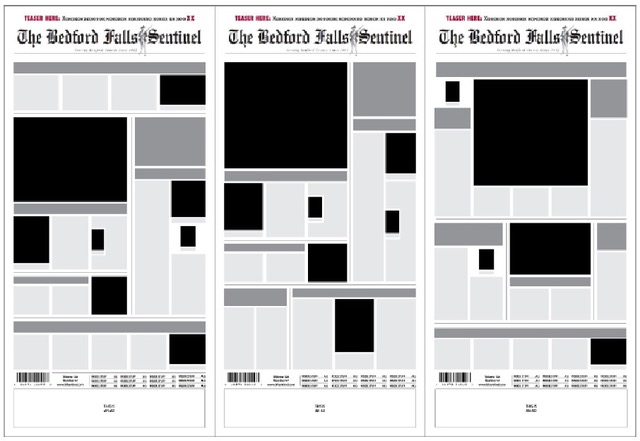
Three different “looks” for your front page. Which would be best for your next issue?
Your plan need not be complex. It need not attempt to answer all the questions. It really can’t. But having a selection of pre-designed models to go from would help.
How about a plan for design consistency? Creating a design style guide’s a good place to start.
Why not take advantage of your software? InDesign style sheets, “next” styles and nested styles can help your consistency and efficiency when designing pages. And InDesign libraries and templates are a gift to designers when they need to place standing design elements into their pages.
It’s not difficult to create a solid design plan. Of course, it takes some time and effort.
John Foust has conducted training programs for thousands of newspaper advertising professionals. Many ad departments are using his training videos to save time and get quick results from in-house training. E-mail for information: john@johnfoust.com
David Ogilvy, one of the legends of the advertising agency business, was known for his extraordinary efficiency. I once read that he would often call a client and set an appointment for eight or twelve or twenty-one minutes of time. When the meeting started, he would place his watch on the table in front of him and finish his presentation at exactly the predetermined time. It was a dramatic and unique way to demonstrate how much he valued time.
Time is one of our most precious commodities. Once this moment is gone, it is gone forever. The best business people – the best sales people – have genuine respect for the other person’s time.
I remember hearing stories about a particular ad manager who could have learned some time management lessons from Ogilvy. She was a notorious time thief.
One of the sales people who worked in her department told me about the time she was supposed to join him in a meeting with a prospective advertiser. “It was going to take about thirty minutes to drive there,” he said. “Like we had planned, I dropped by her office forty minutes before the appointment, because that would give us a good cushion of time to arrive early. She was working at her computer and said, ‘I’ll be ready as soon as I finish this email.’ That took about twenty minutes and put us way behind schedule. Then she stopped in the break room to fill up her fancy stainless steel coffee mug before we left. By the time we got to the prospect’s office, he had been waiting for us for half an hour. I was not surprised when he didn’t buy any advertising.
“That was her pattern of behavior,” he explained. “Everyone on the staff dreaded going to appointments with her. But the bad news didn’t stop with that. When she announced a team meeting, we never knew when she would show up. We’d have to wait there in the conference room, all the time knowing that she was trying to write one more email or make one more phone call before meeting with us. And she never made adjustments to make up for lost time, which threw all of our schedules out of whack for the rest of the day. The irony was that she would make sarcastic and critical remarks if others were late. She showed zero respect for anyone else’s time, which we saw as a sign that she couldn’t care less about other people. We felt like throwing a party when she left the paper to take a job in another industry.”
There we have it: two extreme examples from the advertising business. One from a legendary figure with an exaggerated respect for time. And one from someone whose poor time management skills had a negative impact on everyone around her.
The point of all this is simple: Start on time, stay on track, end on time. Do that and things will run a lot smoother.
(c) Copyright 2018 by John Foust. All rights reserved.
Kevin Slimp is director of the Institute of Newspaper Technology. Email questions to him at kevin@kevinslimp.com.
What are newspaper folks saying about the state of things?
Over the past two weeks, I’ve traveled from coast to coast speaking at newspaper conferences and meeting with Canadian and American journalists about what is happening at their newspapers and, hopefully, offering a little good advice.
As I’ve met with publishers, editors and writers in places like Keene, New Hampshire, Phoenix, Arizona and Bismarck, North Dakota, I’ve become even more convinced that the results of the Newspaper Institute spring publisher’s survey were right on target when it comes to the state of newspapers across the U.S. and Canada.
At newspaper conferences, I often give a “pop quiz” to learn a little about what is going on at newspapers and what journalist think is going on at papers across the country. I used to be surprised that most attendees could guess, with relative success, the answers to the quiz.
For instance, while much of the general public might think most papers are part of large groups, the fact that 51 percent of newspapers are independent and locally owned, doesn’t get past most quiz-takers, and the fact that less than 20 percent of papers are related to large regional or national groups doesn’t surprise too many.
At each recent conference, I’ve taken time to visit with journalists about what is happening at their papers. Just this week in Bismarck, North Dakota, I met with publishers, editors and reporters from more than 20 newspapers in one-on-one meetings.
What did I learn? I learned there are quite a few younger editors and publishers moving up the ranks at newspapers. I learned most newspapers are doing well, and are continually looking for ways to improve their products and serve their communities better.
I met with college and high school newspaper staffs who are excited about their futures in journalism. I met with metro newspaper investigative reporters about how to dig deeper to get better stories. I met with several publishers who were concerned that their readership was rapidly shrinking due to centralized production, meaning their papers are filled with stories from other places that local readers have no interest in reading.
I learned that reporters still struggle with boredom while covering school board, city commission and other meetings that must be attended. I learned there are still a lot of newspapers where one or two people do everything from reporting, designing, selling ads and running the paper.
I learned that print is still king. I’ve learned that the further a newspaper is from its corporate headquarters, the more likely it is that its readership is shrinking rapidly.
Meeting over dinner conversation, I heard many times how hard it is to be a journalist. Hard work and long hours, combined with the wrath of angry readers, requires a special breed. I also learned while many publishers and editors talk about someday moving off to the mountains or beach, in reality they can’t imagine doing anything else.
Yes, journalism is unlike any other career, and newspapers require a special type of journalist. I suppose that’s why I fall in love with every place I go and feel close to so many people I meet.
I recently heard one publisher say, “Journalism is a thankless job.”
I turned to her and said, “Thank you.”
Callings aren’t always easy. Usually, they’re not. But something within continues to drive us, and the world is a better place because of what we do.
I still fall in love with every place I visit. I still meet close friends and make new friends at each conference. I suppose that’s because we’ve heard the same calling.
Ed Henninger is an independent newspaper consultant and the Director of Henninger Consulting. On the web: www.henningerconsulting.com. Phone: 803-325-5252.
Editor Jerry Bellune and I go w-a-y back. We’ve known each other since the mid-90s, when we worked together to breathe new life into a group of newspapers in New Jersey.
Jerry regularly writes a missive to the managers and staff at his newspapers here in South Carolina, and he shares those with me. For my column this month, I’ve decided to pass one of his pieces on to you. It’s bigger than just design — it goes to the heart of what we do for readers.
From Jerry:
WHO DO THINK is our first priority? Our readers, of course, you say. And you are right. Without readers, we are nothing.
Let me share with you a brief newspaper war story. When a smart publisher hired me years ago, he gave me a challenge: “We have a good newspaper for the 1940s,” he said. “But our people have forgotten who they work for – and it isn’t me. Talk with everybody and let me know who mentions our readers first.”
This gave me a chance to talk with people throughout the building. I rode with truck drivers delivering our newspapers in early morning darkness. I talked with more than 100 reporters, editors and photographers. I visited our bureaus and went on calls with our advertising sales people. I asked them what they thought of the paper and what we could do to improve it.
Finally our tough, aging chief photographer said the magic word. “I’ll tell you what’s wrong with this newspaper,” he said bluntly. “Nobody here thinks about or cares about our readers any more.” I could have kissed him.
We have not made this mistake here. All of us care about our readers. But caring for readers means planning, writing, photographing and editing for them. Here are three ways we do that:
In our reporting, we leave no questions unanswered. We think like readers. We gather facts and question sources like readers. Readers want to know the ‘why’ as well as the ‘what’ of news.
We think visually. How can we convey this information visually? we ask. We think about photographs, maps and charts as well as words in our planning. Readers want to see as well as read about the news.
We write short, easy-to-follow stories and sentences. That means 250- to 300-word stories and sentences averaging 15 words. We segment lengthy stories into shorter segments. That helps readers understand what we share with them.
Do we not run longer stories any more? If course we do. Inside feature stories can go 500 to 750 words. We do not continue stories from one page to another as some thoughtless editors do. And this applies to our electronic editions, too.
Readers lead busy lives. They have short attention spans. Let’s make reading our newspapers a pleasure for them.
JERRY BELLUNE has collected tips on editing, reporting and writing that he’s shared with his staff over many years in “The Little Red Book on Writing for Reporters & Editors.” Jerry is looking for suggestions to improve the book. He will send a digital copy to any of my readers who’s willing to read it and make suggestions.
WANT A FREE evaluation of your newspaper’s design? Just contact Ed: edh@henningerconsulting.com | 803-325-5252.
IF THIS COLUMN has been helpful, you may be interested in Ed’s books: Henninger on Design and 101 Henninger Helpful Hints. With the help of Ed’s books, you’ll immediately have a better idea how to design for your readers. Find out more about Henninger on Design and 101 Henninger Helpful Hints by visiting Ed’s web site: www.henningerconsulting.com



 The legal battle between CNN and the White House over the suspension of Jim Acosta’s press credentials is done, at least for now. But it is likely that the larger war—in which NENPA has lined up with other press advocates to ensure fair and open access to press conferences—will continue.








Making the Web, Social Media ‘Better’ Places — with Caution
We’d all like a “better” internet in terms of privacy, politeness, taste and safety. And who would oppose eliminating false or misleading information from social media sites, or preventing online bullying and such?
Last week, some of the world’s most significant, influential and powerful figures around such issues — in the words of The Wall Street Journal, “the giants of the web” — gathered at the 2018 Web Summit in Lisbon, Portugal and in Brussels at an international conference on data privacy and policy.
At the Lisbon meeting, an audience reportedly cheered for a proposed international institute to propose regulations worldwide on social media. United Nations Secretary-General António Guterres warned in a speech that “the weaponization of artificial intelligence is a serious danger” and Microsoft President Brad Smith called for “a digital Geneva Convention” to end state cyberattacks against civilians.
Web inventor Tim Berners-Lee called for private companies, governments and internet users to unite around what he called a “contract for the Web,” a nine-point plan with goals to protect personal privacy, create online methods to counteract harassment and hate speech and for universal access to the web.
In Brussels, Apple CEO Tim Cook advocated for the U.S. to adopt the European Union’s strict data privacy law, enacted in May, allowing consumers to review, edit and delete personal information on the web. Cook warned that technological advances are leading to a “data industrial complex” and that “our own information, from the everyday to the deeply personal, is being weaponized against us with military efficiency.”
So much for the once-hoped for era of “peace, love and harmony” that the World Wide Web was supposed to usher in on behalf of all humanity.
Still, we’ve been here before — and need to keep in mind we’ve overreacted to the threats, real and imagined, posed by new technology before dialing down regulations and codes to a reasonable compromise on free expression, privacy and safety.
Early concerns about privacy noted that the new-fangled telephone could ring into a home at any hour of the day, while proper guests of the day would knock on the door and announce themselves.
Content on radio was relatively unregulated, with government attention directed more to the actual problems with frequencies and interference — until the Communications Act of 1934 gave the Federal Communications Commission power not only to govern the technology but what was said over the airwaves via the so-called “Fairness Doctrine.” Intended to ensure that all voices were heard on public airwaves, the doctrine was abandoned in the 1980s as no longer needed in a world of virtually unlimited cable and satellite channels, but also with the realization that it actually diminished discussion on matters of public interest.
In movies, the “Hays Code” was adopted by Hollywood filmmakers in the early 1930s to head off moves to have Congress set strict standards for what movies could show across a wide range of topics and issues — from comments about the law and drug use to sex and violence. One silly example of the code’s restrictions: Childbirth was considered a “taboo” subject. In the acclaimed film “Gone with the Wind,” as a character was giving birth, actors in the scene could only be shown as shadows on a wall.
The code was on the books for decades but was weakened in the 1940s and 1950s — particularly in 1952 when the U.S. Supreme Court, considering a case involving the movie “The Miracle,” extended First Amendment protections to films.
Likewise in television, the “Television Code” was adopted by the National Association of Broadcasters under threat of a government council to set rules. From 1952 to 1983, the code ruled on everything from how actors dressed to references to religion, sex, family life and more. Famously, the code resulted in married couples shown on TV only using double beds and in 1952, when the star of “I Love Lucy,” Lucille Ball, became pregnant, that word was not permitted — the show was allowed to say only that she was “with child” or “expecting.”
When the sound of a flushing toilet was heard in 1971 in an episode of the groundbreaking sitcom, “All in the Family,” it reflected a growing demand by the public for realism rather than the unrealistic depictions of everyday life that the code had encouraged.
Note that all of those overreactive attempts to regulate came early in the development of those mediums of expression.
The web is barely out of its teenage years, in effect, and social media megaliths such as Facebook and Twitter are even younger. The web’s revolutionizing impact extends from newly accessible public records to instant global communication. And our reliance on social media as a means of reporting news, recording our lives and relaying our views is unlike anything seen in generations, if anything before.
But if history is a guide — and it is — we need to temper calls to “protect” ourselves from that which we do not like or find dangerous, lest we replace such with censored, sanitized and government-regulated messages or content intended to pacify rather than provoke and inform.
There may well be a need to rein in the wild web, to set privacy boundaries and fight real misuse. But we must be certain that the control over what we see, hear, say and access remains as close to our own fingertips as possible — and not handed over to some “National Nanny” claiming to act on our behalf, lest we be confined to a future of shadows on the wall, double beds and a view of life where no one ever uses a toilet.