



New England Newspaper & Press Association
The New England Newspaper & Press Association (NENPA) is the professional trade organization for newspapers in the six New England states: Massachusetts, Connecticut, New Hampshire, Vermont, Maine and Rhode Island.
NENPA is proud to represent and serve more than 450 daily, weekly and specialty newspapers throughout the six-state region.
NENPA is the principal advocate for newspapers in New England, helping them to successfully fulfill their mission to engage and inform the public while navigating and ultimately thriving in today’s evolving media landscape.

Latest eBulletin
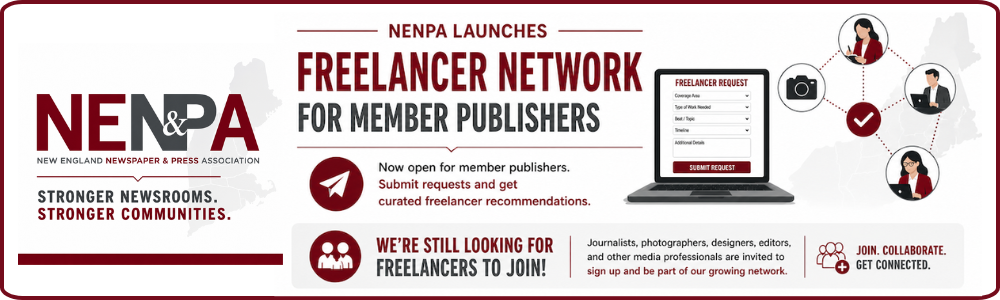
NENPA Freelancer Network to Launch May 15 as New Member Benefit
GBH to merge operations with New England Public Media
Newsroom Spotlight: The Concord Bridge
NENPA Seeks Input from Freelancers to Help Shape New Regional Network
UPCOMING WEBINARS AND EVENTS
News leaders: Join this “ask me anything” to explore how local media are integrating youth voices and needs into daily news and storytelling
The American Press Institute invites local news leaders to an interactive briefing on how dozens of their peers are recognizing young people’s agency, meeting their needs and building affinity to help youth problem-solve personally and engage civically as they grow.
Designed for news leaders, this interactive Zoom meeting will offer insight and space for reflection on how local news can build youth trust by equipping young residents for civic engagement and community leadership.
The American Press Institute regularly convenes leaders working on shared challenges across the local news landscape — issues that affect both their sustainability and their civic impact. In this interactive debrief from a recent summit, API’s summit co-facilitators Senior Vice President Samantha Ragland and Senior Director of Partnerships and Operations Kevin Loker will share what we’ve learned about how local news is building youth trust by redefining youth involvement in local news operations
We’ll share the opportunities for local news to be a force for local youth’s development and ability to thrive, as well as the lived challenges of news leaders passionate about this work.
We’ll pay specific attention to the challenge that local news leaders say they had in serving young people and sustaining youth-focused work. The takeaways, we hope, inspire action you could take in your newsroom to accelerate how local media serves and empowers young people across the country.

Get started with AI in media sales. Learn simple tools, quick wins, and how to boost efficiency, outreach, and results—no expertise needed.
Artificial intelligence is rapidly reshaping the way sales teams operate—and for media organizations, the opportunity is both exciting and overwhelming. If you’ve been wondering where to begin, this session is designed for you.
In this practical, approachable NENPA University webinar, we’ll break down what AI actually means for media sales teams today and how you can start using it right away—without needing to be an expert. We’ll explore the current state of AI adoption among small- to mid-sized organizations and share real-world ways sales teams are beginning to integrate AI into their workflows.
You’ll learn the top four ways AI can support your sales efforts, from improving communication and efficiency to increasing both the quality and quantity of your outreach. We’ll also introduce seven accessible AI tools that can deliver quick wins and measurable ROI, helping you build momentum without overcomplicating your process.
Beyond tools, we’ll focus on strategy—how to start small, scale thoughtfully, and position AI as a teammate rather than a replacement. We’ll also touch on the importance of internal alignment, including building team buy-in, establishing clear policies around AI use, and navigating considerations like ethics and data privacy.
This session is not about having all the answers—it’s about helping you take the first step. Whether you’re AI-curious or ready to experiment, you’ll leave with a clearer understanding of how to begin integrating AI into your media sales approach with confidence.
Jeff Gallop and David Buonfiglio will help you take your first steps with AI in media sales or teach you something you may not have known.
Even if you have incredible findings to report, that might not matter if the data is too complicated — or dull! — to explain. Many of the best ways to report data for audio will translate to print and other media. Learn how to convey complicated data while remaining accurate and holding your audience’s attention.
During this class, you’ll learn:
(1) The basics of data reporting.
(2) The basics of audio reporting.
(3) How to bring the two together — without losing your listeners!
A workshop on care, coaching and connection for post-pandemic news leaders
At its core, trauma-informed leadership recognizes and respects human experiences. Post-pandemic news organizations require us to reorder our skill set, moving “soft” skills to the top. While the soft skills of leadership are hard, API believes these skills will help retain critical perspectives and pivotal voices in news organizations — those from journalists of color and women.
In this self-reflective session — led by Sam Ragland, API’s senior vice president — we’ll check the editing, producing and managing at the (Zoom) door, and instead invite care, coaching and connection to the table. Participants will contribute anonymously to a set of interactive slides and receive real-time coaching and context as their responses come in.
Join this event to:
- Learn a framework for understanding the core needs necessary to support the psychological safety of your team
- Build a 30-day plan that outlines a series of behaviors to practice in order to model the values of either care, coaching or connection
To support journalists and their well-being during Mental Health Awareness Month, API has offered this free, interactive webinar since May 2024. If you attended this session last year and found it helpful, please encourage your colleagues and friends in news to join this year.
This workshop offers a practical introduction to using AI for investigative journalism, focusing on real-world reporting applications. It covers workflows for extracting structure from text, cleaning data, identifying patterns, and checking findings with greater speed and depth, with demonstrations drawn from reporting on audit reports, public budgets, climate spending, and ad library data. It shows how investigative journalists can use AI tools to explore complex information and develop story ideas.
Housing intersects with nearly every major story journalists cover today—from elections and education to health, climate, business, and public safety. Yet many reporters believe housing is a specialized beat or feel unprepared to cover it responsibly.
This session, led by Princeton’s Eviction Lab, is designed for journalists of all beats and experience levels. Whether you’re a breaking news reporter, investigative journalist, data reporter, audience engagement journalist, or editor, we’ll show why housing deserves your attention—and how to cover it well without necessarily becoming a full-time housing reporter.
In this panel, attendees will learn:
- What’s happening nationally in housing and homelessness, including recent shifts in policy, affordability, and displacement—and how these trends connect to electoral politics and local governance.
- Four to five essential data tools every journalist should know to report on housing, eviction, rent, and homelessness, with a practical introduction to accessible resources and datasets.
- How to find housing stories in any community, including tips for identifying newsworthy angles beyond press releases and official statements.
- Ethical sourcing practices, with guidance on interviewing tenants and unhoused people in ways that minimize harm and avoid stigma.
- Examples of strong housing journalism, highlighting work that has driven accountability, influenced policy, or changed public understanding.
- Attendees will leave with concrete tools, story ideas, and a clearer sense of how housing reporting can strengthen their core beat—no matter what they usually cover.