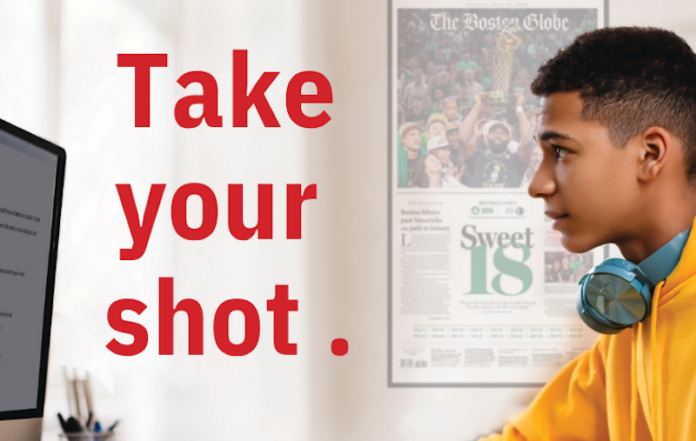
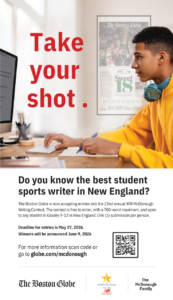
The Boston Globe is now administering the annual Will McDonough Sports Writing Contest, a long-running New England competition previously managed by The Sports Museum for more than 20 years. The contest is free to enter and open to high school students in grades 9–12 throughout New England.
Students are invited to submit one original piece of sports writing. Entries will be judged on writing quality, reporting, use of journalism principles, and the ability to engage readers with sports as a central element of the story.
To participate, a parent or guardian (18+) must first complete the required information form before students email their submission.
The deadline to enter is May 27, 2026. Winners will be announced on June 9, 2026.
The New England Newspaper & Press Association has officially launched its new Freelancer Network, a developing initiative designed to help connect NENPA member publishers with freelance journalists, writers, photographers, designers, and other newsroom professionals across New England.
The project was created in response to ongoing staffing challenges, changing newsroom needs, and growing interest from freelance journalists looking to build stronger relationships with local and regional news organizations. Over the past several weeks, freelancers from across the region have submitted information through NENPA’s intake form, creating an internal database that includes reporting specialties, geographic coverage areas, experience levels, and work samples.
NENPA member publishers can now begin submitting freelancer requests directly to the association. Publishers can request recommendations based on specific newsroom needs, including coverage areas, beats, content production, photography, design, audience engagement, copy editing, and other freelance support.
Rather than operating as a public directory, the service is designed as a managed matching network. NENPA staff will review requests and provide curated freelancer recommendations based on the needs of each publication.
The initiative is intended to support both immediate assignment needs and longer-term newsroom relationships, while also helping freelance journalists gain greater visibility within New England’s local news ecosystem.
Freelancers interested in joining the network can still complete the intake form, and publishers are encouraged to reach out as staffing or project needs arise.
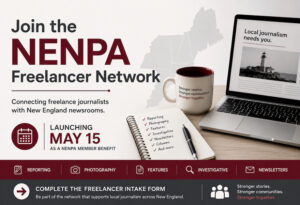
The New England Newspaper & Press Association (NENPA) will officially launch the NENPA Freelancer Network on May 15 as a new member benefit designed to help connect freelance journalists with publishers and news organizations across New England.
The NENPA Freelancer Network is being developed as a centralized freelancer database that will allow NENPA to help facilitate connections between member news organizations and freelance journalists seeking paid assignments, ongoing newsroom relationships, and opportunities to expand the reach of their work.
Freelance journalists, independent writers, photographers, newsletter creators, and other newsroom professionals are encouraged to complete the NENPA Freelancer Intake Form ahead of the launch. The intake form gathers information about coverage areas, experience, availability, formats, rates, and assignment interests to help NENPA make informed matches between freelancers and participating news organizations.
The network is intended to support a wide range of newsroom needs, including reporting, photography, newsletter support, feature writing, investigative projects, and other editorial work. Freelancers who complete the intake form may be contacted by editors, publishers, or hiring managers from participating news organizations across the region.
NENPA is also continuing to gather input from publishers and newsroom leaders about current coverage needs, staffing gaps, and areas where freelance support may be beneficial.
The intake form also includes optional questions related to a potential shared publishing model that could help freelancers distribute recurring content, columns, newsletters, and other work across multiple news organizations.
While NENPA will work to facilitate meaningful connections between freelancers and publishers, participation in the network does not guarantee assignments or employment opportunities.
After seven years of collaboration, GBH and New England Public Media are planning to formally merge by the summer of 2026, creating a statewide media organization expected to reach more than 1.3 million people across Massachusetts every week.
“This is all about preserving local news,” GBH President and CEO Susan Goldberg said in an interview. “So at a time when local news is endangered coast to coast, at a time when more than $1.1 billion has been taken away from local public media, what we’re doing by this is figuring out: How do we be as efficient as we can to make sure we preserve the most important things … we do? And local news, in terms of a forward- facing operation, is one of the most important things we do.
“This is about, How do we make sure those great stories in western Massachusetts have more scale and have more audience and can be seen by more people across the state?” Goldberg added. “The same is true with WCAI.”
New England Public Media, or NEPM, was created in 2019 as an affiliation between three entities: the GBH-owned television station WGBY; New England Public Radio, which was operating the station WFCR in Springfield for the University of Massachusetts; and UMass.
GBH technically took ownership of NEPM, but NEPM was constituted as its own nonprofit with its own fiduciary board and largely operated independently, even as GBH ran its human resources and finance operations.
Now, Goldberg said, the merger will result in even more collaboration in areas like sponsorships and public events, as well as cost-saving efficiencies stemming from consolidation. For example, NEPM and GBH will now be audited together rather than separately, and will file taxes as one entity rather than two. According to Goldberg, the merger could also result in a net reduction in member fees paid to PBS and NPR for national programming.
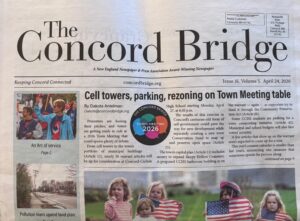
The Concord Bridge has quickly established itself as a vital source of local news, filling a critical gap in what had become a news desert. With a clear mission and a disciplined approach to coverage, the newsroom has focused on delivering consistent, community-centered journalism while building meaningful connections with its audience.
Launched with the goal of restoring reliable local reporting, the Bridge has leaned into a simple but powerful idea: cover the community deeply, consistently, and with purpose. That focus has helped the publication gain traction in a relatively short period of time, proving that even in challenging environments, there is strong demand for trustworthy local news.
A key part of that success has been the newsroom’s ability to identify stories that matter—and to stay with them. One example is its reporting on local shelter conditions, which began as a routine inquiry but evolved into a deeper investigation with real community impact. By following the story beyond the initial headline and continuing to ask questions, the newsroom demonstrated the kind of accountability journalism that builds credibility and trust.
The Bridge has also shown a willingness to experiment with how it delivers news. During local elections, the team introduced live blogging as a way to provide real-time updates and keep readers engaged throughout the day. The approach not only increased audience interaction but also created a more dynamic, responsive news experience—one that met readers where they were and how they consume information today.
Underlying all of this is a strong connection to the community. The newsroom’s work reflects a clear understanding of its audience and a commitment to serving their needs—whether through daily reporting, deeper enterprise stories, or new formats designed to increase accessibility and engagement.
Through smart editorial strategy, thoughtful audience engagement, and a willingness to adapt, the Concord Bridge has created a model that offers valuable lessons for other newsrooms navigating similar challenges. That work has not gone unnoticed. They have earned numerous awards already, but the real measure of success is the publication’s impact: restoring access to reliable local reporting and strengthening the connection between a community and its news.
📊 Snapshot
Publication Name: The Concord Bridge Location: Concord, MA Website: concordbridge.org Founded: 2022 Leadership: Maile Hulihan, CEO, Celeste Katz Marston, Editor-in-Chief Model: Nonprofit Type: Free weekly print + daily digital publication Frequency: Weekly (web updated daily) Distribution: Free to ~8,700 households and businesses Staff Size: Under 10, cross-trained team Mission: A nonpartisan, nonprofit newspaper of record serving the Concord community
“We’re a weekly newspaper that acts like a daily.” – Celeste Katz Marston
🧭 Editorial Approach
The Concord Bridge is intentionally hyperlocal—focusing on the issues that directly impact residents.
Key focus areas:
Local government and accountability reporting
Schools and education
High school sports and community life
Major town events and civic issues
Notably not covered:
National politics (except when there is a direct local impact)
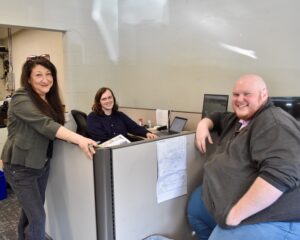
Editor-in-Chief, Celeste Katz Marston works in the office closely with reporters Dakota Antelman (left) and Trace Salzbrenner (right).
🎯 What’s Working
Live coverage of town meetings and major events
Strong visual storytelling and design
Highly engaged letters to the editor section
Community contributors, including student correspondents
💰 Revenue Model
~60% donor-supported
Advertising, obituaries, and legal notices
Custom publishing
Sponsorship
🎨 Visual & Audience Strategy
Heavy use of photography and thoughtful layout
Photo essays and strong front-page visuals
Social media engagement driven by imagery
🤝 Community Engagement
Active social media interaction
Community events and presentations
Direct outreach (including phone calls with readers)
🧨 Impact Journalism
Shelter investigation → halted unsafe placements
Election coverage → increased turnout
Consistent coverage of difficult, high-impact issues
⚙️ Operations & Workflow
Small, collaborative, cross-trained team
Structured editorial workflow and regular news meetings in office
Tools: Slack, Google Drive, social platforms
🚧 Challenges
Scaling with a small team
Building sustainable revenue
Managing high expectations
What we’re exploring
Events
Membership
Merchandising
💡 Advice & Opportunities
Try this: Invest in visuals, design, and live blogging capabilities; it drives engagement.
Avoid this: Trying to cover everything.
Big opportunity: Events and further developing a member model for community-supported local news.
Stickers were used to designate supporter levels in the first round of a member support campaign.
🏆 NENPA Recognition
The Concord Bridge’s work has also been recognized across the region, earning multiple honors in the 2025 New England Better Newspaper Competition, along with top awards in the fall.
At the 2025 Fall Awards Program, CEO Maile Hulihan was honored with the Cornerstone Award, recognizing her leadership and contributions to local journalism, and The Concord Bridge won a Publick Occurrences Award for “Milestone 250.”
In the Better Newspaper Competition, The Concord Bridge received multiple First Place awards, including:
Our First Small-Donor Fundraising Campaign (Staff & Board)
Fire! (Photography, Ken McGagh)
A Patriot’s Day (Rob Reinalda)
‘Minute Man’ marks 150th birthday… (Laurie O’Neill)
Milestone 250 LIVE (Staff)
On Walden Pond (Ken McGagh)
Additional honors included:
Second Place:Concord Election 2025 (Dakota Antelman), One if by lamb… (Rob Reinalda), Time Outdoors (Wilson Kerr)
Third Place:Emergency Shelter Conditions (Dakota Antelman), Patriots Day 2025 (Ken McGagh), ‘He’s experienced our lives with us’ (Margaret Carroll-Bergman)
Judges highlighted the newsroom’s persistent reporting, strong visual storytelling, and ability to drive real community impact—particularly in coverage that prompted action and helped inform voters during a contentious local election.
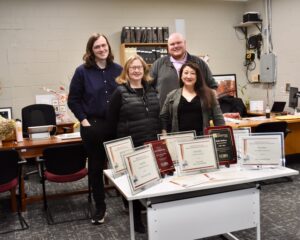
Some of the staff of The Concord Bridge pictured with their 2025 New England Better Newspaper awards.
⭐ Best Quote
“We talk a lot about revealing Concord to itself because we’re not shying away from things that are different from how people would like it to be.” – Maile Hulihan
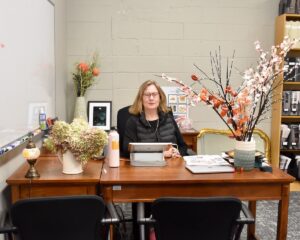
CEO Maile Hulihan, came out of retirement to head the team at The Concord Bridge. Hulihan was the 2025 NENPA Cornerstone Award recipient. She will be retiring in June.
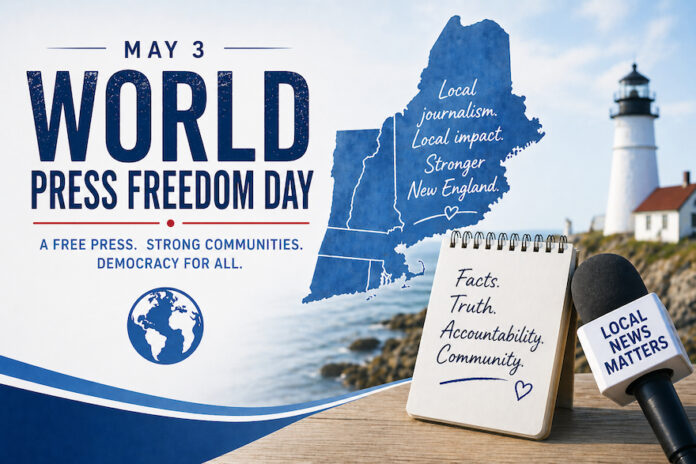
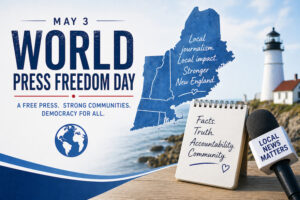
Each year on May 3, news organizations, journalists, and advocates around the world mark World Press Freedom Day, a recognition established by the United Nations General Assembly in December 1993 to affirm the fundamental importance of a free and independent press.
While the day is global in scope, its meaning is deeply local.
In New England, where community newsrooms serve as the backbone of civic life, press freedom is not an abstract principle—it’s a daily responsibility. From covering town meetings and school committees to investigating issues that hold local institutions accountable, journalists across the region are doing essential work that directly impacts the communities they serve.
This year’s World Press Freedom Day 2026 Global Conference, taking place in Lusaka, Zambia, highlights the growing intersection of journalism, technology, civic space, and human rights. The hybrid international gathering will bring together journalists, digital rights advocates, policymakers, educators, and technologists to explore how these forces are reshaping the information ecosystem—and what it will take to protect it moving forward.
That conversation resonates strongly here at home.
New England newsrooms are navigating many of the same challenges reflected on the global stage: adapting to rapid technological change, addressing misinformation, building sustainable business models, and maintaining public trust. The rise of artificial intelligence, evolving audience behaviors, and economic pressures are all influencing how journalism is produced and consumed.
At the same time, local journalists continue to face pressures that underscore the importance of press freedom protections—whether it’s access to public records, transparency from government officials, or the ability to report without interference.
World Press Freedom Day offers an opportunity not only to reflect on these challenges, but also to recognize the resilience and dedication of journalists across our region. It’s a moment to reaffirm our collective commitment to independent reporting, ethical standards, and the public’s right to know.
At NENPA, that commitment extends beyond a single day. Through advocacy, training, collaboration, and initiatives like the Know Your News campaign, we continue working to support and strengthen local journalism across New England.
On May 3, we join the global community in recognizing the essential role of a free press—and we celebrate the journalists in our own communities who make that freedom meaningful every day.
The New England Newspaper & Press Association is inviting freelance journalists, independent writers, and newsroom professionals across New England to share information about their experience, interests, and availability as part of a new initiative to strengthen connections between freelancers and newsrooms.
As the local news landscape continues to evolve, many freelancers are navigating a mix of opportunities, challenges, and changing expectations around how they work and where their reporting appears. Through this effort, NENPA is gathering input directly from freelancers to better understand areas of expertise, the types of assignments they are seeking, their availability, and their expectations around compensation and working relationships.
The information collected will help inform the development of a centralized freelancer network designed to connect journalists with editors and publishers across the region in a more consistent and effective way. By building this resource with direct input from freelancers, NENPA aims to ensure that it reflects the needs and priorities of the journalists it is designed to support.
Freelancers are encouraged to complete a short survey, which takes approximately 5–7 minutes. In addition to questions about coverage areas, experience, and rates, the survey also includes optional questions about interest in a potential shared publishing model. This concept would allow journalists to distribute content across multiple outlets, offering an opportunity to expand reach—particularly for those producing recurring columns, newsletters, or feature work.
NENPA is also continuing to gather input from publishers and newsroom leaders about their current coverage needs and staffing challenges. If you have not yet completed the newsroom needs survey, your participation is encouraged. Feedback from publishers will help ensure that the freelancer network is aligned with real-world newsroom needs and supports meaningful, productive connections between journalists and news organizations.
The information gathered through these surveys will guide the development of a more connected and responsive system for linking freelancers with opportunities across New England. While participation does not guarantee assignments, it will play an important role in shaping a network designed to better support both journalists and the newsrooms they serve.
NENPA remains committed to strengthening local journalism across the region, and this initiative represents an important step toward building a more collaborative and sustainable future for freelancers and news organizations alike.
This April, we’re proud to welcome a new group of members to the New England Newspaper & Press Association community. Each brings a strong commitment to local journalism and the communities they serve, reinforcing the vital role of independent news across our region.
Please join us in welcoming:
The Belmont Voice – A nonprofit weekly and online publication dedicated to covering the stories that matter most to Belmont residents.
Carlisle Mosquito – A trusted nonprofit weekly and digital news source focused on community-driven reporting in Carlisle.
James G. Neuger – Joining as an Associate Member, bringing valuable photography experience and perspective to the NENPA network.
From hyperlocal reporting to broader industry insight, these new members reflect the strength, diversity, and resilience of New England journalism today.
We’re excited to have them as part of NENPA and look forward to supporting their work, fostering connections, and continuing to build a strong future for local news—together.
Jim Pumarlo is a former editor of the Red Wing (Minn.) Republican Eagle. He writes, speaks, and provides training on community newsroom success strategies. He is the author of “Journalism Primer: A Guide to Community News Coverage,” “Votes and Quotes: A Guide to Outstanding Election Coverage,” and “Bad News and Good Judgment: A Guide to Reporting on Sensitive Issues in Small-Town Newspapers.” He can be reached and welcomes comments and questions at jim@pumarlo.com.
Election season is underway. Many would say the cycle never ends. No sooner are votes tallied than strategists eye the next election. Make no mistake, many lawmakers routinely cast votes with one eye on policy and one eye on politics, especially if they are in swing districts.
Office-holders are scrutinized more than ever in today’s political dynamics. In turn, media are under the microscope.
The scope of coverage will vary by newspaper and community. Election season strains newsrooms already strapped for resources. Consider these starting points:
First, keep the focus local. Do what you know best and do what no one else is doing for your readers.
Second, introduce yourselves early to candidates. Promote the roles of both the news and advertising departments.
I place public affairs coverage at the heart of a newspaper’s responsibilities. In that sphere, nothing is more important than the selection of candidates who will shape policies affecting readers’ everyday lives.
Think about your bread and butter. What’s more likely to receive a front-page headline: An action in Washington, D.C., or at the State Capitol, or a debate at a packed meeting of the city council, school board, or county board?
I don’t suggest ignoring the more expansive conversations. Elections in Minnesota got much more interesting with the decision of Gov. Tim Walz not to seek a third term. The ripple effect will likely reach legislative races and even local contests, raising issues that warrant attention.
The increasingly caustic political environment at national and state levels has negatively influenced local political discourse, which has made some newspapers more cautious about giving space to broader topics. That makes it all the more important to shed light on local topics and candidates, offering a trusted voice to navigate the chaos of social media. And, when appropriate, to filter national and state issues for messages relevant to your communities.
The first step is to commit to comprehensive election coverage. The second step – carrying out that pledge – may prove difficult despite best intentions. Publishers more and more are frustrated with candidates and campaigns that simply refuge to engage with the newspaper, even declining to complete basic questionnaires. Even more annoying is the growing loss of advertising dollars.
Your best offense is to get in front of candidates early. Individuals seeking elective office are applying for a job. They must convince their bosses – the electorate – that they are the most qualified to effectively advance constituent interests. You are in an excellent position to help present that information in the clearest and most meaningful manner.
Start by writing a welcome letter congratulating candidates on their decision to seek elective office, for giving their time and talent to make the community a better place to live. Include answers to the most frequently asked questions about newspaper policies and operations. Follow up with a face-to-face meeting to communicate editorial procedures as well as advertising opportunities. It’s ideal to have separate conversations. In all cases, make clear the distinction between news and advertising departments.
Then underscore this is the candidate’s opportunity to be introduced to constituents, to state positions on priority issues.If you can’t interview them – if they won’t give you access, it is fair game to interview associates, supporters and others. Campaigns need treasurers. That can be a place to start.
On that front, publishers often bemoan the lack of political advertising, especially in local races. But how many newspapers develop and approach candidates with an advertising campaign similar to welcoming a new merchant in town? Many individuals are novices to the political arena. Seize the opportunity to be a key adviser in spreading their messages.
A final note: Communicate. I’m a firm believer in explaining newspaper operations and policies and wrote a weekly column while sitting behind the editor’s desk. Election season provides ample fodder on a variety of fronts. Some columns can be written each election cycle and can be preemptive on questions that inevitably will be raised.
Election coverage is one of the most exhaustive and scrutinized tasks facing newsrooms. At the same time, reporting on candidates and campaigns is themost fundamental element of a newspaper’s service to democracy in action. Solid reporting helps voters elect better people to make decisions on their behalf.
Newspapers should use their community knowledge to deliver an inside look at candidates and set a framework for constructive debate. The rewards are to all involved, from candidates and the voters to your community and your newspaper.
John Foust has conducted training programs for thousands of newspaper advertising professionals. Many ad departments are using his training DVDs to save time and get quick results from in-house training. Email for information: john@johnfoust.com
A quick study of billboards can give us a better understanding of what works best in advertising. Because motorists are on the move, billboards have just a few seconds to be seen and read. It’s the same with printed pages and digital screens – readers have only a moment to notice an ad, as they pass. That’s why the best messages have a “billboard effect.” They stand out at a glance.
One of the best billboards I’ve seen was on Interstate 95 in South Carolina. Beside the bridge over Lake Marion, there was a large sign featuring an illustration of a striped bass which stretched nearly from border-to-border, big as a whale. The picture appeared against a clean background, with the headline, “Not quite actual size.” The Santee Cooper logo was at the bottom.
Santee Cooper is the state-owned electric and water utility which provides hydroelectric power from the Santee and Cooper rivers. The company created Lake Marion and Lake Moultrie, which are well-known for fishing and outdoor recreation. Their sign beside I-95 was nearly impossible to miss.
Compare that sign to another one I remember. It was so bad that I stopped to count the words – 48 in all, along with two logos, one web site listing, two sets of directions and no illustration. The billboard was promoting a restaurant, although the only people who knew it was a restaurant were probably the owners of the restaurant and the folks who put up the sign.
Two billboards, opposite impact. How would those same ads look on a newspaper page or web site? Likely the same as on the roadside. One would work and one wouldn’t. The striped bass would leap off the page and the screen. And the restaurant ad would fade into the background.
Let’s take a look at what goes into the billboard effect:
Large graphic hook. Every ad – large or small – can benefit from a graphic hook. Like the fish which took up the majority of space, any advertiser can feature a large single graphic in their ads. There’s nothing wrong with having several pictures in an ad, just make sure one is considerably larger than the others.
If there’s no illustration, turn the headline into a graphic hook – with large, bold typography.
Clean background. White space will never go out of style. In addition to making the information which appears on that white space more noticeable and readable, it provides breathing room between the ad elements and the border.
Many powerful ads have more white space than “ink” space. White space is like a beacon which says, “Hey, this is important.”
Simple headline. While billboard copy should be limited to a short and bold headline, most print and digital ads have accompanying body copy. In either case, the headline should be easy to read at a glance.
Turning the pages of a newspaper is like driving on the highway. Ads go by so quickly that it’s a challenge to grab attention before readers have moved on.
(c) Copyright 2026 by John Foust. All rights reserved.
 The Boston Globe is now administering the annual Will McDonough Sports Writing Contest, a long-running New England competition previously managed by The Sports Museum for more than 20 years. The contest is free to enter and open to high school students in grades 9–12 throughout New England.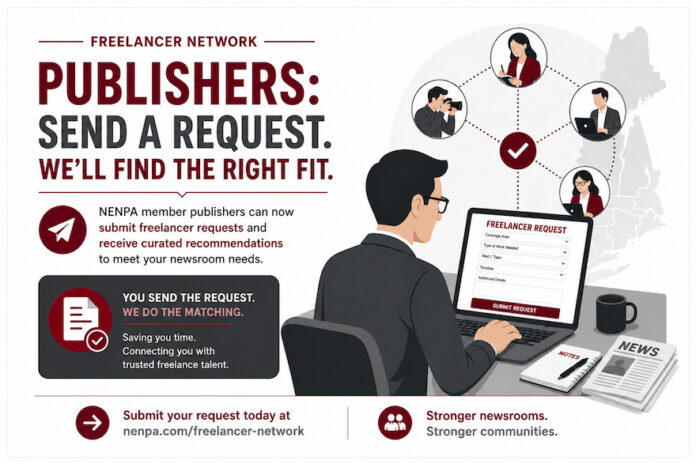
 The New England Newspaper & Press Association has officially launched its new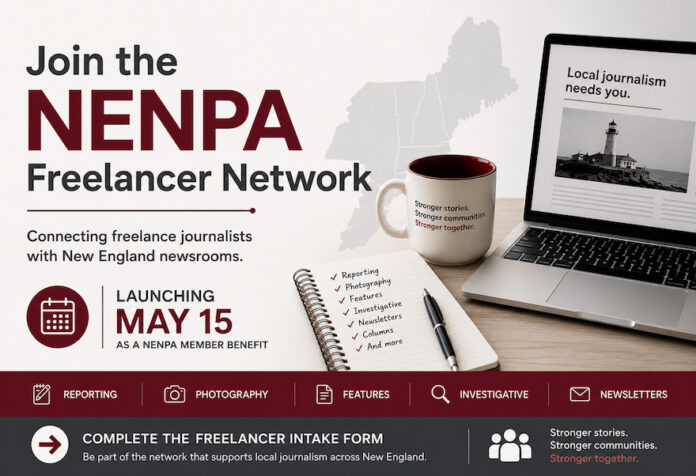
 The New England Newspaper & Press Association (NENPA) will officially launch the NENPA Freelancer Network on May 15 as a new member benefit designed to help connect freelance journalists with publishers and news organizations across New England.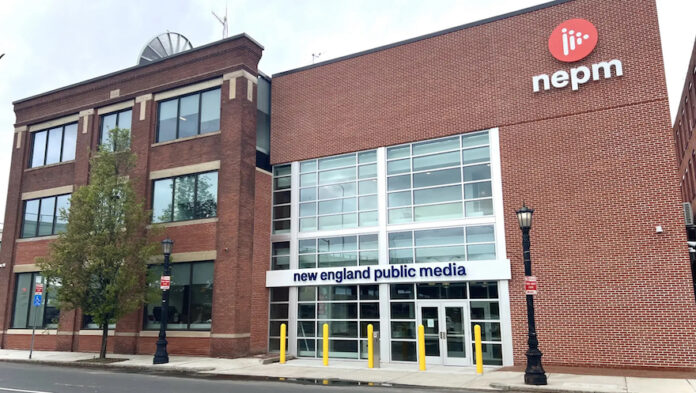
 After seven years of collaboration, GBH and New England Public Media are planning to formally merge by the summer of 2026, creating a statewide media organization expected to reach more than 1.3 million people across Massachusetts every week.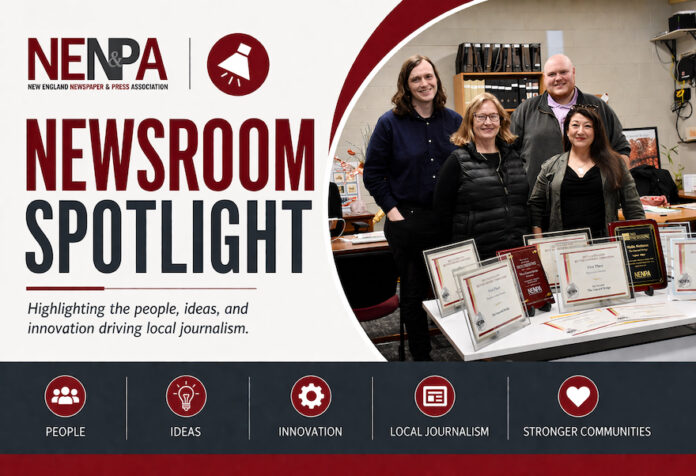
 What we’re exploring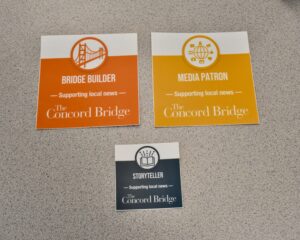
 Each year on May 3, news organizations, journalists, and advocates around the world mark World Press Freedom Day, a recognition established by the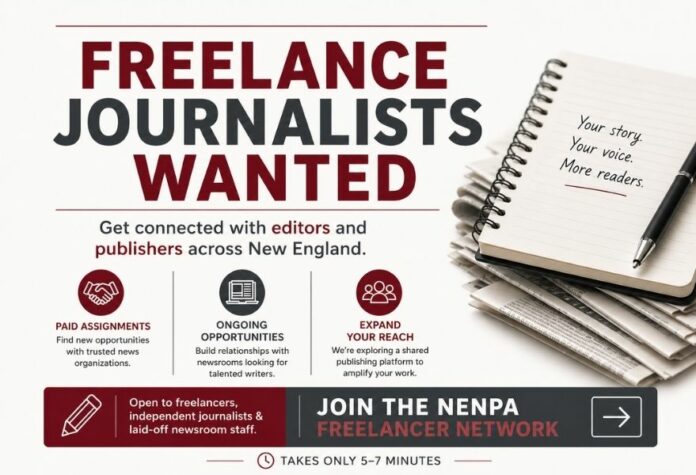
 The New England Newspaper & Press Association is inviting freelance journalists, independent writers, and newsroom professionals across New England to share information about their experience, interests, and availability as part of a new initiative to strengthen connections between freelancers and newsrooms.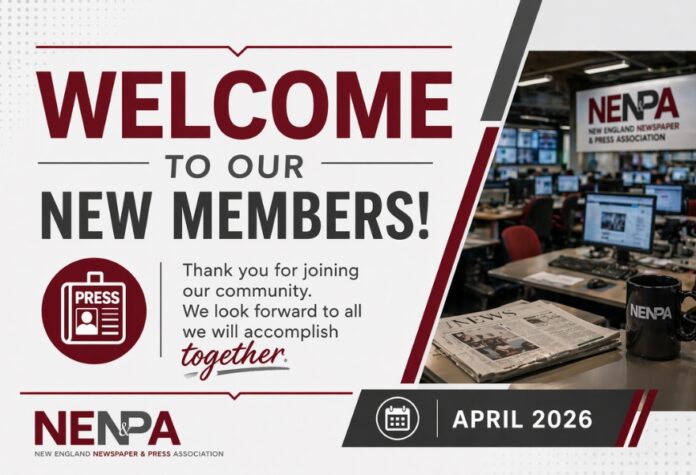
 This April, we’re proud to welcome a new group of members to the New England Newspaper & Press Association community. Each brings a strong commitment to local journalism and the communities they serve, reinforcing the vital role of independent news across our region.