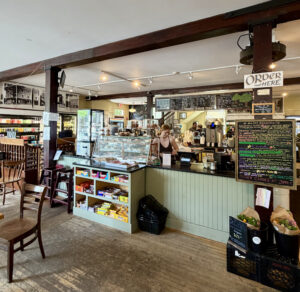
Tucked above the General Store in the center of Harvard, Massachusetts, The Harvard Press operates from the literal heart of the community it covers.
Founded in 2006 after the decline and eventual closure of the town’s former newspaper, the independently owned weekly was created by residents determined to preserve strong local journalism in Harvard.
Today, nearly two decades later, the paper remains deeply woven into community life — covering local government, schools, development, and civic issues while building unusually strong reader support and engagement. At the 2020 Town Meeting, during the height of the pandemic, the paper was named “2019 Citizen of Note.” The award is given each year by the Select Board to an outstanding Harvard citizen or organization.
The support by the community extends beyond subscriptions. The newspaper currently operates rent-free from the third floor of the General Store thanks to the generosity of the building’s owners, a reflection of how strongly the community values the paper’s presence in town.
During NENPA’s visit, one theme emerged repeatedly: The Harvard Press is not simply producing a newspaper — it is actively sustaining civic life in the community it serves.
📊 Snapshot
Founded: 2006 Location: Harvard, Massachusetts Publication Type: Weekly community newspaper Coverage Area: Harvard and surrounding regional issues impacting the town Ownership Model: Independent / locally operated Distribution: Paid subscription model reaching roughly two-thirds of local households Editorial Focus: Hyperlocal news, town government, schools, features, community life, photography Staff Structure: Small core staff supported by freelancers, hourly contributors, and community reporters
✍️ Editorial Approach
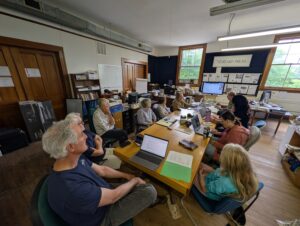
The Harvard Press staff gathers every Thursday morning for editorial and newsroom planning meetings to organize coverage and begin producing the next issue.
“We have three priorities,” Editor John Osborn explained during NENPA’s visit. “First is covering the news. Second is community building. Third is training.”
Approximately 99% of the paper’s coverage is focused specifically on Harvard itself. The newsroom intentionally avoids national coverage and only reports on regional or state issues when they directly affect the community.
Town meeting coverage remains one of the publication’s signature strengths.
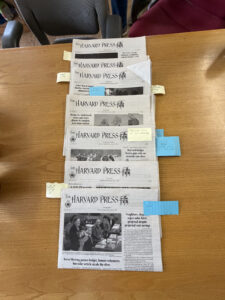
Each year, The Harvard Press publishes detailed “warrant in plain English” explainers that translate complicated municipal language into accessible reporting residents can actually understand before voting.
“People come to the meeting with our paper,” Osborn said. “If they forgot it, they’ll ask for another copy so they can sit there and read the paper while they’re voting.”
The newsroom also works intentionally to balance hard news with features, photography, and community storytelling in every issue.
✅ What’s Working
The Harvard Press provides extensive coverage of local government and Town Meeting issues, helping residents understand complex topics such as the town budget before casting their votes.
Several strategies are helping The Harvard Press maintain strong community trust and support:
Hyperlocal reporting focused almost entirely on Harvard
Deep town meeting and civic coverage
Strong photography and feature storytelling
Community engagement events and reader surveys
A highly successful sustaining subscriber program
Community contributor and citizen journalist training
Consistent weekly editorial planning and workflow systems
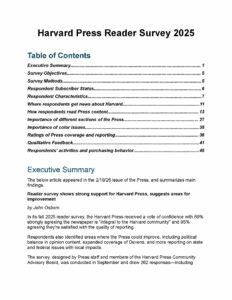
The newsroom also noted that readers consistently expressed strong trust in the publication during a recent audience survey that generated more than 200 responses.
“People really, really trust us and value us,” shared co-owner Sue Robbins.
💰 Revenue Model
The Harvard Press currently operates with revenue split roughly between advertising and circulation, supplemented by donations and fundraising initiatives.
One of the paper’s most successful efforts has been its sustaining subscriber program, where readers voluntarily pay approximately double the standard subscription rate to provide additional support for the newspaper.
“We have 400 sustaining subscribers,” explained Lisa Aciukewicz, publisher and co-owner. “We are so supported by this town.”
The newsroom also accepts donations through nonprofit partnership arrangements and recently joined the Report for America Accelerator program to help explore long-term sustainability strategies.
Online advertising is intentionally limited to local businesses in order to preserve the paper’s intensely local identity and reader experience.
“I think we realize the strength of our product is tied to how local we keep it,” Aciukewicz explained.
🤝 Community Engagement
The Harvard Press’s first reader survey in 2025 was a resounding success, drawing responses from more than 200 residents and generating overwhelmingly positive feedback.
Community engagement is deeply integrated into the newsroom’s culture.
The Harvard Press regularly:
Co-sponsors election forums with the League of Women Voters
Hosts “Coffee with the Editor” conversations
Encourages reader letters and feedback
Started conducting audience surveys in 2025
Maintains a community advisory board
Recruits and trains new contributors from within the community
Earlier this year, the newsroom launched a large recruitment campaign using postcards, banners, and community outreach to attract new contributors.
The effort brought approximately 30 residents to an initial information session.
“We got like 30 people at that first meeting,” Osborn recalled. “And then we whittle it down and train them.”
⚙️ Operations & Workflow
Despite its small size, the newsroom operates with highly structured systems and routines.
Every Thursday morning after the paper goes to print, staff gather for editorial and newsroom planning meetings to organize the next issue.
A shared Google Sheet tracks:
Story assignments
Photos
Ad volume
Deadlines
Page budgets
Production status
“We couldn’t do it without ‘the spreadsheet’,” joked managing editor, Valerie Hurley.
🎓 Training & Community Contributors
Training has become one of the newsroom’s defining priorities.
Because the paper operates with a small staff, The Harvard Press has built an internal pipeline for training community reporters and contributors.
Osborn has led workshops teaching residents how to interview, report, and write stories, while the newsroom has also worked extensively with local students interested in journalism.
Several former student participants have gone on to careers at major news organizations, including The Boston Globe and The New York Times.
The newsroom also developed programs like “Report for Harvard,” which paired local students with community members to produce stories highlighting unsung contributors throughout town.
⚠️ Challenges
Like many local news organizations, The Harvard Press faces ongoing sustainability and staffing challenges.
Leadership spoke candidly about:
Retaining younger journalists
Aging newsroom leadership
Limited financial resources
The difficulty of balancing journalism with personal financial realities
The broader economics of local news
“It’s that broken economics of local journalism,” Aciukewicz said. “Somebody’s got to solve it.”
Staff also noted that many contributors dedicate far more time and energy to the paper than their compensation reflects.
🔍 What They’re Exploring
Current areas of experimentation and growth include:
A major website redesign that will eventually introduce a paywall, digital subscriptions, and more frequent online updates.
Expanded fundraising and nonprofit partnerships
Report for America Accelerator participation
Additional community contributor training
Potential newsletter development
More frequent digital publishing workflows
Leadership hopes these efforts will help strengthen long-term sustainability while maintaining the publication’s local focus and identity.
💡 Advice & Opportunities for Other Newsrooms
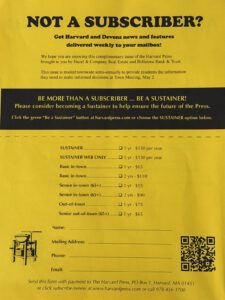
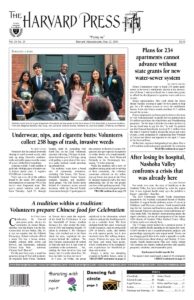
This insert was included in The Harvard Press’s annual Town Meeting issue, which is mailed to every household in town. The piece encourages readers to support local journalism through subscriptions, donations, and sustaining memberships.
The Harvard Press shared several strategies other community newspapers may want to explore:
Sustaining Subscriber Programs
The newsroom strongly recommends offering readers an option to financially support local journalism beyond standard subscription pricing.
“If you’re not doing that, that is the lowest hanging fruit,” Aciukewicz said.
Town Meeting Coverage
The paper mails expanded town meeting coverage to every household — including non-subscribers — helping drive civic engagement, subscriptions, and advertising revenue.
Community Training
Building pipelines for local contributors and citizen journalists can help small newsrooms expand coverage while strengthening community ties.
Reader Surveys
The newsroom found audience surveys extremely valuable for understanding reader priorities and building trust.
🏆 NENPA Recognition
The Harvard Press’s commitment to local journalism was recognized in the 2025 New England Better Newspaper Competition, where the newsroom earned multiple awards across opinion writing, public service reporting, photography, and overall excellence.
The paper received First Place for General Excellence, one of the competition’s highest honors, recognizing the overall quality of the publication. The newsroom also earned First Place for Invisible Hunger: How Loaves & Fishes is Feeding Families in Need by Julie Gowel and First Place for Heidi Gomez’s commentary, Dissed-abled: Wheelchair Users Need Equality of Access and Opportunity, which judges praised as “a real public service.”
Coverage of the closure of Nashoba Valley Medical Center earned Second Place, with judges noting the series documented not only the loss of a community hospital but the broader impact on residents, emergency services, and regional health care access. The paper also received Second Place for Jen Manell’s photograph Booksale.
For the staff, awards serve as more than recognition—they validate the work of a small newsroom committed to serving its community.
For the staff, the recognition serves as both validation and motivation.
“We can’t pay people what larger organizations can,” Aciukewicz explained. “So for them to win an award is huge.”
The awards also reinforce community trust and credibility within the town.
🔮 Looking Ahead
Located on the third floor of Harvard’s General Store, The Harvard Press operates from the heart of the community it serves. The building’s first floor houses a café and market, while the second floor provides shared workspace for residents and visitors, making it an ideal home for a hyperlocal newspaper.
What stood out most during NENPA’s visit was the extraordinary dedication of the people producing the paper.
Staff members routinely contribute far beyond what their compensation would suggest, driven by a belief that strong local journalism remains essential to the health of the community.
That belief is reflected in the support surrounding them.
When the General Store building housing the newsroom was sold last year, staff feared they might lose their longtime office space. Instead, the new owners chose to continue offering the paper free rent — another reminder of how deeply embedded The Harvard Press has become in the life of the town.
In many ways, The Harvard Press represents both the challenges and possibilities facing small local newspapers today: limited resources, constant experimentation, uncertain economics — but also extraordinary trust, civic value, and community support.
⭐ Best Quote
The Harvard Press leadership team includes (from left): Lisa Aciukewicz, co-owner; John Osborn, editor-in-chief; Sue Robbins, co-owner; and Valerie Hurley, managing editor.
“We have three priorities: covering the news, community building, and training.” — John Osborn, Editor, The Harvard Press

 Tucked above the General Store in the center of Harvard, Massachusetts, The Harvard Press operates from the literal heart of the community it covers.
 Founded: 2006