
Celebration time!
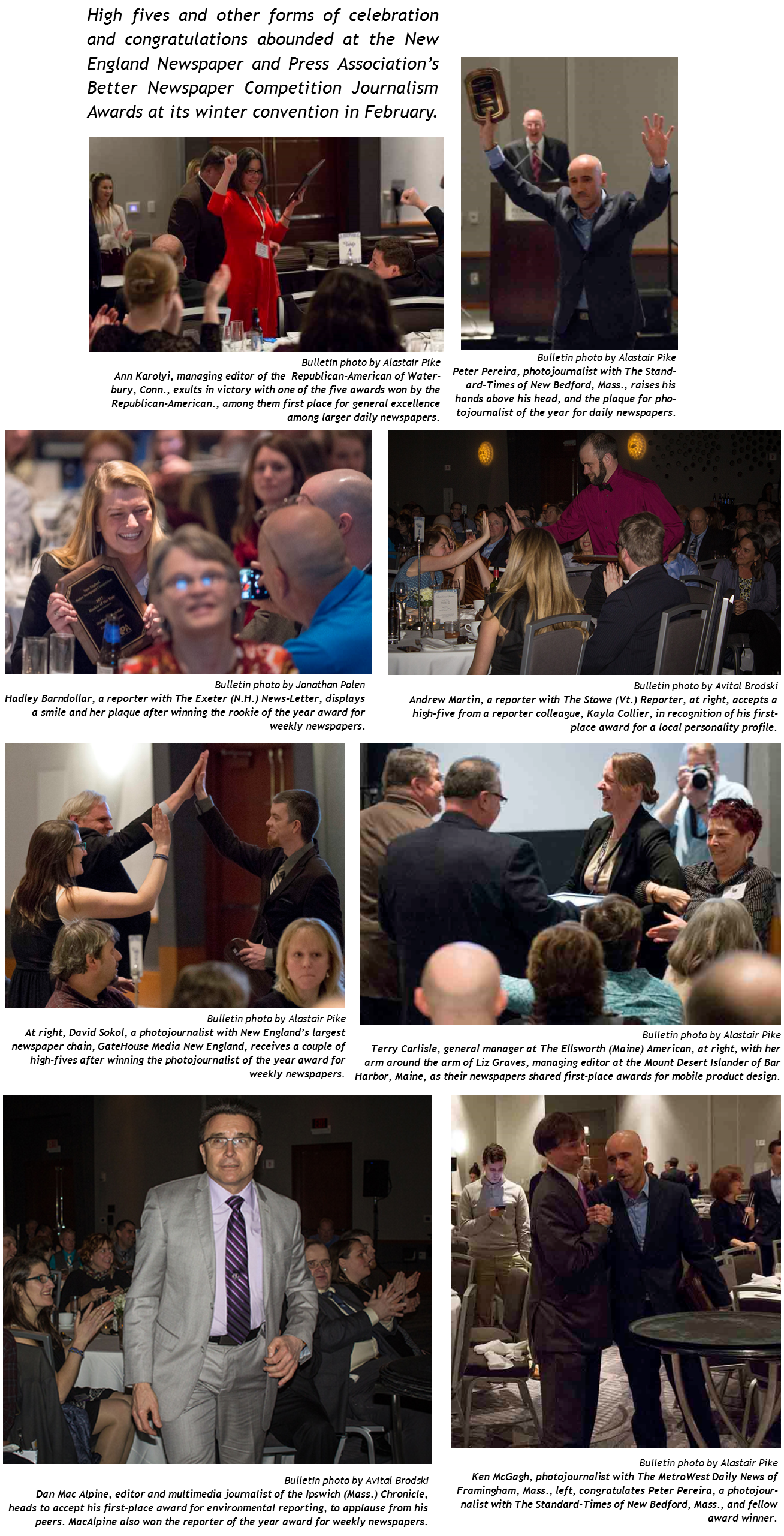
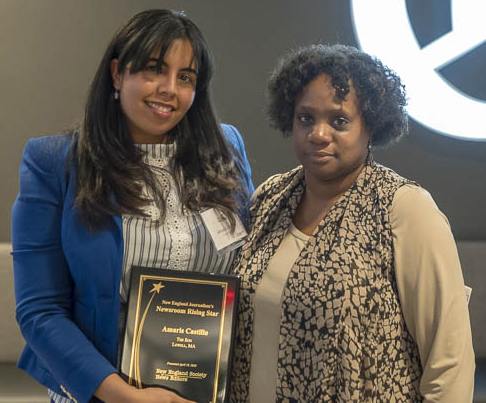
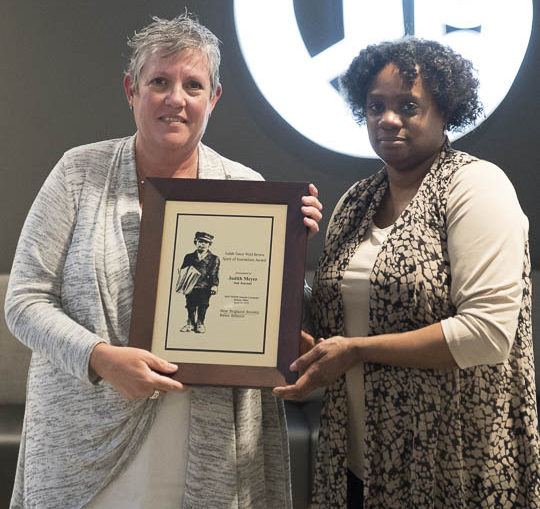
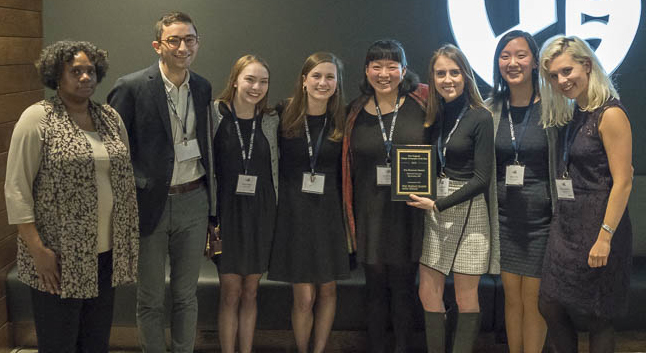
From left: Harry DiPrinzio, Louisa Moore, Rachael Allen, Jenny Ibsen, Sarah Drumm, Allison Wei, Ellise Lueders
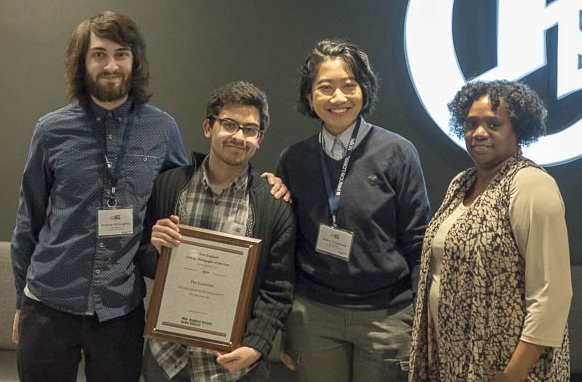
From left: Andrew Willoughby, Cesareo Contreras, Nadira Wicaksana
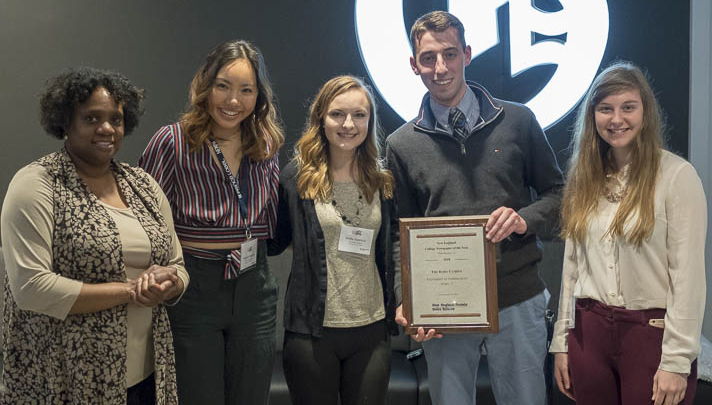
From left: Kimberly Nguyen, Molly Stadnicki, Connor Donahue, Stephanie Sheehan
Not present: The Harvard Crimson, Harvard University, Cambridge, Mass., First Runner-up.
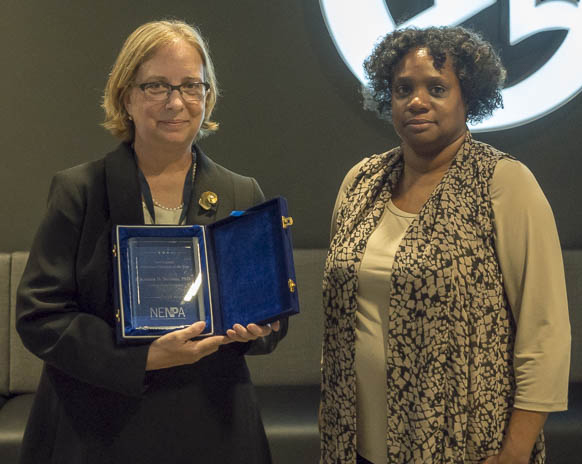
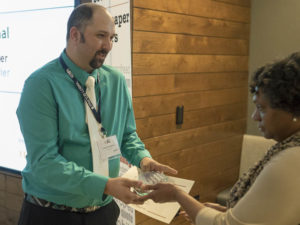
All award winners pictured with Paula Bouknight, president of the New England Society of News Editors.
Bulletin photos by Jonathan Polen
‘Mentoring happens in the moment. Mentoring happens every day.’
— Judith Meyer,
Executive editor,
Sun Journal,
Lewiston, ME
By Kaitlyn Mangelinkx
Bulletin Correspondent
“The world would be a poorer place without (journalists),” Scott Allen, assistant managing editor of special projects at The Boston Globe, said, fittingly, in his introductory speech at the recent New England Society of News Editors awards ceremony.
Allen’s speech mentioned themes of concern that would be echoed by award winners who spoke after him.
The remarks of winners of the New England Society of Newspaper Editors awards indicated that journalism is more than a passion for them; it is an obligation.
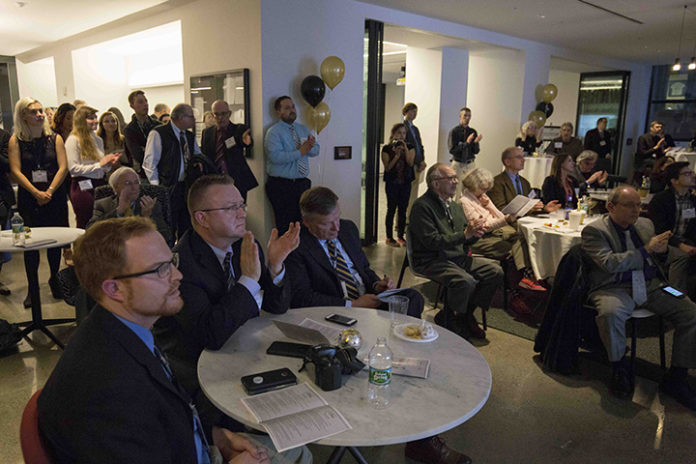
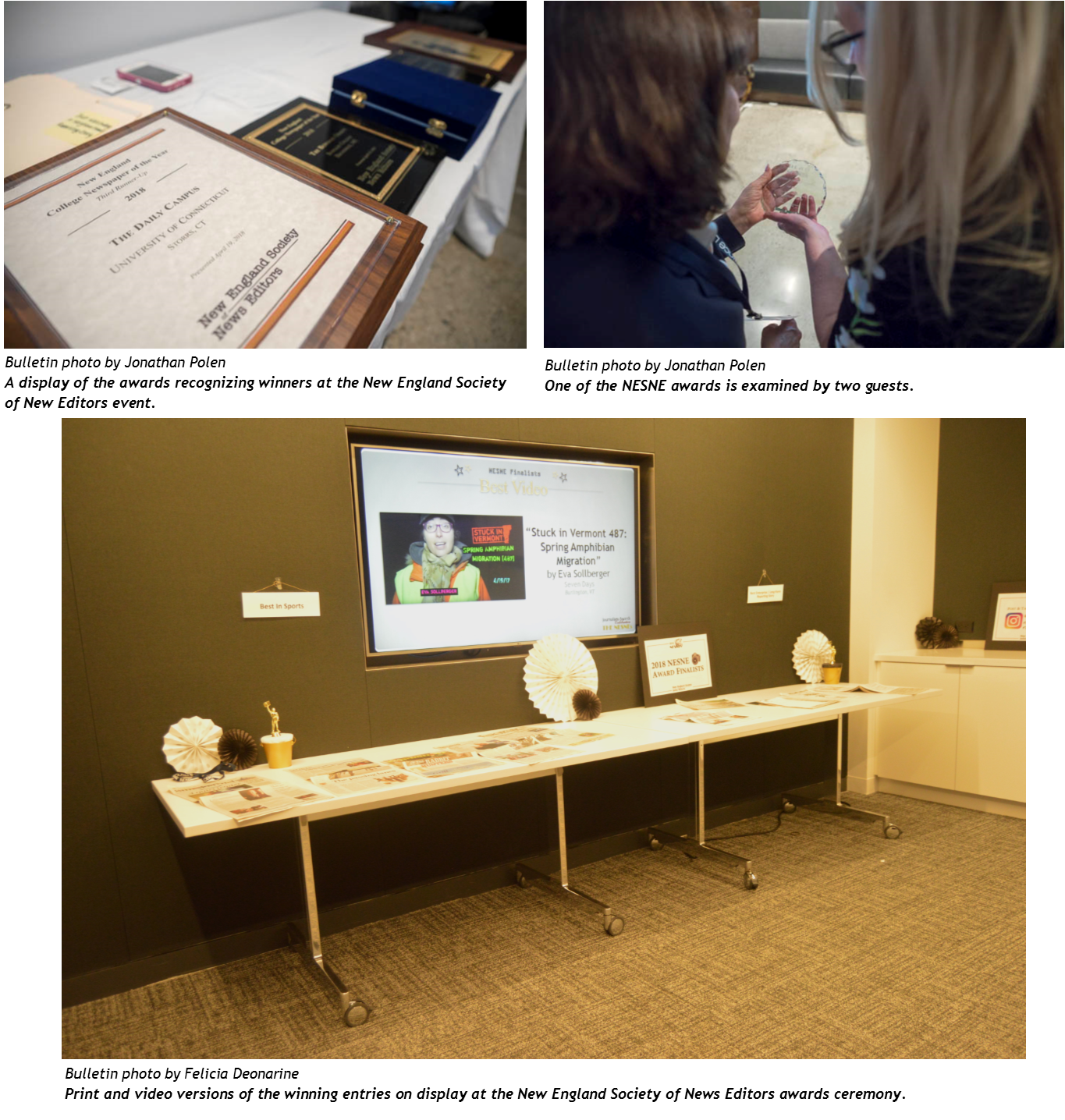
The awards ceremony took place Thursday, April 19, at The Boston Globe. About 80 people attended.
The following received the five key individual awards:
Nevious, a journalism professor at Franklin Pierce University in Rindge, N.H., and director of its Marlin Fitzwater Center for Communication, was lauded for her dedication to students. She teaches courses focusing on innovation in journalism and on political
journalism.
Phyllis S. Zrzavy, a professor of communications at Franklin Pierce, introduced Nevious as a mentor for many student groups who offers students special opportunities, such as covering political primaries and listening to influential speakers. Zrzavy said Nevious draws speakers not only for her college students, in a series called “Tuesday Briefings,” but also for high school journalists around the country during a summer program. Nevious focuses on ensuring that all her students are prepared for a future of important work in the news industry, no matter what changes or innovations occur, Zrzavy said.
Nevious said in accepting her award that earlier in her career she taught students on manual typewriters.
“What hasn’t changed is the need for insatiable, trained journalists,” she said.
Nevious said that, despite the changes, she remains passionate about the impact journalism can have. She reflected on trips on which she brought students to cover political primaries and rallies. She views those opportunities as chances to spread her passion for journalism to the younger generation, moving them from students to professionals capable of making change.
Castillo is a reporter at The Sun of Lowell, Mass. She was nominated for the award by the Sun’s editor, Jim Campanini, who said Castillo “epitomizes what is really a pioneer in journalism.”
Castillo joined the Sun in 2017, moving from Florida, where she was known for a series called “Bodega Stories,” which she wrote on her own time by talking with residents of
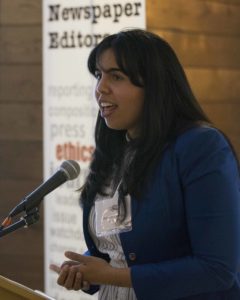
Manatee County in Florida, where she was a reporter for the Bradenton Herald. Campanini said that, after seeing the Bodega series, he was thrilled to have Castillo’s perspective as a reporter in Lowell after she moved to Massachusetts, a point he mentioned when introducing her. Campanini said he was awed by the passion Castillo put into her work, creating “Bodega Stories” as a passion project to help spread the narratives of under-represented communities.
Since coming to the Sun, Castillo has continued her “gumshoe” reporting, talking to residents and gaining perspective as the first Spanish-speaking reporter at the Sun, a point of pride that Castillo and Campanini both mentioned in their speeches.
In her acceptance speech, Castillo said she is “proud to be a child of immigrants,” using that perspective to speak out about the concerns of Latino communities, both in Florida and Massachusetts. Castillo thanked those at the Sun for trusting her perspective, giving the example of a story she wrote during her lunch hour after talking to Puerto Rican residents in Lowell in the days before Hurricane Maria. The story was published on the front page of the Sun the next day.
Meyer, executive editor of the Sun Journal of Lewiston, Maine, received the award that honors the accomplishments of an outstanding female journalist in New England. Meyer was introduced by Justin Pelletier, the Sun Journal’s managing editor, who described Meyer’s impact in the newsroom. Under her leadership, the Sun Journal newsroom has learned the importance of passion, following in Meyer’s footsteps as she not only works as editor of the paper, but regularly covers stories herself, often winning awards for her work, Pelletier said.
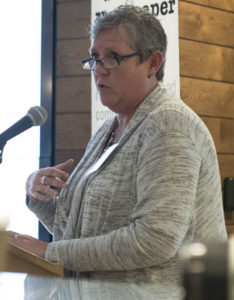
In her acceptance speech, Meyer said she “fell into this crazy profession that we share 20 years ago, completely by accident.” She began as a freelancer, before finding her passion for journalism when covering a routine story. The story involved talking with the local medical examiner’s office, where Meyer found the cause of death for a local man. She was then contacted by the man’s mother, who had not been able to receive any explanation about her son’s death from the medical examiner’s office. That prompted Meyer to focus on the responsibility of journalists to ensure that government officials are held accountable.
Meyer also discussed mentoring younger journalists, something she views as an obligation to the future of journalism.
“Mentoring happens in the moment,” she said. “Mentoring happens every day.”
The following other award winners were honored at the event:
The Harvard Crimson, Harvard University, first runner-up
The Gatepost, Framingham State University, second runner-up
The Daily Campus, University of Connecticut, third runner-up
Winner:
Paul Choinierre, The Day, New London, Conn, for “Simmons goes Haberek”
Finalists:
New Hampshire Union Leader, Manchester, N.H., for “City Matters”
The Standard-Times, New Bedford, Mass., for “Editor gets life-changing payback”
The Hartford (Conn.) Courant, for “7 Reasons to Save Hartford”
Addison Independent, Middlebury, Vt., for “Does VTrans take advantage”
Winner:
Christopher Williams, Sun Journal, Lewiston, Maine, for “Caged in Van No. 1304”
Finalists:
Sun Journal, Lewiston, Maine, for “Tell my family I love them”
Seven Days, Burlington, Vt., for “Death by Drugs”
The Colchester (Vt.) Sun, for “Paradise Lost”
The Patriot Ledger, Quincy, Mass., for “Who is the Real Scott Wolas?”
Winner:
Elodie Reed and Allie Morris, Concord (N.H.) Monitor, for “Living Transgender”
Finalists:
West Hartford (Conn.) LIFE, for “A story of horror and hope”
Seven Days, Burlington, Vt., for “Lucky Bums”
The Hartford (Conn.) Courant, for “Two Lives Shared”
Seven Days, Burlington, Vt., for “Life Sentence”
Winner:
Vanessa de la Torre and Matthew Kauffman, The Hartford (Conn.) Courant, for “Left Behind”
Finalists:
Sun Journal, Lewiston, Maine, for “Caged in Van No. 1304”
Boston Business Journal, for “Behind the Curtain”
The Providence (R.I.) Journal, for “Pot and Profit”
Worcester (Mass.) Magazine, for “In the Eye of the Commonwealth, landfill battle reaches fever pitch”
Winner:
Tom Mooney and Jennifer Bogdan, The Providence (R.I.) Journal, for
“Children at Risk”
Finalists:
The Republican, Springfield, Mass., for “Officials refuse to release report on probe of police”
Daily Hampshire Gazette, Northampton, Mass., for “Under the Table”
The Hartford (Conn.) Courant, for “Left Behind”
The Hartford Courant, for “State probe finds misuse of tech school funds”
Winner:
Ken McGagh, The MetroWest Daily News, Framingham, Mass., for “Amputee Marine finishes Marathon”
Finalists:
The MetroWest Daily News, Framingham Mass., for “Helping hands at Marathon finish”
The Herald-News, Fall River, Mass., for “Rescue”
Brattleboro (Vt.) Reformer, for “ALS: The price on the body”
The Enterprise, Brockton, Mass., for “Heartbreaking”
Winner:
Steve Heaslip, Cape Cod Times, Hyannis, Mass., for “Kennedy stamp dedication”
Finalists:
Telegram & Gazette, Worcester, Mass., for “Gardner’s homer lifts Shrewsbury”
The Inquirer and Mirror, Nantucket, Mass., for “Full Moon”
The Standard-Times, New Bedford, Mass., for “Touching up history”
Somerville (Mass.) Journal, for “Double head”
Winner:
Peter Huoppi, The Day, New London, Conn., for “WiredZone: New-London-NFA Thanksgiving Game”
Finalists:
Brattleboro (Vt.) Reformer, for “Andy’s Journey: The Struggles through ALS”
The Hartford (Conn.) Courant, for “Rare conjoined twins seek ordinary life in extraordinary circumstances”
Seven Days, Burlington, Vt., for “Stuck In Vermont 460: River of Light”
Seven Days, for “Stuck In Vermont 487: Spring Amphibian Migration”
Winner:
Staff, Vineyard Gazette, Martha’s Vineyard, Mass., for “The Time Machine”
Finalists:
Cape Cod Times, Hyannis, Mass., for “JFK’s 100th Centennial”
The Standard-Times, New Bedford, Mass., for “www.southcoasttoday.com”
Winner:
Justin Pelletier, Sun Journal, Lewiston, Maine, for “A quiet leader”
Finalists:
The Salem (Mass.) News, for “One of a Kind”
The Martha’s Vineyard Times, Vineyard Haven, Mass., for “The Last of the Rabbit Hunters”
The Republican-American, Waterbury, Conn., for “Marathon Man”
Telegram & Gazette, Worcester, Mass., for “The Passing Lanes”
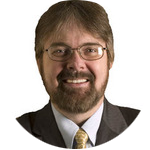
Kevin Slimp is director of the Institute of Newspaper Technology.
Email questions to him at
kevin@kevinslimp.com
So much to write about, so little space.
It’s been a whirlwind of a week for me, beginning in Knoxville, Tenn., where I caught a flight for what was supposed to be a quick trip to Winnipeg, Manitoba, before heading home for a couple of days, then heading to Sioux Falls, S.D., and Lincoln, Neb.
As I prepared to make my journey home, my plans were waylaid by a blizzard that shut down the Minneapolis airport, transforming my two-day visit to Winnipeg to five days. With my return flight rescheduled, there was no time to make it home to Tennessee, then back to Sioux Falls, where I was scheduled to meet a client.
This column is about my trip. Not the weather, although understanding how my schedule was altered plays an important role in understanding what happened during those 10 days.
At some point in the recent past, I realized I had spoken at 60 of the 63 press associations in North America during the past 20 years. With so many trips to so many places, it’s only natural I would become friends with some of the folks I meet along the way.
What stood out to me during my 10-day journey has been the number of incredibly deep conversations I’ve had with publishers and government officials in the United States and Canada about the importance of what we do at newspapers. They were not superficial conversations. I visited the legislature of Manitoba (you have time for things like that when you can’t leave a country), at the invitation of Greg Nesbitt, a former publisher and member of the legislature.
I visited with the leader of one of the political parties in Manitoba. We discussed the crucial importance of a free press, and even talked about some recent decisions in Canada that could have disastrous consequences for a free press. He ripped off a piece of paper and gave me his email address and phone number. We plan to keep in touch.
When I eventually made it to Sioux Falls, I was greeted with an overnight storm that generated close to a foot of snow. While most people in the city were tucked in their warm homes, I took off to visit newspaper friends in the Sioux Falls area. Once again, our conversations turned serious, sharing concerns about a shortage of newsprint, the effects of venture capitalists on our industry and other matters.
Throughout those discussions, I noticed a common thread. Not a single person seemed panicked about everything happening in our industry. The newsprint shortage is surely temporary. I even connected some friends in the United States with paper plants in Canada while I was there. The venture capitalists will eventually fire their last employees, sell their remaining buildings, and get out of the way.
Scenes like we saw in Denver, Chicago, Knoxville, and San Diego the previous week seemed to energize everyone in the newspaper business, even folks who work at those papers.
In Winnipeg, I met Darrell, who has been starting papers in small towns in Manitoba. I connected him with Joey, who has been doing the same thing in Kansas.
In Nebraska, I had a three-hour conversation with Rob Dump, one of my favorite community publishers, as we drove to Lincoln together for the Nebraska Press Association Convention. In Lincoln, the conversation continued as I met with Rob and his wife, Peggy Year, another of my favorite publishers, as we shared our concerns and dreams about our industry for more than three hours.
Here’s what I learned during my 10-day trek to Manitoba, South Dakota and Nebraska. In the 25 years I have been consulting with newspapers, I can’t remember a time when there was so much interest among publishers in what is happening in our industry, and so many people who are determined to change course from the pessimism of the past few years to doing whatever it takes to steer our industry in a positive direction.
Like many of you, I believe there is no freedom without a free press. Like many of you, I’ve got my sights set on a future dedicated to protecting that freedom. Dominoes are falling. I, for one, can’t wait to see where they land.
Ruth Poger, 80, of Shelburne, Vt., died April 6 in Burlington, Vt.
Beginning in 1977, Poger was a founding member, editor, and later publisher of The Other Paper in South Burlington, Vt.
She was a member of the South Burlington (Vt.) Democratic City Committee, on which she eventually was chairwoman. She became active in the state Democratic Party, and was its executive director. She later was a Democratic national committeewoman. In 1974 and 1978, she was the first woman to chair a Vermont gubernatorial campaign, and in 1980 she directed the U.S. Census in Vermont.
She leaves her husband, Sid; two daughters, Julia and Toby; two grandchildren; a brother.
James F. “Jim” Berry, 88, of Hudson, Mass., died March 15 after a long period of failing health.
He was employed in advertising sales for The Beacon of Acton, Mass., and the former Enterprise-Sun of Marlborough, Mass. He was the founder of the Marlborough City Post.
Berry leaves his wife, Lorraine; three sons; Michael, Robert and Joseph; two daughters, Barbara and Elizabeth; 12 grandchildren; three great-grandchildren.
Gordon Andrews Glover, 93, of South Freeport, Maine, died April 11 at Bay Square in Yarmouth, Maine.
He was a reporter and New England news chief for The Associated Press.
He later owned a weekly newspaper, The Citizen of Morris County, based in Whippany, N.J., and was its editor and publisher.
Glover was an editorial page editor for the New York Daily News.
He also had been a speechwriter in Washington, D.C., for a U.S. senator.
Gordon leaves four children, Susan, Margaret, Barbara and William; eight grandchildren, Alison, Chloe, Charles, Riley, Reed, Margaret, Sara Jane and Ginny; two great-grandchildren.
Phyllis Baker Newton, 94, of Harwich, Mass., and Naples, Fla., died March 5 at Harbor Point in Centerville, Mass.
During her several decades as a journalist, Newton was editor of the Needham (Mass.) Chronicle for about three years. She wrote a daily advice column under a pen name for the former Boston Herald Traveler. Newton’s byline also appeared in Time Magazine, The Sun of Lowell, Mass., the Newton (Mass.) Graphic, the Dedham (Mass.) Transcript, and The Patriot Ledger of Quincy, Mass.
During her journalism career, Newton established a public relations business in 1947, marketing to schools, theaters and other businesses. She sold the business to a competitor after a few years.
She leaves two sons, Gary and John; a daughter, Beth; six grandchildren; six great-grandchildren; a brother.
Eugene Russell Donnelly Jr., 79, of Pepperell, Mass., died Feb. 19 at home.
Donnelly was employed at the Telegram & Gazette of Worcester, Mass., until the late 1990s. He began as a reporter and later was regional editor. He then was head of marketing there, and ended his career with a second stint on the newspapers’ editorial board. He also was an outdoor columnist there, writing about hunting, fishing, camping and conservation
He leaves his wife, Helen; two sons; Benjamin and Nicholas; three granddaughters; a grandson; a brother.
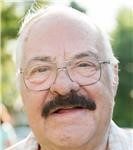 Daniel Hovey
Daniel Hovey, 82, of Meriden, Conn., died April 16 in Meriden.
Hovey was an editor of the Ipswich (Mass.) Chronicle before becoming editor at the Hamilton-Wenham (Mass.) Chronicle, and finally, city editor of the former Beverly Evening (Mass.) Times.
He became director of press relations at Northeastern University in 1961, and four years later, founded and was director for four years of the Department of Public Information at the University of Hartford in Connecticut.
Hovey leaves his wife, The Rev. Diane; a daughter, Heidi; a son, Elric; two stepsons, Zachary and Geoffrey; seven grandchildren; 13 great-grandchildren; two siblings; his former wife, Nanci.
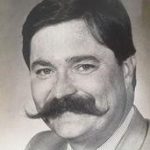 Peter Thomas Farrelly Jr.
Peter Thomas Farrelly, Jr., 65, of Shelton, Conn., died April 6.
Farrelly was a writer and editor during his career, and was employed with the Norwalk (Conn.) Hour and later the Fairfield County Catholic, based in Bridgeport, Conn., the Greenwich (Conn.) Time, and the Connecticut Post of Bridgeport.
Farrelly leaves his wife, Mary Jo; four sons, Joseph, Sean, Kevin and Brian; a daughter, Heather; two brothers; three sisters.
William L. Barschdorf, 84, of Pittsfield, Mass., died March 19 at Berkshire Medical Center in Pittsfield.
His career began as a reporter-photographer at the Bennington (Vt.) Banner. He was later sports editor there. He was employed at the Banner from 1953 to 1956.
He then went to the then-Springfield (Mass.) Union and covered the North Berkshire area of Massachusetts as bureau chief in 1956 and 1957. He later briefly joined the Northampton bureau before covering a variety of assignments on the Union’s city staff. He also was the Union’s business and industry editor and worked on its night city editor’s desk.
Barschdorf became community relations and employee communication specialist at General Electric Co. in Pittsfield in 1966. During 26 years there, he received several corporate communication excellence awards, most of them as writer-editor of the GE News.
He leaves his wife, Geralyn; two sons, Fred and William; two daughters, Nancy and Julie; 11 grandchildren; four great-grandchildren; a sister; a brother.
Daniel Ambrose Neary Jr., 77, of East Montpelier, Vt., died March 9 in Berlin, Vt., from complications of Parkinson’s disease.
Neary was a reporter for the Rutland (Vt.) Herald. He later was Associated Press bureau chief in Montpelier from 1968 to 1973.
Later in life, he wrote short stories and film reviews and took black-and-white photographs in a style described by critics as “stark” and “austere.” Neary also had two books published, “Vanishing Vermont” and “Rage in the Hills.”
He leaves twin daughters, Carla and Jessica; a grandson. Kirby; a sister
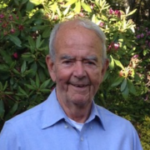 James W. Morrissey Jr.
James W. Morrissey Jr., 85, of Quincy, Mass., died April 10 at Seasons Hospice Milton (Mass.) Inpatient Center after a long battle with Alzheimer’s disease.
He was business editor for the former Malden (Mass.) Evening News.
He leaves his wife, Arlene; three surrogate children, Jacob, Andrew and Joseph; three grandchildren; a brother.
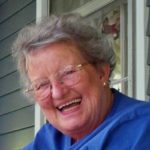 Mary Ellen (Monroe) Nihill
Mary Ellen (Monroe) Nihill, 89, died March 17 at Waterbury (Conn.) Hospital.
She was employed as a copy editor for many years at the company that now publishes The Republican of Springfield, Mass., and its sister Sunday newspaper.
She leaves two children, Michael and Joanne, and five grandchildren, Nicholas, Joey, Jamella, Yasin and Braheim.
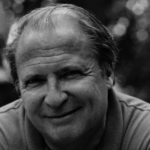 Dave Behrens
Dave Behrens, 84, of Manhattan died March 24 after a brief illness.
Behrens began his career at the New Haven (Conn.) Register and later joined the Miami Herald.
In 1968, he was hired as a reporter at Newsday. In 1970, he was assigned by Newsday to cover the women’s movement. Not long after joining Newsday, Behrens became part of “The Heroin Trail” coverage that won a Pulitzer Prize in 1974. He ultimately became a feature writer for Newsday, and retired in 2004.
Behrens leaves his wife, Patricia.
Terry Louise Cowles, 90, of Old Saybrook, Conn., and formerly of Westbrook, Conn., died Jan. 6.
She was a cub reporter at the then-Framingham (Mass.) Daily News, a columnist at The Call of Woonsocket, R.I., and an editorial secretary at the New Yorker magazine. She also had been a script writer for then-radio station WAAB-AM in Worcester, Mass., and WTVL-TV in Waterville, Maine.
Cowles leaves five nieces Priscilla, Marjorie, Nancy, Susan and Linda; a nephew, Vernon; two second cousins; many grandnieces, grandnephews, great-grandnieces, and great-grandnephews.
Phyllis Jane (Freeman) Nissen, 71, of Wakefield, Mass., formerly of Reading, Mass., died March 13 in her home after a brief battle with cancer.
She was a feature writer for the Reading (Mass.) Times Chronicle; Wakefield (Mass.) Times Chronicle; the Middlesex East supplement to those newspapers and others in the group whose flagship is the Daily Times Chronicle of Woburn, Mass.; and other local newspapers.
She wrote columns, including School Notes, about the local schools, and About the Towns, about activities in area communities.
She leaves her husband, Stanley; four children, Misti, Melanie, Gregory and Courtney; eight grandchildren; a brother.
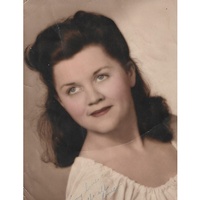 Mary Barker
Mary McCuin Coellner Barker, 94, of Exeter, N.H., died March 12 at home.
Barker was a reporter for The Haverhill (Mass.) Gazette.
She leaves five children, James, Nan, Mark, Mari and Roseann; 12 grandchildren; 14 great-grandchildren.
Lois Irene Carlson Martin, 89, of Plymouth, Conn., died April 13 at Gardner Heights in Shelton, Conn.
Martin reported on Plymouth for the Bristol (Conn.) Press.
She leaves two children, Natalie and Daniel; five grandchildren, Erika, Catherine, Andrew, Caitlin and Lindsay; a great-granddaughter; a sister.
Richard Charles “Chuck” Robarts, 85, of Stamford, Conn., died March 25 at Stamford Hospital of complication from Parkinson’s disease.
In 1956, he became a cub reporter for the Portland (Maine) Press Herald.
He leaves his wife, Dee; two sons, Alexander and Andrew; three granddaughters; a brother.
Wayne D. Lima, 63, of Lincoln, R.I., died unexpectedly April 6.
Lima was a sports column writer at The Times of Pawtucket, R.I.
He leaves his wife, Sharon; a daughter, Stacy.
Robert Stanley Cwalinski, 81, formerly of Adams, Mass., died April 10 at North Adams (Mass.) Commons.
Cwalinski was employed with The Republican of Springfield, Mass., for which his assignments included covering baseball Hall of Famers Ted Williams and Joe DiMaggio.
He leaves two sons, Jeffrey and James; four granddaughters, Marianna, Faith, Joy and Nancy Rae; two sisters.
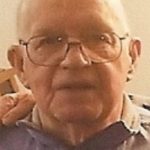 John M. Noonan
 John M. Noonan, 90, of Worcester, Mass., died April 15 in St. Vincent Hospital in Worcester.
He was a pressman for 49 years with the Telegram & Gazette of Worcester.
He leaves his wife, Linda; two sons, John and James; four daughters, Sheila, Patricia, Mary and Anne; 18 grandchildren; many great-grandchildren; two siblings.
Paul Joseph Pilkington, 76, died April 10.
Pilkington was a pressman for 40 years at the then-Providence (R.I.) Journal Bulletin.
He leaves his wife, Margaret Mary; two daughters, Margaret and Catherine; two grandchildren; a brother.
Rene R. Rousselle, 96, of Winooski, Vt., has died.
Rousselle spent 38 years as a pressman and union member at The Burlington (Vt.) Free Press.
He leaves a daughter, Susan; three grandchildren, JoyLee, JayDan and Donald; four great-grandchildren, five great-great-grandchildren; a sister.
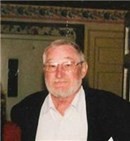 Charles K. Goff
Charles K. Goff, 78, of Andover, Mass., died April 11 at Kaplan Hospice House in Danvers, Mass., after a lengthy illness.
He was employed in the newspaper printing business, including with The Boston Globe and Boston Herald. He retired from the Herald.
He leaves two children, Kenneth and Elaine; two grandsons, Gregory and Brian.
Mary Lou Touart, 95, of Lexington, Mass., died Feb. 25 in her apartment in Lexington.
She wrote the Scene and Heard column in the Lexington Minuteman for 15 years.
She also had been an assistant fashion editor for Women’s Day Magazine, based in New York City.
She was a member of Lexington’s Permanent Building Committee, served 11 years as a Lexington town meeting member, and was a publicist for several successful Lexington selectman candidates.
She leaves three children, Ellen, Katherine and Douglas, and five grandchildren, Carlie, Erika, Anabel, Eliza and Susannah.
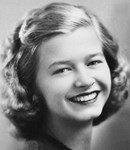 Joyce Ann (Baker) Cassinari
Joyce Ann (Baker) Cassinari, 89, of Littleton, Mass., died April 13 at Life Care Center of Nashoba Valley in Littleton.
Cassinari was the Littleton correspondent for The Sun of Lowell, Mass., for several years.
Cassinari leaves three children, Richard, Lynne and Leslie, and seven grandchildren, Rebekah, Michael, Jacob, Hannah, Daniel, Julia and Jeffrey.
Kathryn L. “Katy” Forry, 76, died April 17 in her home in Delaware after a battle with gallbladder cancer.
She was a correspondent in Jaffrey and Rindge, N.H., for the Keene (N.H.) Sentinel.
Forry ran as a Democrat unsuccessfully for a seat in the New Hampshire House of Representatives in 2006 and for governor of New Hampshire in 2008.
She leaves her husband, David; two sons, Eric and Karl; three siblings.
Helen Peterson, 92, died April 1 in Mansfield, Mass., after an illness.
In 1954, she became a freelance writer for the Williamstown (Mass.) News. She also was a reporter for the Newark (N.J.) Evening News.
Helen leaves two daughters, Jane and Lucy; a son, Matthew; a granddaughter, Laura.
Lisa E. (Bullens) Madden, 63, of Spencer, Mass., died Feb. 25 in her home.
Lisa was a newspaper distributor for the Telegram & Gazette of Worcester, Mass., for 27 years, and served 400-plus clients in Leicester, Oakham, Spencer and Barre, Mass. In December, she retired because of illness.
Madden leaves her husband, Patrick; a son, Domenico; four daughters, Antoinette, Susan, Angela and Brittany; five grandchildren; a brother; a sister.
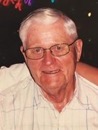 Wendell H. Hawley
Wendell H. Hawley, 97, died April 8 at Birchwood Rehab Facility in Burlington, Vt., after a brief illness.
Wendell began his career in the circulation department at The Burlington Free Press.
He leaves a daughter, Barbara; a son, Gary; two grandchildren, Lucas and Lindsay.
 Roger F. LaFlamme
 Roger F. LaFlamme, 88, of Southbridge, Mass., died March 11 at the Southbridge Rehabilitation and Healthcare Center after an illness.
For 25 years, he delivered newspapers part time for the Southbridge Evening News.
He leaves his wife, Rose; three children, James, Brenda and Cathy; five grandchildren; four great-grandchildren; a brother.
Mary Lou Nason, 62, of Old Orchard Beach, Maine, died March 5 at the Gosnell Memorial Hospice House in Scarborough, Maine.
She delivered the Portland (Maine) Press Herald in Old Orchard Beach for several years.
She leaves four sons, Peter, Jerry, Dennis and Daniel; 13 grandchildren, Layne, Nicole, Makayla, Jerry III, Maria, Dylan, Brianna, Olivia, Elizabeth, Daniel Jr., Hannah, Autumn and Lila; two brothers; a sister.
 Barbara June Clarkson
Barbara June Clarkson, 82, of Fitchburg, Mass., died March 10.
In 1971, Clarkson joined the Sentinel & Enterprise of Fitchburg. She retired in January 2017 after working there for 31 years.
Clarkson leaves six children, Linda, Teresa, Robert, Irene, William and Elizabeth; four stepchildren, Douglas, Vicki, Robert and Sandra; 23 grandchildren; 10 great-grandchildren; a sister; two brothers.
Helen Didriksen, 77, of Nantucket, Mass., Southold, N.Y., and Little Gasparilla Island, Fla., and formerly of Riverside Conn., died March 27 on Nantucket.
Didriksen was a reporter for a newspaper in Greenwich, Conn.
She leaves her husband, Philip, four children; Bradford, Michael, Stephen and Katherine; six grandchildren.
The obituaries were written, at least in part, from published reports by Bulletin correspondents Ajoa Addae, Nadine El-Bawab, Felicia Deonarine, Angela Gomba, Nico Hall, Eliezer Meraz, Mohammed Razzaque, Casey Rochette and Thomas Ward, undergraduate students at Northeastern University.
By Rebekah Patton
Bulletin Correspondent
Technology has made news more accessible for today’s audiences. With technology, the accessibility of news is changing. The mediums on which audiences prefer to access news are changing. The mindset of audiences is changing.
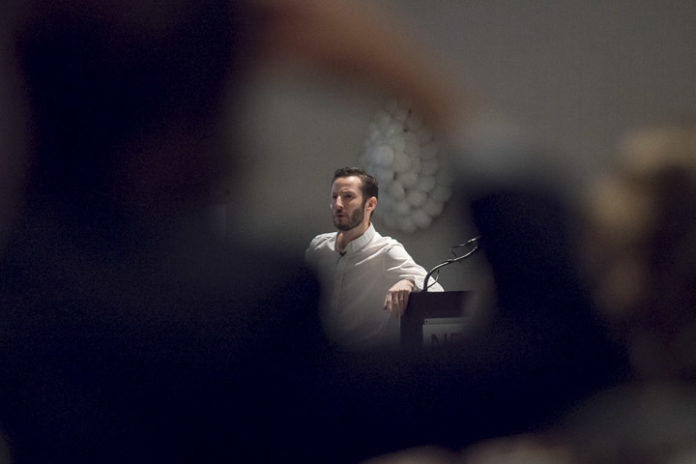
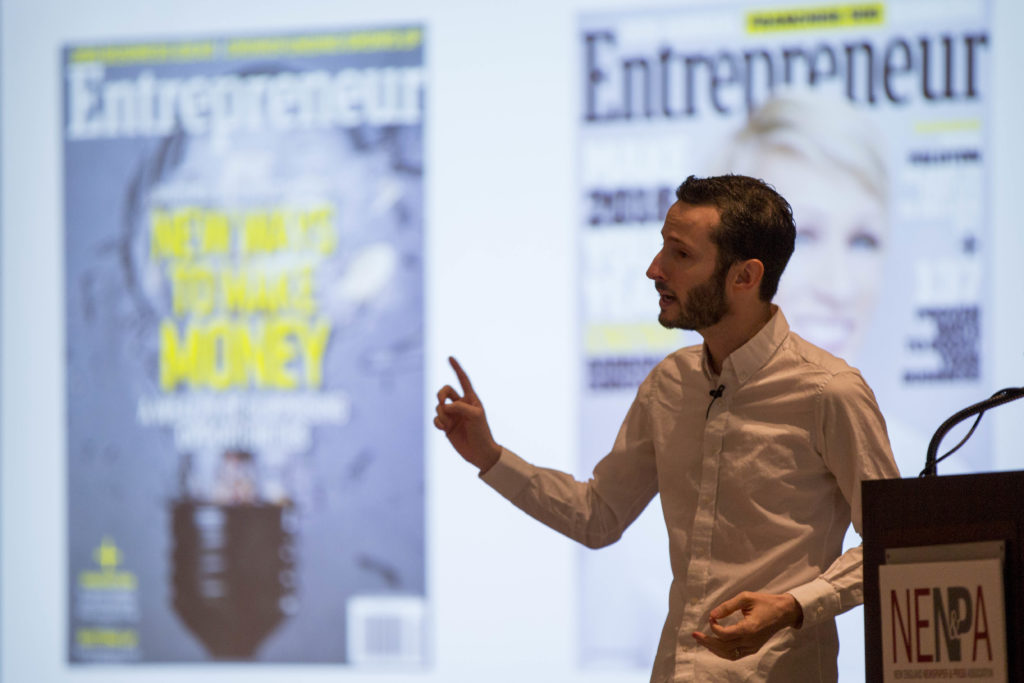
Aware of this, Jason Feifer, editor in chief of Entrepreneur magazine, stressed the need for innovation and risk-taking in journalism. Feifer shared his experience working with entrepreneurs, and how their thought process has affected his thought process.
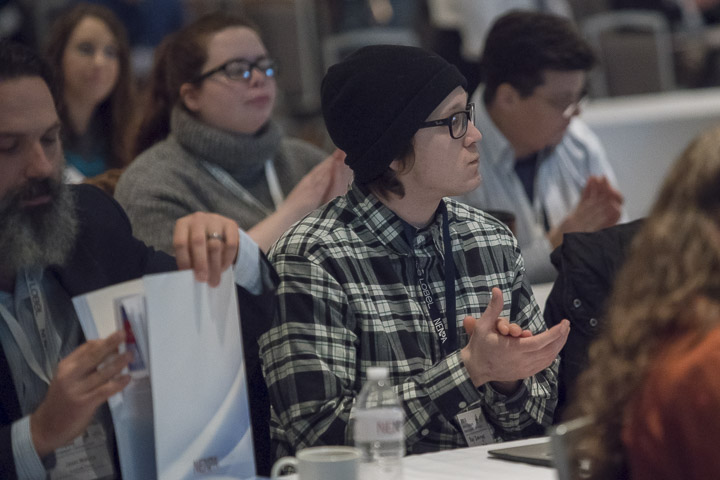
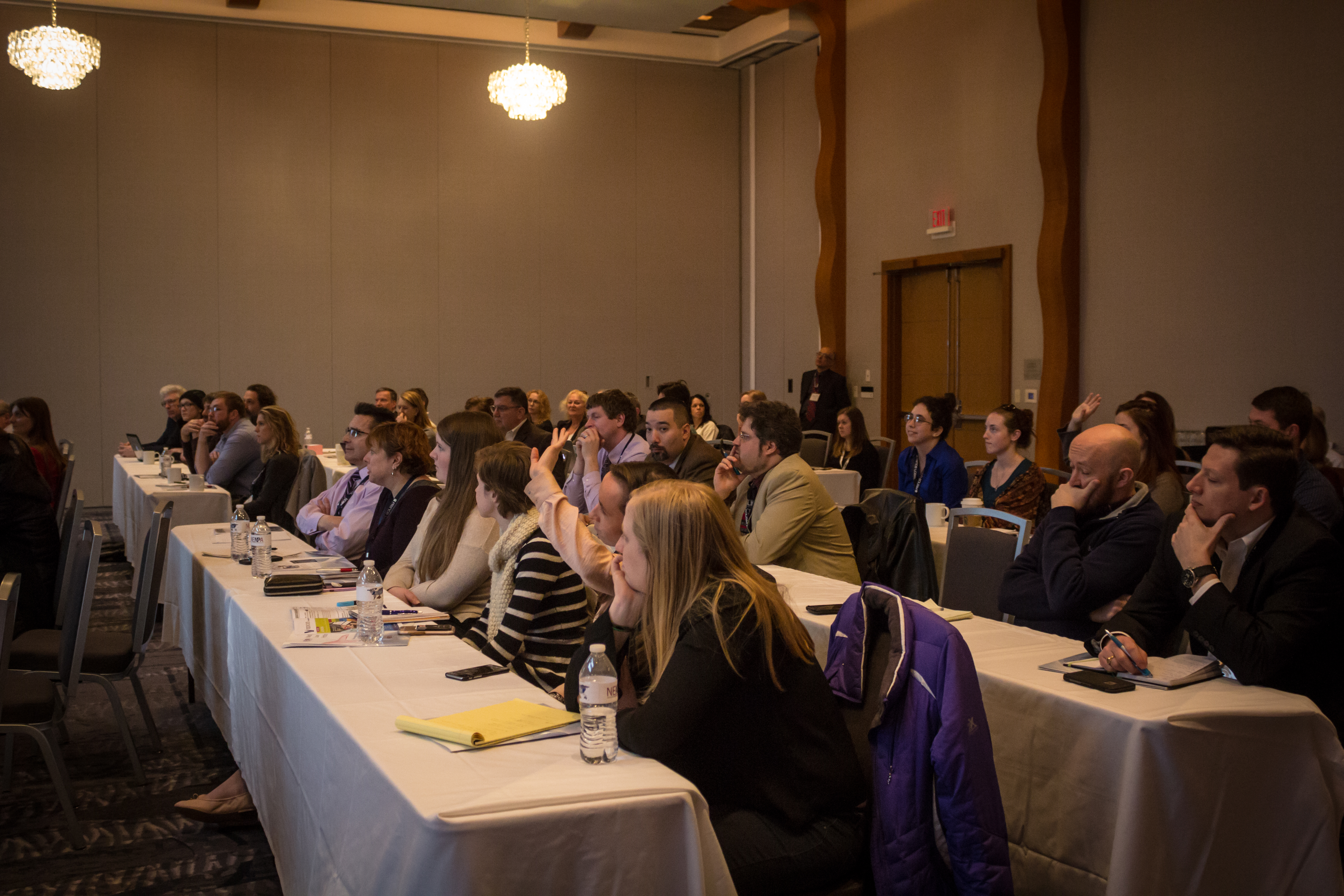
More than 100 journalists and students gathered for his keynote speech Friday, Feb. 23, the first day of the New England Newspaper and Press Association’s two-day 2018 winter convention at the Renaissance Boston Waterfront Hotel.
Feifer’s take-home mantra was to live in a state of “permanent beta.” It values the state of change, of malleability, of everlasting evolution.
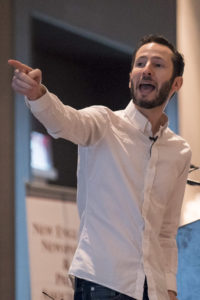
“You are never a finished product,” he said. “You are always changing, always revising. You live in a state of constant learning, of constant challenging. If (you are) a finished product, you are just on a shelf, and at some point, you are thrown into the garbage.”
What interests Feifer is that entrepreneurs are familiar with being uncomfortable. They might even be comfortable with it; they know that what works today will not work tomorrow.
He touted the merits of permanent beta — focusing on sharing a product with a community rather than on ownership of that product.
He introduced his podcast, “Pessimists Archive.” With each episode, the speakers on the podcast discuss moments when new technologies were introduced, and why those technologies initially perplexed and terrified people.
His example was the invention of the bicycle in the late 1800s. Feifer emphasized that employers and industries panicked because the invention of the bicycle changed consumption patterns.
Specifically, the hat industry felt threatened by the novel technology because they thought that felt hats would be blown off the heads of bicycle riders, who would therefore buy fewer felt hats. In fact, the felt hatters pressed for Congress to approve legislation for bicycle owners to purchase at least two felt hats a year.
Members of the audience chuckled at the absurdity.
“And yet, haven’t we done that in some sort of way ourselves?” Feifer asked.
Members of the audience leaned in intently.
“We’ve said, ‘You know what, I know how to do something well, I’ve been doing it well for a long time, so everybody else needs to stop so I can keep doing this thing’,” Feifer said.
In the long run, if the fancy felt hatters had just accepted and embraced the change of selling other types of hats, such as ball caps, they would have made a tremendous profit: Currently, the hat industry has produced more than double the revenue of the bicycle manufacture industry and the bicycle repair industry combined, Feifer said. But because the felt hatters did not embrace the change, they realized limited opportunity and room for their growth.
“The reality is, change needs to be made,” he said. “Ask uncomfortable questions. Be comfortable with the uncomfortable. So let’s get uncomfortable.”
His approach doesn’t apply just to entrepreneurs, he said: Journalists need to find solace in innovation.
Like the hat industry, the news industry has felt and will feel threatened by the invention of new technologies. The solution is not to tear down that new invention or force people to interpret the news the same way, simply because that way worked in the past. Feifer said the solution is to ask questions and innovate. The solution is to take risks in the industry and figure out what the readers and listeners want to read and hear, and how they want to read and hear it.
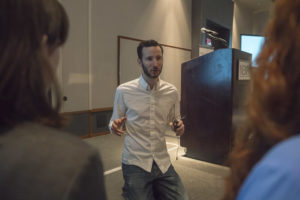
“Entrepreneurs always ask themselves, ‘Why am I doing something the way that I am doing it?’ If the answer is, ‘Because that’s the way things have always been done,’ that answer is wrong,” Feifer said.
Feifer recollected that when he first became editor in chief of Entrepreneur in October 2016, he didn’t know how to connect with his audience of entrepreneurs.
And then he thought, “Entrepreneurs are just risk takers, and I’m a risk taker. I know how to relate to them. I’ve been entrepreneurial in my career.”
He talked about his experience at the Gardner (Mass.) News and Telegram & Gazette of Worcester, Mass., and his decision to freelance because of his desire to target a larger audience. He also discussed his later journey through different magazines, including Maxim and Men’s Health, and ending with becoming executive editor in 2015 and editor in chief in 2016 of Entrepreneur.
“We don’t have to open businesses to be entrepreneurial,” he said. “We just have to think in a different way.”
He discussed a time when several entrepreneurs wanted to have a conversation about the definition of the word entrepreneur, because no one really had a set answer. Then he came to realize that the reason is because of the flexibility of its meaning. “It’s not a particular thing,” he told those entrepreneurs. “It’s a mindset. It’s an identity.”
He asked the convention audience: “What if the future of the business is not the content?”
Audience members shared expressions of wonder.
“What if the content is the reason why people trust us and love us, but not the reason why we make money?” he asked.
Then Feifer discussed an idea that resonated with the audience: Established magazines, newspapers and podcasts have great brand equity.
He said readers of magazines and newspapers will almost intuitively say: “Oh, I love (a certain magazine)!” and when Feifer asks them what they like about it or if they read the latest issue, they reply that they haven’t read the magazine in years.
“If that’s the situation, what is that saying?” Feifer said.
“It says people love brands,” he said. “They love us, but they won’t pay for our product. And even if we’re providing it for free, they still don’t read it. There’s a gap here.
“What if Entrepreneur solves problems that leaders have, and that’s how we make money? What if we were a consulting agency and that’s how we make money?”
He acknowledged that that was an uncomfortable idea, and that intrigued him even more.
“What if the content is the reason why people love us and trust us and will continue to do what it has always done, but it is not the thing that finances us?” he asked.
Feifer said the relationship between consumer and producer shouldn’t be one with rigid boundaries.
“What if journalists aren’t the only ones who can tell stories?” he asked.
Feifer said that, despite his preference to leave the writing and storytelling up to him and his fellow journalists, the reality is that readers like to write. What’s even better is that they like to read what they write.
Feifer introduced the idea of contributor networking. Readers can submit pieces to be published, potentially, on the Entrepreneur website.
His suggestions about letting readers become writers, and other ways of engaging audiences, had the ring of a hat manufacturer encouraging bicycle riders to wear different hats.
By Nadine El-Bawab
Bulletin Correspondent
The evolution of social media has made it easier than ever to access news at the touch of a button. And as Katie Bowler put it, it’s a “good way to increase community engagement,” but it has also made it harder than ever for journalists to do their job.
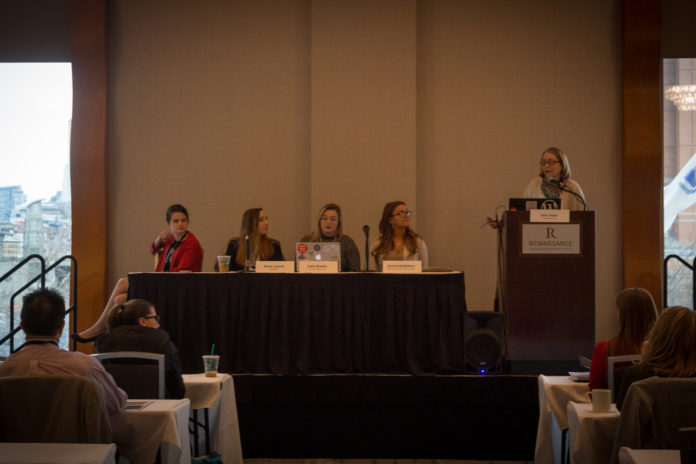
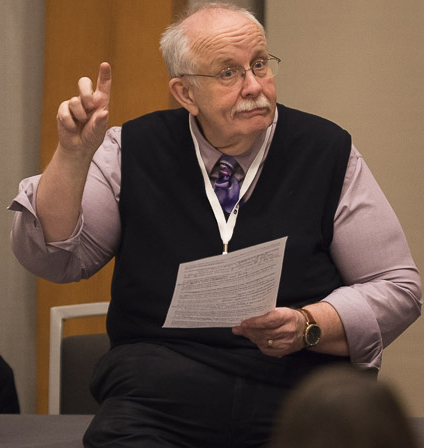
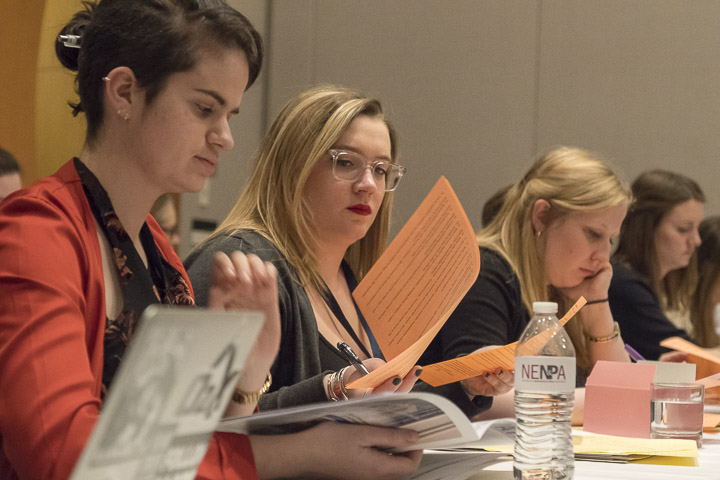
Bowler was a panelist at a session titled “Social media strategies for small media organizations” at the New England Newspaper and Press Association’s recent winter convention.
BJ Roche, a journalism professor at the University of Massachusetts-Amherst, was on the panel with Bowler, a reporter at the Somerville (Mass.) Reporter, and three other young reporters, Aviva Luttrell, a reporter at MassLive.com, the online news site of The Republican of Springfield, Mass.; Serena McMahon, social media coordinator and a news writer at The Massachusetts Daily Collegian, the student newspaper at UMass-Amherst; and Faith Gregory, newsletter editor and a writer at the Amherst Wire, an online student magazine at UMass-Amherst, and Amherst Live, a live online magazine show.
The panel shared tips and tools to use Facebook, Twitter and Instagram to a news organization’s advantage.
Luttrell provided statistics that showed that traffic on Facebook peaks about 8 to 9 a.m., making that a good time to post stories. But she also suggested another use for Facebook — “as a platform for receiving tips through Facebook messaging; have someone check that regularly … set up response assistance if you are not regularly checking it and tell (those trying to contact you) other ways to contact you.”
She also suggested that journalists “join groups in the community to follow what people are interested in.” That’s a good way to get story ideas and to become Facebook friends with people in the community, Luttrell said. But she cautioned journalists to avoid being biased or one-sided on Facebook.
Luttrell suggested using Facebook Live’s streaming video to “tease … future stories.”
Bowler said journalists should publicize their Facebook footage all the time, but to make sure that you “have a captivating story when you are doing Facebook Live.”
‘Tweets with photos receive 18 percent more clicks.’
— Serena McMahon,
Social Media Coordinator, news writer,
Massachusetts Daily Collegian
Roche said it’s good to have more than one person working on Facebook Live’s live streaming at a time; have someone handling the camera and someone responding to the comments as they are made. When you are showing a live stream, it is also good to have your branding somewhere on the screen to increase brand awareness.
Gregory said hashtags can be fun to use on Instagram and Twitter, but because of the many possible combinations that could make up a hashtag, it’s important to “have a tag style guide at your newspaper, and make it completely consistent” in using the most popular form of the hashtag to get the most social media attention possible and to keep all related posts under the same hashtag.
Gregory said she considers Instagram to be the best way to “visually engage with your audience, … (and it) allows you to attract a younger readership.”
She suggested that in creating a caption, only put the lead of the story in the caption rather than a long summary.
Gregory said that for frequency of posting, “a couple of times a week is good … Don’t over-post” because that will cost you followers. Try to stay consistent in the number of posts every week, so it is best to “have something in the bag when you don’t have a post lined up,” she said. Have backup stories that can be posted. Her general advice on using Instagram was: “If you are going to do it, do it well or don’t do it at all.”
McMahon discussed Twitter and said that “tweets with photos receive 18 percent more clicks.”
She said horizontal photos look better on Twitter.
McMahon said “NPR does a good job of using photos with their tweets,” and recommended visiting its account for examples.
She said it is important to schedule weekend tweets to keep your audience up to date when they have the most free time.
More social media tips from the panelists are available here.
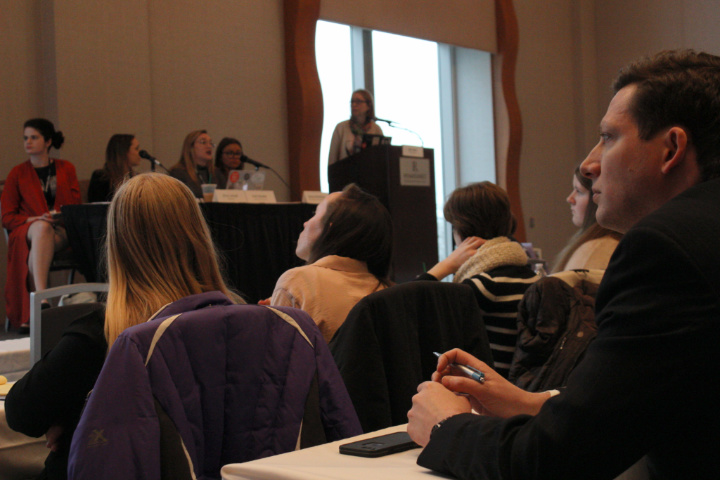
More than 50 people attended the discussion Saturday, Feb. 24, in the Renaissance Boston Waterfront Hotel in South Boston.
By Nadine El-Bawab
Bulletin Correspondent
Often, government offices are unwilling to give out records to reporters even when that information is supposed to be public, and as Mike Donoghue put it: “Records are really your best source of information.”
In a session titled “The Ask: Getting public records you need” at the New England Newspaper and Press Association’s recent winter convention, Donoghue shared 25 tips on how to obtain the information you need from those reluctant offices.
Donoghue was a longtime news and sports writer at The Burlington (Vt.) Free Press and has been an adjunct professor of journalism and mass communications since 1985 at St. Michael’s College in Colchester, Vt. He is first vice president of the New England First Amendment Coalition’s board of directors.
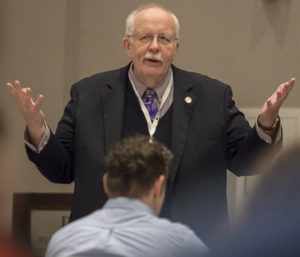
At the top of the list of tips, Donoghue advised journalists to “read your state open government laws (public records/open meeting) word for word at least once a year. (Make it a birthday present to yourself, or do it each New Year’s Day! Look at the federal Freedom of Information Act (FOIA) too.”
Donoghue said that, even though that might seem tedious, it has been helpful in reminding him what documents are public and are relevant to the stories on which he is working, and it tells him what documents he should be requesting.
“Just by reading the law and having it fresh in your mind you just might get onto something,” Donoghue said.
Changes to those laws could also affect what documents are available to you, so make sure your information is constantly up to date, Donoghue said.
And always remember to be puzzled when someone declines your requests and “don’t be afraid to call them out on redactions or things that don’t make sense,” he said.
An underlying theme of many of his tips was the importance of being patient and being kind but assertive in dealing with the gatekeepers of information, especially those with whom you are frequently in contact.
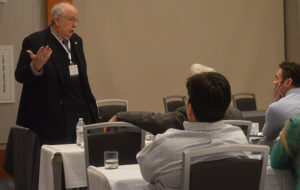
Another of Donoghue’s tips was to think out of the box when choosing to whom to send public records requests, especially when you are experiencing pushback from those you have contacted.
“Never accept ‘no’ for an answer. Everybody has a boss (and those people each have a boss),” he advised.
Finally, he said, it is important to make sure to “say ‘Thank you.’ And say it often. (Today, tomorrow and after the story appears. Officials love to hear it.)”
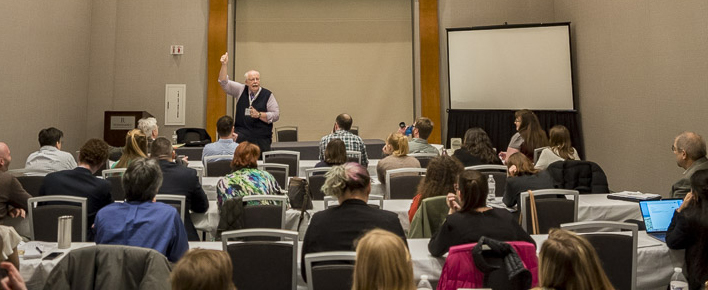
About 45 people attended the session, held Saturday, Feb. 24, in the Renaissance Boston Waterfront Hotel in South Boston.
Hannity Hassle: Let’s apply ‘Five Ws and How’
Gene Policinski
Inside the
First Amendment
Gene Policinski is president and chief operating officer of the Newseum Institute. He can be reached at gpolicinski@newseum.org, or follow him on Twitter at @genefac.
If the burning national question of the moment is whether Fox News Channel star Sean Hannity is a “journalist” or not, let’s use the long-held set of journalistic questions to investigate: The proverbial who, what, when, where, why and how?
First, the “who”: Sean Patrick Hannity is a cable TV conservative talk show host and best-selling author. Most recently he is said to serve as an unpaid adviser to President Trump — some people say that relationship is so close that he “has a desk” at the White House. Hannity was born in New York City, and has spent much of his broadcast career there.
Next, let’s go to “when” and “where”: Hannity’s TV show anchors the Fox prime-time lineup with an audience of about 3 million nightly. His syndicated radio show goes out via the Web and on a host of radio stations. He spent a few early years at TV stations in Alabama and Georgia, before returning to that self-proclaimed urban liberal bastion of New York City to find conservative fame and fortune.
“How” and “why” generally are outside the realm of First Amendment consideration. The nation’s founders didn’t include any specific definition of a free press practitioner, and why Hannity — or any of us — speaks or writes about politics is none of the government’s business.
So, what about the “what”? Hannity said that he is a journalist in a 2016 interview with The New York Times — and said that he is not a journalist (“I’m just a talk show host”) in a 2016 interview with The Boston Globe. The Washington Post‘s Paul Farhi just wrote that in an interview with the Times earlier this year, Hannity said, “I’m a journalist. But I’m an advocacy journalist, or an opinion journalist.”
As it happens, the First Amendment’s protection of a free press covers any and all of those roles in terms of free expression. Objective or biased, nonpartisan or politically motivated: All protected.
But it’s trickier when it comes to the professional definitions and codes of journalism, where ethical standards come into play. And yes, journalism does have ethics — and most journalists follow them, despite some people’s claims to the contrary. Transparency about business relationships is a basic rule, along with the admonishment to avoid such complications if at all possible.
Did Hannity have an obligation to let viewers know of his connection to President Trump’s lawyer Michael Cohen — which for some as-yet unknown reason he and Cohen reportedly sought to keep secret? Yes, but not because of politics. In plain terms, we should just know “where he’s coming from.”
No one has been shocked that Hannity is highly critical of federal authorities who served search warrants at Cohen’s office, home and hotel room and confiscated records and computers, and that he defends Trump’s privacy and attorney-client privilege. But was that defense rooted in a personal matter? There were audible gasps in the courtroom, reports say, when Hannity was revealed during a recent hearing in New York to be a client of Cohen.
Was the non-disclosure in any way connected to the fact that Cohen’s two other clients (Trump and a high-ranking GOP official) apparently used the lawyer to broker financial deals with women who claim a sexual relationship with them? Or could it be just a simple defense of a friend, rather than one related to legal standards or constitutional concerns?
To some degree, the “Hannity Hassle” afflicts much of the cable talk show world, where the motivation seems focused more on generating chatter (i.e., ratings) than doing actual journalism. And then there’s the larger problem that reporters from news organizations so often now appear on such shows as pundits, while the networks’ hosts — often former politicians — claim at times to be reporting “breaking news.”
It’s not just on TV that the crossover duties have impact: In some large part, a push for a national shield law protecting journalists and their confidential sources has failed because of the difficulty of defining who is a journalist.
Making it harder for all of us to determine whether the “what” we see and hear is fact or opinion, which damages the very foundations of self-governance.
When the nation’s founders protected a free press, they presumed it would be part of an independent system that would keep an eye on government and society on behalf of the rest of us — not just generate ratings or circulation.
We cannot make the required decisions of a self-governing society if the facts on which we base those decisions come to us via blurry “news” sources whose role and motivations are suspect — or worse, kept secret.
And that admonition does not just apply to Sean Hannity.