

Gannett commits to make workforce as diverse as America

Gannett, the owner of USA TODAY and more than 260 local news operations, announced a broad initiative last week to make its workforce as diverse as the country by 2025 and to expand the number of journalists focused on covering issues related to race and identity, social justice and equality.
Gannett also disclosed demographic figures for the entire company. Company leaders described the move as a commitment to transparency as they work to ensure that local operations throughout the USA TODAY Network reflect their individual communities and that USA TODAY’s workforce reflects the nation.
LMC Releases Member Survey of COVID-19 Impact on Local Newspapers
NEW YORK – The Local Media Consortium released the results of an FTI Consulting survey of COVID-19’s effect on local newspapers, which found that the US newspaper industry continues to face the repercussions of the COVID-19 pandemic, with significant impacts in print advertising revenues.

The survey polled LMC members on how their revenue, advertising, and subscriptions have been affected due to the pandemic, as well as what they forecast for the remainder of Q3 and Q4.
The results showed three key themes: print ROP advertising and free-standing inserts (FSI) preprints trends continue their downward trajectory; digital advertising appears to be rebounding, and digital subscriptions are growing rapidly. More specifically, the report found:
Read more
Sales webinar delivers best practices to succeed despite coronavirus
Peter Lamb’s August 13 webinar, “Who is winning the revenue war, and why?”, packed a tremendous amount of valuable information on sales best practices and new revenue ideas into a 45-minute presentation.
His direct, practical approach was delivered with a level of confidence gained after more than three decades of sales and marketing experience, consulting with some of the world’s largest media companies to make them more efficient, more competitive, and more profitable.
Lamb focused on delivering a few “nuggets of information”. How can we utilize sales best practices and new revenue ideas as the country is recovering from the effects of the coronavirus pandemic and how to be memorable to your clients.
“When you are memorable, you can get past the gatekeeper and have no problem getting an appointment,” said Lamb.
The basis of his process starts with TLC, not tender, loving care but think like the customer. Pretend the customer is next to you. Think about what you have done since March, is it to make money or for the customer?
Lamb believes that customers want to hear from you but they want it to be on their terms. You are their trusted partner and link to the outside world but they do not want to be sold. They want the ability to vent, you to listen, and provide options to address some of their challenges through Covid-19 and beyond. This can be a teaching moment for you to educate them about what’s going on at your company and in the world of advertising.
The next part of the process, which works in person or through a video meeting, is LADDER:
- Look them in the eye
- Ask questions
- Do not change the subject
- Do not interrupt
- Empathize
- Respond
A sales call with existing customers during this time is about making it personal, letting them talk, and leveraging the relationship you’ve built. This is the time to ask questions like:
- Given everything going on with COVID, what takes up most of your time?
- What have you done since March to increase, grow, or promote your business?
- Going forward what are your top two or three marketing challenges?
- What have been your top-selling products or services for the past four months?
- Given the past four months, what charities or causes do you subscribe to or endorse?
End the call with, “I appreciate your time. I will meet with my team of experts and come up with some options to meet the challenges you are facing.” Then take out your phone, whether in person or on a video call, and start looking at your calendar for dates. The customer will usually do the same thing and you conclude with your appointment booked to come back with a proposal.
Prospecting during this time is about finding out as much as you can about the prospect. Lead off with a survey to determine the impact of COVID on local businesses and how your company can assist. Ask for a couple of minutes of their time to do the survey and then ask a quick personal question like, “How are you and your family doing during this crisis?” Then shut up and listen to them talk.
For prospects ask these questions:
- What have you done since March to increase, grow, or promote your business?
- Did you manage to retain your most valuable customers?
- Who are your most valuable customers?
- Going forward what are your top two or three marketing challenges?
- When people talk about your business what do they say they like?
- Given the past four months, what charities or causes do you subscribe to or endorse?
End the call with, “I appreciate your time, and if you don’t mind me asking what inspired you to start your business?” Let them talk and before closing and ask if they have any questions for you. Let them know your team of experts will come up with some options to meet their challenges and either you or someone from your team will reach back out to them with the information.
The first thing you do when putting a proposal together for the prospect is review any relevant market data you have access to like Pulse Research or Borrell. Figure out how the date applies to their situation when putting your proposal together.
Think about including branded content or events as part of your proposal. These two revenue generating ideas are being used around the world today by media companies.
Lamb uses a 12-minute proposal format he likens to the McDonald’s Happy Meal.
- Step 1 – Address the needs you discovered during your previous meeting with the customer in four or five points.
- Step 2 – Why use us? Walks the customer through four or five bullets about your company and coverage and emphasizes that the most important point is getting you as a representative who will take care of them. Give examples of other customers and how you have helped them.
- Step 3 – This is the “Happy Meal” part where you present the package options.
- Step 4 – You present the monthly investment, not cost, for package options.
- Step 5 – Go for the close or set-up next meeting.
Remember to listen, let them talk. The more you talk at this point the more likely you are to lose the prospect.
So what are the traits of a great sales representative according to Lamb:
- Passionate about your business.
- Product confidence.
- You love objections.
- Frequently request field rides, or video-call sit-ins with your manager to observe you and get their feedback.
- You win every contest.
- Always fight for good ad copy to make sure the ad will work.
- Make 30 calls a day, which leads to 3-4 conversations, which leads to 2-3 proposals.
There are more valuable sales best practices and revenue ideas to learn by watching the recording of the presentation.
Lamb is doing a follow-up presentation geared towards publishers, ad directors, and sales managers on Thursday, August 20 at 10:30 am. Register here for the event. Peter Lamb can be reached at lambps@aol.com.
Webinar Resources – Making the most of your fundraising campaign
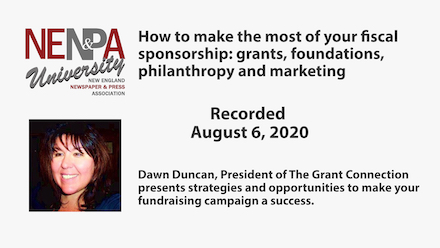
This webinar was developed to make your fiscal sponsorship program more successful and is essential for publishers, revenue directors, marketing managers, and any others involved in the success of your Local Community News Fund of New England or other fundraising campaigns.
This free session, held on August 6, defines what a fiscal sponsorship program is, how it can be used, and strategies to make your campaign successful to achieve your fundraising goals.
The session explored questions such as:
– How can grants, foundations, and philanthropy fit into your fundraising strategy?
– How do you find these opportunities and how do you approach them?
– How should you be marketing your campaign? We profiled one member and how they raised over $18,000 from individual donors in their first three weeks!
Presented by NENPA University, Dawn Duncan, President of The Grant Connection, Linda Conway, Executive Director of NENPA and Tara Cleary, Social Media Marketing Manager of NENPA.
Resources from webinar:
How To Make the Most Of Your Fiscal Sponsorship Slides
Foundations For News and Public Information
The Jamestown Press Campaign Launch Front Page
The Jamestown Press Campaign Launch Editorial
The Jamestown Press Campaign Launch Ad
Are you capturing all community voices?

Minnesota is in the spotlight following the recent death of a black man during a police arrest. Racial unrest has erupted everywhere and forced all institutions and organizations – everyone –to examine attitudes toward and treatment of minorities.

It’s an opportune time for newspapers to ask: Are all of your readers’ voices represented in your coverage?
Providing as many perspectives as possible to an issue or event should be part and parcel to everyday reporting. It’s the foundation of a well-rounded story.
The examples surface in everyday reporting. Consider a city council debating whether to give a tax break to a prospective big-box retailer. Stakeholders range from existing merchants to consumers. Are you reporting the comments solely of those at the front of the room? Are the opinions of those individuals in the back of the room – and, more broadly, residents across the community – given equal attention?
The necessity to give voice to all constituencies is elevated in an issue as powerful as race relations. The death of George Floyd has generated broad coverage of everything from protests to legislative proposals.
The events warrant an examination in the broadest sense of how all voices in a community are represented in everyday coverage. How are you monitoring and reporting on the demographic and social fabric of your communities?
Here’s an action item for your next newsroom meeting: Ask reporters to identify the community newsmakers. Better yet, review newspapers from the past few months and circle anyone receiving attention in words and photos.
Several individuals are likely to be on the list, no matter the community: for example, the mayor and city council president; the superintendent and school board chair; the county’s chief administrator and the county board chair; local legislators; the heads of key local commissions and task forces. And these folks probably appear with some regularity.
Then identify who is missing. Are there constituencies who live, work and play in your community but rarely are recognized? Your newspaper content, if it is to be regarded a living history, should reflect the full range of dynamics that make up your community fabric.
Examine your coverage to see if it reflects all aspects of the local landscape. This exercise if far from a once-and-done newsroom brainstorming. Include your entire newspaper family, which often represents a cross-section of your community.
Go beyond the newspaper as well. Here are some ideas:
Convene a readers’ board. Rotate a panel of citizens to regularly evaluate newspaper content.
Solicit perspectives for bigger projects such as in-depth series. Connect first with the stakeholders of a story idea, who can identify aspects they deem important to understanding a subject.
Identify and follow key influencers. The digital world brings the community to you at any time and any place. Find local bloggers, tweeters and other influencers on Facebook, Instagram and other social media. Track what’s on their minds.
Provide online forums. Have a regular “chat with editors.”
Convene brown bag lunches. Invite community members to discuss topics ranging from overall content to specific content beginning with: What voices are we missing?
Conduct a “call the editors” night. Promote an evening when managers will be “on call” to answer any and all questions, or to focus attention on a specific topic.
Identifying opportunities for expanded coverage is the first step. Developing and implementing a plan of action are next. This should be viewed as a long-term and neverending process. Make no mistake, any new initiatives will tax an already burdened newsroom in today’s changing media landscape. You cannot simply add tasks without redeploying and/or adding resources.
Share the process with your readers and encourage their participation. At the same time, make it clear that you’ll be the final arbiter of which ideas will be carried out among the multitude you’ll likely receive.
A couple of points in that regard: Be clear in setting expectations; you can’t be all things to all readers. Weigh your action plans carefully; avoid token stories and focus on coverage that can be continuing and substantive.
All of this is hard work, but the effort will reap dividends for everyone. The ideas will translate into substantive content, and your newspaper will increase its relevancy in readers’ everyday lives.
Ten ways to mess up an online presentation

These days, ad professionals are conducting more digital presentations than ever before. While there are some similarities with in-person meetings, there are some significant differences. Let’s take a quick look at ten of the biggest mistakes in online presentations:

1. Problems with technology. “Can you hear me now?” is more than a line from an old television spot; it’s a reality of many online conversations. As you plan the presentation, be sure to consider the meeting platform, webcams, and desktop-tablet-phone differences. It’s better to address those issues ahead of time than to be surprised when things are underway.
2. Unprofessional appearance. Even if you’re presenting from home or an informal business environment, it’s important to look professional. While a business suit is not necessarily required, be sure to look neat. And don’t forget to smile.
3. Camera movement. My wife had a recent call, in which one of the participants started walking around with his laptop computer. For several minutes, the camera treated everyone to jerky views of his ceiling and kitchen cabinets, all while he was talking.
For goodness’ sakes, keep the camera in one position.
4. Distractions. We all know it’s not good to see someone fumbling with papers during a meeting at a conference table. That’s just as bad in an online presentation because it indicates disorganization.
In addition, be sure to clean up your background, so it is simple and free of clutter.
5. Hard-to-see exhibits and graphics. Advance planning is the key, here. If you display ads or charts, prepare carefully so everything will go smoothly. If you hold something up to the camera, make sure it is super-simple and in steady hands.
6. Winging it. There’s a sneaky little voice in some salespersons’ minds that says, “Hey, you’re not meeting in someone else’s office. You’re in familiar surroundings, and you know so much about your product that you can make the sale just by talking off the cuff.”
Don’t listen to that voice. The only way to be at your best is to prepare and practice.
7. Not acknowledging everyone. There is often a tendency to talk to the main contact and pay little attention to others in a meeting. That’s always bad manners, whether face-to-face or on a screen.
8. Talking in a monotone. It’s not just what you say; it’s how you say it. One of the fastest ways to lose attention is to speak in a tone of voice that lacks energy and enthusiasm.
Put some excitement in your words.
9. Talking too much. A remote call is not a license to “talk at” people. Whatever the format, a sales conversation should be a dialogue, not a monologue. Think of ways to encourage. Ask plenty of questions and respond to their answers with respect. 10. Not listening between the lines. Watch for facial expressions and listen for voice infections, just like you do in on-site presentations. If you don’t, you may miss something which could be a deal maker or deal-breaker.
10. Not listening between the lines. Watch for facial expressions and listen for voice infections, just like you do in on-site presentations. If you don’t, you may miss something which could be a deal maker or deal-breaker.
(c) Copyright 2020 by John Foust. All rights reserved.
Peter Lamb Shares Best Practices in Sales and Management
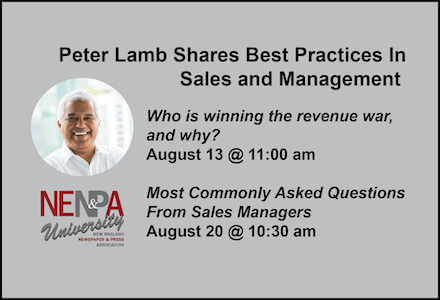
Two exciting webinars will be presented by in August by Peter Lamb, president of Lamb Consulting, a strategy firm based in Miami, Florida.
Lamb, who has more than three decades of sales and marketing experience, will share best practices for sales and management from his work with some of the world’s largest media companies to make them more efficient, more competitive, and more profitable.
His consulting practice focuses on taking sophisticated strategic marketing principles and techniques, learned at Harvard Business School, and syncing them with a hands-on sales approach, to generate new revenue streams. Lamb supports newspapers to achieve ROI by focusing on NEW-NEW revenue, an approach that targets customers that have never used your products or services.
Lamb’s speaking engagements, seminars, and webinars have been endorsed by many national/international media events, including the WAN-IFRA World Newspaper Congress, International Classified Marketing Association, Local Media Association, and more.
Don’t miss these valuable sessions, free to NENPA members, and share the information with anyone on your staff who would benefit from them.
Who is winning the revenue war, and why? – REGISTER FOR THIS SESSION
Aug 13 @ 11:00 am – 12:00 pm
This session is geared towards sales representatives and their managers and will cover who is winning the revenue war and why by relating best practices from sales reps around the world, with the challenging COVID-19 times in mind. These are some of the questions and topics we will explore:
– What do your customers really want from you?
– What should you be saying to your Customer?
– Questions to challenge and provoke your CUSTOMER.
– The Methodology of the 12-minute presentation.
– Profile of a GREAT Sales rep……how do you measure up?
Most Commonly Asked Questions From Sales Managers – REGISTER FOR THIS SESSION
Aug 20 @ 10:30 am – 11:30 am
This session is geared towards publishers, revenue officers, and ad directors. It will explore some of the most commonly asked questions from sales managers around the world:
– What should my Monday morning meeting format be?
– How much time should I spend in the field?
– Should I close the sale for the rep? Let them sink?
– What contests should I use?
– How do I build a winning team?
– What is the MODEL week for me?
Webinar Resources – Covering Business News In Challenging Times
The coronavirus pandemic is dominating headlines, generating stories on issues touching nearly every aspect of lives. Business lockdowns and restrictions have redefined commerce and reshaped daily routines. Business news from all aspects deserves extra attention during these extraordinary times.
This is also an opportunity to think about expanded business coverage during ordinary times. Stories about employers and employees have a big impact on communities. What happens at the workplace might even overshadow a decision of a local governing body. Yet, many newspapers struggle for consistent coverage of employers and employees.
This free session held on July 30 offers practical steps to start on a path of substantive coverage, including helping businesspeople understand the importance of reporting the good news as well as the bad news. Developing business news is an important step toward increased advertising revenue as well.
Presented by NENPA University and Jim Pumarlo, Owner Community Newsroom Success Strategies.
Resources from webinar:
Harsh words in presidential campaigns: Protected, nothing new
So, you think the already harsh language in this year’s presidential campaign is the worst ever?
Probably not — and additionally, political speech, vulgarities, mocking nicknames, claims of incompetence and criminal conduct and a host of personal attacks all are protected by the First Amendment’s guarantee of freedom of speech.
gpolicinski@freedomforum.org, or follow him on Twitter at @genefac.
The high legal bar for public figures to successfully sue for defamation, combined with a historical judicial reluctance to intervene in political campaigns, allows candidates and their surrogates to sling the most vituperative verbal assaults.
And throughout our history, they have.
Historian Rick Shenkman, author of “Presidential Ambition: Gaining Power at Any Cost,” has said, “Our first two elections were pretty clean, but after that they became dirty … Even George Washington (who ran unopposed in his first election, in 1788) complained he had to endure more attacks than Emperor Nero.”
The first real presidential contest, in 1800, produced what many historians might rank as number one in personal attacks, as then-President John Adams faced off against Vice President Thomas Jefferson.
From the president of Yale University, an Adams supporter, came the warning that if Jefferson won, “We would see our wives and daughters the victims of legal prostitution.” A newspaper in Connecticut declared that Jefferson would establish a nation where “murder, robbery, rape, adultery and incest will openly be taught and practiced.”
In response, Jefferson’s advocates wrote that Adams was a liar, a would-be king, repulsive and a “gross hypocrite” who “behaved neither like a man nor like a woman but instead possessed a hideous hermaphroditical character.”
A cartoon in 1800 shows a kneeling Jefferson about to place the U.S. Constitution into a fire built on a pedestal labeled French “despotism,” already ablaze with papers labeled as American patriotic essays.
Adams’s son, John Quincy Adams, was both target and attacker in the presidential elections of 1824 and 1828 when facing Andrew Jackson, who lost to Adams in the first contest and won four years later.
“American President: A Reference Resource” by the Miller Center at the University of Virginia, notes that in those contests, Adams called Jackson a “corruptionist, an aristocrat and a budding tyrant in the model of Caesar or Napoleon,” whose election would mean the end of the new American nation.
Adams’s opponents spread the unjustified charge that the president had arranged a sexual liaison between a young American girl and the Russian tsar during Adams’s time as U.S. ambassador to Russia. On the lighter side, they also published reports that Adams did not wear underwear and went barefoot to church services.
Jackson suffered through attacks in the 1828 election on his wife, Rachel, who it was said — apparently with some justification by historians — had not yet divorced her first husband before marrying Jackson. She died of a heart attack after Election Day but before Jackson’s inauguration, and at her funeral, the president-elect blamed his campaign opponents for her death. “May God Almighty forgiver her murderers, as I know she forgave them,” he said. “I never can.”
While social media may have energized today’s political exchanges — for good or bad — use and abuse of new means of communication are not new, either. In the presidential election of 1928, eventual winner Herbert Hoover ran against three-term N.Y. Gov. Al Smith, the first Catholic to be nominated by either major party. Smith’s religion was a major factor in the campaign, just three years after the Ku Klux Klan held a major parade in the streets of Washington, D.C.
“News photos” were manipulated and false claims spread that New York City’s just-completed Holland Tunnel was in fact a secret passage not to New Jersey, but to Vatican City — to be used by the pope, who would prompt Smith to take over the United States. In similar fashion, a political cartoon titled “Cabinet Meeting — If Al were elected” appeared in the “Fellowship Forum,” an official publication of the Klan. It shows the pope and other Catholic clergy at a table in the White House, with Smith in a servant’s uniform holding a whiskey jug. A news report says “more than 100,000 copies were intended to flood” southern states days before the election.
(Smith, soundly defeated, had a last laugh: In accounts by both his supporters and opponents, who no doubt had differing views on its meaning, Smith is said to have sent a one-word telegram to the pope after losing: “Unpack.”)
Some political opponents have a much more serious response to what they see as scurrilous or defamatory political speech. In 2010, an Iowa state senator won a lawsuit and more than $230,000 in damages against his opponent over a political ad he said falsely linked him to a company alleged to have sold a dangerous drug to children.
But the Iowa Supreme Court overturned the jury verdict, saying “The result … is not to imply actual malice cannot exist within the rough and tumble Wild West approach to negative commercials that have seemingly become standard discourse in many political campaigns. … but the high standards established under the First Amendment to permit a free exchange of ideas within the same discourse must also be protected.”
President Trump has said multiple times that he wants to “open up” libel laws, which could affect future campaigns by weakening free speech protections resting on a landmark 1964 U.S. Supreme Court decision, New York Times Co. v. Sullivan. It reinforced those protections when public officials (later expanded to include public figures) are involved.
Justice William Brennan wrote that the decision was rooted in a “profound national commitment to the principle that debate on public issues should be uninhibited, robust and wide open and that it may well include vehement, caustic and sometimes unpleasantly sharp attacks on government and public officials.”
Whether offended by Trump’s impolitic use of derogatory nicknames for his opponents, or by “Saturday Night Live” Trump parodies on TV, that commitment to “uninhibited, robust and wide-open” debate on issues and even candidate personalities is a hallmark of American democracy — even if, at times, we might cringe at how it’s carried out.
Politicians get their say during campaigns. Government stays out of the way. And we get to respond at the ballot box.