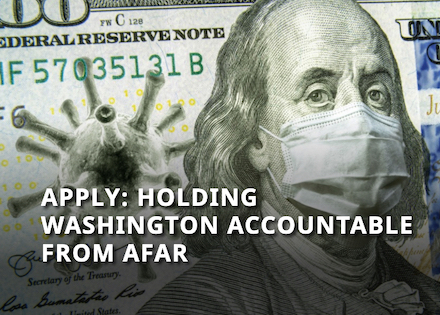
This online NPF fellowship will help journalists follow the money in Washington, whether they’re reporting from the Capitol or covering the effects of federal spending and financial regulation on their states and local communities.
Sessions meet Fridays online for 2.5 hours, starting April 30, 2021, for eight weeks. The application deadline is Monday, April 12 at Midnight.
This fellowship will offer skills, sources, and best practices to journalists who want to track the $1.9 trillion COVID relief package and report on whether the funds are flowing to and/or having an effect in communities disproportionally affected by the COIVD-19 pandemic. It is also designed to help journalists who wish to power their accountability reporting with a deeper understanding of congressional finance, corporate lobbying, antitrust, taxation, and other federal regulatory issues that will be debated in 2021 and beyond.
When government fails, it’s the rare public official who says, “Oops. My fault.”
That’s human nature, particularly for officials in the public eye who may have to run for office again. No one wants to be held directly responsible for letting the public down.
Ken Paulson is the director of the Free Speech Center at Middle Tennessee State University, a lawyer and a former editor-in-chief of USA Today.
Case in point is the recent catastrophe in Texas, when unexpected winter storms left 4 million homes without power, ruptured pipes and tainted the water supply for many.
Texas’ energy grid essentially collapsed. While Texas Gov. Greg Abbott was quick to blame frozen wind turbines, the cause was much more complex than that. To truly understand how things went so terribly wrong will require time, study and research.
So, too, with the coronavirus vaccine distribution. In this state and others, residents are frustrated with the slow rollout of vaccines. Is it poor distribution? Politics? A flawed strategy? These are literally matters of life and death.
But how do you get to the truth when public officials so rarely step up to take direct responsibility for failures?
The answer is public records. And public meetings. And access to the information that taxpayers deserve.
States throughout the country have laws that guarantee access to government records and meetings. But the details vary widely and there are many statutory exceptions. New challenges to access emerge every year in virtually every state.
The need to fight for government transparency is reaffirmed each year during Sunshine Week, a national awareness event overseen by the News Leaders Association and keyed to the March 16 birthday of James Madison. The fourth president of the United States drafted the Bill of Rights – including the guarantee of a free press – in 1791.
That journalism connection reflects the role news media play in the free flow of information, but it unfortunately can also leave the public with a sense that Sunshine Week reflects the concerns of a single industry.
To the contrary, access to government information is critical to every American who cares about the quality of his or her community, state and nation.
It’s important to see government employees – including elected officials – as the people we hire through our tax dollars to do a good job for all of us. If you run a business or hire a contractor, you wouldn’t hesitate to demand a full understanding of how something went wrong. That should be exactly our relationship with government.
Getting that information, though, requires public meetings where residents can ask questions. It also means access to the documents that led to a poor decision. Words on paper can be much more forthright than the dissembling of politicians.
It’s critical that we hold government accountable, for better or worse. (It’s also important to acknowledge when government leaders are doing a good job.)
How can you help? I have two suggestions.
First, keep doing exactly what you’re doing at this moment. Read and support your local newspaper. Local journalists, more than anyone else, will stand up for your right to information. Facebook will not be going toe-to-toe with your mayor.
Second, when you believe government isn’t doing its job, demand an explanation. Ask to see the documents. Attend public meetings. And above all, support legislative efforts to make government more transparent.
It’s too easy for officials who have failed us to point fingers, blame the media and wait for their side of the partisan fence to rally to their defense. We deserve better. We all pay taxes to support the work of the government. We should get our money’s worth.
As journalists, we rely on open government and freedom of information principles to keep the public informed about their government. Too often, though, we are met with roadblocks.
With Sunshine Week happening on March 14-20, we invite you to hold our government leaders and agencies accountable by running an editorial on the importance of open government.
Please join us in raising our collective voice for transparency and access to public information, and what it means for your readers and community.
This is a call for action on the importance of open government. Please publish an editorial during Sunshine Week, March 14-20. Write your own or you can use one of the two below. To educate your staff or readers a list of free Sunshine Week webinars is also included below.
Let us know that you’ll be participating and we’ll collect all editorials submitted and feature them in our eBulletin at the end of the month.
There’s a reason we need a free press, despite its faults and foibles: Democracy won’t work without it.
This column expresses the views of Gene Policinski, senior fellow for the First Amendment, Freedom Forum.He can be reached at gpolicinski@freedomforum.org, or follow him on Twitter at @genefac.
The grand experiment in self-governance that is the United States is rooted in trust and confidence we all will work toward the greater good. But the nation’s founders had experience with a king and his expected benevolence — and what could happen when things didn’t work out.
So, they provided for three branches of government to balance each other, along with periodic elections and the rights for us to assemble and seek change when we think things have gone astray.
All fine, but also relatively long-term solutions. How do we know what our government is doing, how well it is operating or whether our elected officials are up to the job?
Enter the only profession mentioned in the Constitution: A free press, to serve as a “watchdog on government.” A free press the government cannot control, to offer an independent, regular update on behalf of the rest of us.
Let’s stop to acknowledge that many of us are dissatisfied with the free press we have. Survey after survey shows low public trust in our news outlets and in the journalists who staff them.
But in those same Freedom Forum surveys about the First Amendment that began in 1997, the desire for that watchdog role remains high, often supported by a majority of people questioned.
How can these two results co-exist? The answers rest in what kind of press we mean. Much of the highly visible kerfuffle on social sites today concerns national reporting, and more narrowly, the political pundits on cable TV and the tiny percentage of journalists who are the White House press corps.
For most of us, today’s journalism is something different — and much more relevant to us. We see a news media bringing us the day-to-day information we need to live our lives: What local officials are saying, weather forecasts and crime, health and safety reports for our communities. The work of journalists helps us get things done. Reporters ask the questions we would ask if we could be there.
Jurors in Des Moines, Iowa, this week appeared to support the role of journalists as watchdog when they acquitted reporter Andrea Sahouri, who was arrested while covering a Black Lives Matter protest despite her repeated protestations that she was a journalist.
Local journalists, who are the vast majority of the 24,000-plus on the job today, live in the communities on which they report. In just the past month, they have reported on COVID-19 vaccination programs — both the successes and failures by officials we depend upon to keep us safe and fight the pandemic.
Other recent stories told by big and small news operations alike will benefit hundreds of thousands, if not millions of us.
A report on nursing homes in New York state disclosed they may have tested unproven COVID-19 treatments on residents, despite safety warnings, without telling family members. A news partnership in South Carolina found the state has dropped virtually all oversight of local officials’ activities, leading to “questionable or illegal perks of holding public office.” In Mississippi, residents now know a biodiesel plant is accused of illegally dumping hazardous material into public waterways.
Throughout our nation’s history, it has been a free press that has probed, prodded and produced safer food and medicines and helped reveal waste, fraud and abuse of public trust.
Reporters uncover these stories only by poring over records, reviewing court documents and interviewing sources — activities most of us don’t have the time, skill or opportunity to do.
The guarantee that a press is free does not guarantee it will always be good or correct, or that we will like what it presents. But there are more ways than ever to get news and information and to find reports we can trust or verify.
Ironically, the newest source for news and information has helped create some of the greatest threats to a free press in the nation’s history:
The web has decimated financial support for traditional media, and newer media is not yet robust enough to take its place. This results in “news deserts,” where no regular sources of journalism exist.
Misinformation can now spread across the globe in milliseconds, sowing doubt, confusion and mistrust of the reports and motives of a free press.
The free press in any form has been weakened by cuts in staff, with surveys showing the ranks to be less than half of what they were 20 years ago.
Not all the news about a free press is bleak. New financial models are being tested. Collaborations between news organizations and nonpartisan expert collectives have shown results. New attention is focused on regrowing the ranks of local journalism. But more is needed, from increased public support to new revenue sources to regaining the public trust.
On March 16, we celebrate the birthday of James Madison, the principal author of the First Amendment and the rest of the Bill of Rights. He called a free press “one of the great bulwarks of liberty.”
This generation, perhaps unlike any other, is being called on to defend that bulwark and, in the process, protect our liberty.
Named after the late publisher of The Providence Journal, the Hamblett Award is given each year to an individual who has promoted, defended or advocated for the First Amendment throughout his or her career.
The program will be held online. Ticket and registration information can be found here. All proceeds will benefit civics and First Amendment education in New England.
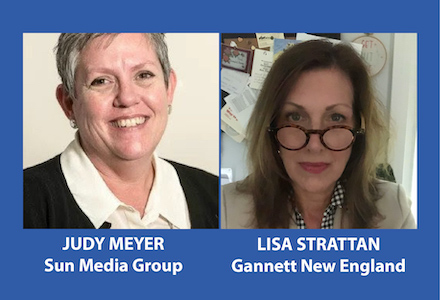
The New England First Amendment Coalition is pleased to announce two additions to its Board of Directors: Judy Meyer, Executive Editor of the Sun Journal, Kennebec Journal and Morning Sentinel; and Lisa Strattan, vice president of News for Gannett New England.
“We are thrilled to have Judy and Lisa join our Board of Directors,” said Justin Silverman, NEFAC’s executive director. “Their experience and expertise will help strengthen our advocacy in Maine and throughout all New England states.”
Editor & Publisher put out their call several months ago for their annual 10 News Publishers That Do It Right contest. Newsrooms had a lot on their plates, being right in the middle of the pandemic, and they were not even certain how many newsrooms would submit to this year’s contest. But they received more than 50 nominations.
The Record-Journal based in Meriden, Connecticut made the list of 10 news publishers that are getting it right.
Like other newsrooms around the country, when the pandemic hit in March 2020, the Record-Journal had to suddenly think of new and innovative ways to conduct business. Like accepting donations from the public through the Local Media Association’s COVID-19 local news fund, raising $21,000 from donations in a two-month period.
Then in May, they received a $99,501 COVID-19 relief grant from Facebook and put it to use immediately bringing back furloughed employees, investing in technology, and providing free marketing for nonprofits like the United Way and others.
In a recent article for Editor & Publisher Gabe Schneider writes about how journalism outlets need new and better social media policies, especially in the wake of the events of 2020.
“But even in the wake of massive protests, even as management at many legacy newspapers committed to better social media policies, and even as journalism has shifted to a mostly online workforce, there’s been a lack of movement in newsrooms to craft a social media policy that allows journalists of color to just do their jobs.”
“The trend line is that reporters, often Black, are punished for their perspective, even if it’s rooted in reporting and facts. Punishment can mean being barred from covering a topic that is close to the reporter’s identity, or an implied threat of being fired.”
The Maynard 200 fellowship provides cutting-edge training and year-long mentorship for leaders, storytellers and media entrepreneurs of diverse backgrounds via the expertise of a distinguished faculty across relevant disciplines. The program supports and emboldens the next generation of leaders, creators and founders of new media ventures.
Candidates can apply for one of three tracks — Storytelling, Advanced Leadership and Media Entrepreneurship.
The program is tuition-free thanks to funding by Google News Initiative, Craig Newmark Philanthropies and The Wunderkinder Foundation. Some travel support will be available for the second training week if it is in person.
The application period opened last year, and the new extended deadline is March 5, 2021.
Fellows are required to attend both training weeks and to participate in the year-long mentorship and supplementary courses.

 As journalists, we rely on open government and freedom of information principles to keep the public informed about their government. Too often, though, we are met with roadblocks.





Open government is key to honest government
When government fails, it’s the rare public official who says, “Oops. My fault.”
That’s human nature, particularly for officials in the public eye who may have to run for office again. No one wants to be held directly responsible for letting the public down.
Case in point is the recent catastrophe in Texas, when unexpected winter storms left 4 million homes without power, ruptured pipes and tainted the water supply for many.
Texas’ energy grid essentially collapsed. While Texas Gov. Greg Abbott was quick to blame frozen wind turbines, the cause was much more complex than that. To truly understand how things went so terribly wrong will require time, study and research.
So, too, with the coronavirus vaccine distribution. In this state and others, residents are frustrated with the slow rollout of vaccines. Is it poor distribution? Politics? A flawed strategy? These are literally matters of life and death.
But how do you get to the truth when public officials so rarely step up to take direct responsibility for failures?
The answer is public records. And public meetings. And access to the information that taxpayers deserve.
States throughout the country have laws that guarantee access to government records and meetings. But the details vary widely and there are many statutory exceptions. New challenges to access emerge every year in virtually every state.
The need to fight for government transparency is reaffirmed each year during Sunshine Week, a national awareness event overseen by the News Leaders Association and keyed to the March 16 birthday of James Madison. The fourth president of the United States drafted the Bill of Rights – including the guarantee of a free press – in 1791.
That journalism connection reflects the role news media play in the free flow of information, but it unfortunately can also leave the public with a sense that Sunshine Week reflects the concerns of a single industry.
To the contrary, access to government information is critical to every American who cares about the quality of his or her community, state and nation.
It’s important to see government employees – including elected officials – as the people we hire through our tax dollars to do a good job for all of us. If you run a business or hire a contractor, you wouldn’t hesitate to demand a full understanding of how something went wrong. That should be exactly our relationship with government.
Getting that information, though, requires public meetings where residents can ask questions. It also means access to the documents that led to a poor decision. Words on paper can be much more forthright than the dissembling of politicians.
It’s critical that we hold government accountable, for better or worse. (It’s also important to acknowledge when government leaders are doing a good job.)
How can you help? I have two suggestions.
First, keep doing exactly what you’re doing at this moment. Read and support your local newspaper. Local journalists, more than anyone else, will stand up for your right to information. Facebook will not be going toe-to-toe with your mayor.
Second, when you believe government isn’t doing its job, demand an explanation. Ask to see the documents. Attend public meetings. And above all, support legislative efforts to make government more transparent.
It’s too easy for officials who have failed us to point fingers, blame the media and wait for their side of the partisan fence to rally to their defense. We deserve better. We all pay taxes to support the work of the government. We should get our money’s worth.
Please join us in raising our collective voice for transparency and access to public information, and what it means for your readers and community by publishing an editorial during Sunshine Week, March 14-20.