Madison Cawthorn, a Republican candidate for the House from North Carolina, created an attack website accusing a journalist of leaving a job in academia “to work for non-white males, like Cory Booker, who aims to ruin white males running for office.”
The journalist, Tom Fiedler, who had written favorably about Cawthorn’s opponent, is a former dean of the Boston University College of Communications and past president of the New England First Amendment Coalition. He volunteered for the 2020 presidential campaign of Booker, D-N.J.
While local reporters rush to cover the decade’s most important stories, publishers have tried to find their financial footing in Covid-19’s “new normal.”
Last spring, as the pandemic arrived in the United States and spread, local journalists — largely from home offices — wrote about closing businesses, town-by-town testing procedures, and community resilience, attempting to quell uncertainty.
Emma Cotton of VTDigger.com dives into the high stakes for newspapers, their coverage areas, and how Vermont newspapers are adapting to the changes brought about by the pandemic through interviews with publishers, editors, and media experts.
Local Media Foundation announced the first stipends for investigative reporting recipients from the Fund for Local Journalism. The winners include a diverse mix of local news organizations, all focused on empowering critical change in their communities.
In this round, stipends go to projects focused on one of three topics: education, social injustice, or the unhoused.
10 investigative reporting stipends of $5,000 each, will be awarded.
This data-driven project will dive deep into the numbers to better understand if New Hampshire’s policing is fair to minority populations by evaluating ten years of history from all NH cities and towns on issues related to police funding, the number of officers, demographics of the departments, and violent crime arrests. Finally, they will propose solutions.
Seven Days, Vermont’s free, independent newsweekly, won four first-place awards from the Association of Alternative Newsmedia in a virtual ceremony on September 18. One of the winning entries, a joint project with Vermont Public Radio about Vermont’s state-licensed assisted living and residential care homes, received a national Edward R. Murrow award for investigative reporting from the Radio Television Digital News Association on October 10.
Editor & Publisher (E&P), the Poynter Institute and America’s Newspapers have partnered to launch the Media Job Board, serving the media industry with cutting-edge job-matching technology and targeted network distribution powered by PandoLogic.
Job seekers can connect with Media Staffing Network (MSN), a totally “media-focused” staffing company, to help them make the next move in their careers.
Employers who post jobs on the new Media Job Board receive unprecedented reach to top media professionals across many websites and on TheJobNetwork™, the largest recruitment ad network of job sites in North America.
Through this new partnership, job postings appear on the website at www.mediajobboard.com, in Editor & Publisher magazine and on Poynter’s website.
Editors and reporters are facing some of their biggest challenges in gathering news during the pandemic. Access to everyday sources is increasingly limited with no relief on the horizon.
Jim Pumarlo writes, speaks and provides training on community newsroom success strategies. He is author of “Journalism Primer: A Guide to Community News Coverage,” “Votes and Quotes: A Guide to Outstanding Election Coverage” and “Bad News and Good Judgment: A Guide to Reporting on Sensitive Issues in Small-Town Newspapers.” He can be reached at www.pumarlo.com and welcomes comments and questions at jim@pumarlo.com.
Reporters no longer can walk into offices unannounced, and appointments are restricted. Remote work remains the norm at many places.
And don’t expect immediate responses to phone calls. Individuals are often consumed by Zoom meetings as the new norm for communications.
Logistics are demanding enough to connect with your regular corps of newsmakers. Then consider everyday readers – the local names and faces who provide so many distinctive stories – who may be approached by a reporter for the first time. They are likely more hesitant – at least extra cautious – as they protect personal health.
Solid reporting still can be done during these extraordinary times, but it takes extra effort. Small and large newspapers are generating excellent stories not only on the pandemic but also on the everyday churn of news.
At the same time, it’s disheartening to see those newsrooms that have taken the shortcuts, all to the detriment of substantive content.
Residents object to a proposal under consideration by a school board. The reporter, watching a TV broadcast of the meeting, quotes the speakers but fails to identify them.
The primary election determines which candidates for local offices will advance to the general election. Winners are reported – but no vote totals and no apparent attempt to get comments from any of the winners or losers.
Three longtime city employees retire, representing nearly 100 years of service. The communications director is the sole source for the story, which is basically a brief bio of each employee.
Any number of announcements from new sports coaches to political candidacies to community initiatives are handled by press releases only – no conversation with a reporter.
A major employer reopens after being shut down during the pandemic. The story recites what is on the company’s website.
Navigating the pandemic unfortunately has resulted in far too many single-source stories without the benefit of Q&A by reporters. Press releases are published verbatim. Questions are posed, and responses returned via email or text message. Government actions are reported, but there is no follow-up on how decisions affect residents and businesses.
Reporting indeed demands additional effort during the pandemic. It also takes more planning as contacting individuals often requires multiple inquiries.
So take the extra steps. Connect via Zoom or telephone. Zoom offers reporters the option to record and post video of their interviews. Also, digital recording via Zoom offers automatic transcription so reporters can use bits and pieces for tweets, Facebook and other social media, and video clips for YouTube. Meet face to face, wearing a mask and practicing social distancing. In-person interviews allow reporters to describe the environment and elaborate on details that distinguish feature stories.
At minimum, reporters need to be honest and transparent with readers. Let them know the nature of the “interviews” – whether information is gathered by an exchange of emails or text messages, participation in a virtual event, or watching a broadcast.
And don’t forget the long-term impact of lackadaisical reporting. Sources will become accustomed to “feeding” stories word-for-word to reporters and may well be more reluctant to engage in an interview.
I remain a firm believer that local newspapers have an edge in the fractured media landscape by being the premier clearinghouse of information in your communities. Your newspaper family represents a valuable, collective set of eyes and ears. But you must use those resources to remain the go-to source for news and advertising.
Consider this event that caught the attention of an entire town and was reported in media across the state.
A speeding vehicle crashed into a historic building causing extensive damage to the business and upstairs apartments. The building was immediately condemned until next steps were determined. Onlookers streamed to the site; roads were closed.
The post went up on the newspaper’s website. The report included comments from an eye witness to the crash, but otherwise relied solely on press releases.
Two days later, the same two stories appeared verbatim in the print edition. Still no interview with the business owner, the employees present when the accident occurred, or the upstairs tenants who felt the building shake. No identification of the displaced residents or information about assistance for temporary shelter. No mention of fundraising efforts or accompanying contact information. No initial dollar estimate of the damage. The fundamental 5Ws and H of all stories were nonexistent in the report.
For other aggressive reporters, what is the tool you’ll use for your live channel? When a story breaks, how fast can you be there live and broadcast in real time? Do you have a URL set up, and do your readers know about it?
Then consider other missed opportunities for the newspaper to shine in its coverage and distinguish itself from competing media. Connect with the building inspector and an engineer to offer perspective on how such a crash resulted in such extensive damage. Chronicle the origins and tenants of the building, one of the more historic structures in the downtown. Work with city officials to videotape the damage and post it on the website. You can add to the list.
Newspapers across the country are fighting for their survival due to economic repercussions of COVID-19. Circumstances have prompted editors and publishers to regularly promote the message: “We’re here 24/7 reporting on the stories in your community.”
Such pronouncements are only as persuasive as the supporting evidence.
Ten Black-owned media organizations have joined forces with the Local Media Association (LMA) to launch the Fund for Black Journalism, an initiative to reimagine and support the Black press. The campaign can be found at givebutter.com/journalismfundblacknewspapers. The goal is to raise $25 million over the course of three years. At press time, it has raised $112,175.
These funds will be invested in shared services, technology, staff investment and Black news entrepreneurship. News outlets will be able to access resources like researchers that will be hired with the fund, and they will also receive stipends on a regular basis.
The Donald W. Reynolds Journalism Institute is now accepting 2021-22 RJI Fellowship applications from individuals or organizations with an innovative journalism project idea that could also benefit the industry.
Potential project ideas could include devising new strategies or models to solve a problem, building new tools, creating a prototype, or advancing a prototype, so it’s ready to launch.
This year’s fellowship projects address the increasing challenges in covering climate change, unpublishing, harassment of marginalized journalists and more.
RJI will be hosting its 15th class of fellows in 2021–22. Applications are due Dec. 18, 2020.
Since launching in 2004, the fellowship program has hosted a wide variety of entrepreneurs and innovators that have come from different backgrounds including large legacy newsrooms and small nonprofits.
“Our fellows are trailblazers, creative thinkers, determined doers and great partners,” says Randy Picht, RJI’s executive director. “If that sounds like you, then it’s time to apply.”
RJI’s eight-month fellowship is a flexible program with three types of fellowship options — residential, nonresidential and institutional that give fellows the time, space and resources they need to work on projects.
The 2020 election is no laughing matter — except that it is, in the great American tradition of humor and satire that has marked virtually every election.
This column expresses the views of Gene Policinski, senior fellow for the First Amendment, Freedom Forum. He can be reached at gpolicinski@freedomforum.org, or follow him on Twitter at @genefac.
This time around: Jim Carey’s nascent “Joe Biden” and Alec Baldwin’s long-running “Donald Trump;” the late-nightly salvoes of Stephen Colbert and the daily — sometimes hourly — haranguing tweets from Trump himself; conservative talk radio’s sharp-edged verbal darts and the Lincoln Project’s wickedly humorous videos.
As it has since the 1970s, NBC’s “Saturday Night Live” again steps into the role of the nation’s satirist, continuing a tradition that stretches back nearly 250 years, into the colonial era with its biting print depictions of King George III and frequent effigies burned or hung from trees in public squares.
The First Amendment’s protection of free speech shelters those who poke, prod and even anger those in power — via satire and parody — and elections bring out those efforts tenfold.
Thomas Jefferson and John Adams tossed insults and satirized images of each other in competing newspapers in the 1800 presidential race. Blunt, single-sheet cartoons were hung in taverns and homes depicting Andrew Jackson as a ruthless authoritarian. One, published in 1830, showed him dressed as a king, complete with crown, trampling on the U.S. Constitution.
“Political satire has been used throughout American history as a more gentle way of commentary,” says Alison Dagnes, a Shippensburg University political science professor and author of the book “A Conservative Walks Into a Bar: The Politics of Political Humor.”
One recurring question: Why there are more liberal political satirists than conservatives, both today and in the past? Dagnes writes that “conservatism supports institutions and satire aims to take those institutions down a peg … the very nature of satire mandates challenges to the power structure.”
Two modern-day comedians exemplify those who have swum against that liberal tide: Dennis Miller, who pivoted to a conservative view after the Sept. 11 attacks, who said of his political views that he found “liberalism is like a nude beach — it sounds great until you get there.” And self-described “libertarian conservative” P.J. O’Rourke, who said the Obama administration was simply “the Carter administration in better sweaters” and supported Hillary Clinton in 2016 over Trump, saying “She’s wrong about absolutely everything, but she’s wrong within normal parameters.”
How effective can satirists be in shaping events in the real world? William “Boss” Tweed, whose crime syndicate in the 1870s stole or extorted more than $2 billion dollars (today’s value) in public funds, was the target of Harper’s Weekly cartoonist Thomas Nast. Nast drew the corpulent Tweed as a bulgingly fat character with a money bag in place of his head and historians often credit Nast as fueling the charge to bring Tweed to justice.
Another Nast cartoon of note, from the Newseum collection, “The Only Thing They Respect or Fear,” shows Tweed doffing his hat to a row of hangman nooses, as his cronies cringe in fear. Political cartoonists are credited with helping Abraham Lincoln win reelection in 1864 and a century later, The Washington Post’s Herblock (Herbert Block) was viewed by critics and admirers as a major reason the Watergate scandal remained in public view even as the administration worked to downplay it.
Block relished his work, writing that it was “an irreverent form of expression, and one particularly suited to scoffing at the high and the mighty. If the prime role of a free press is to serve as critic of government, cartooning is often the cutting edge of that criticism.”
Social media often focuses on the “cut” in cutting edge: When Trump returned to the White House from treatment for COVID-19, satirists immediately posted their own version of his purposeful balcony appearance and maskless salute — from titling single images as “Benito Trumpolini” (after a similar pose by Italian dictator Benito Mussolini) to a Lincoln Project video, “Covita,” parodying the lyrics from Broadway showtune “Don’t Cry for Me, Argentina” as “Don’t Cry For Me, White House Staffers.”
Trump has done his own part on social media to carry satire forward in history, with memorable tweeted nicknames such as “Sleepy Joe” (Biden), “Crooked Hillary” (Clinton), “Little Marco” (Rubio) and “Lyin’ Ted” (Cruz).
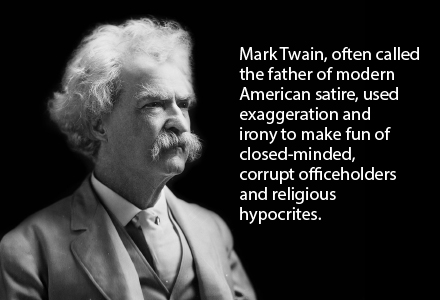
Mark Twain, often called the father of modern American satire, wrote such classics as “Huckleberry Finn” and “A Connecticut Yankee in King Arthur’s Court” using exaggeration and irony to make fun of closed-minded, corrupt officeholders and religious hypocrites.
A direct Twain descendant-in-humor, early radio celebrity and newspaper columnist Will Rogers used homespun language to jab politics in general. “I don’t belong to any organized political party,” he once said. “I’m a Democrat.” Another line from Rogers: “The trouble with practical jokes is that very often they get elected.”
“Saturday Night Live” (SNL) and “The Daily Show,” with comedians Jon Stewart and now Trevor Noah, have set the tone for modern political satire.
Each election cycle for more than 40 years, SNL has produced memorable political parody — from Chevy Chase’s devasting portrayals of Gerald Ford (actually an accomplished athlete) as a bumbler, to Phil Hartman’s cheeseburger-guzzling Bill Clinton, to Tina Fey’s remarkable and transformative skewering of 2008 GOP vice-presidential candidate Sarah Palin.
Stewart’s prominence in political satire from 1999 to 2015 produced a unique form of praise: Some credited him and his program as a new form of journalism. While his staff of writers and researchers included former journalists as fact-checkers to ensure accuracy, Stewart consistently said he put comedy first. Still, as my Freedom Forum colleague Patty Rhule said of Stewart and his program in a New York Times interview about the show as centerpiece of the Newseum’s 2019 “Seriously Funny” exhibit: “For a generation, he was their voice of the news.”
Stewart was the latest iteration of post-World War II comedians willing to take on social mores, censors and sometimes the courts: Mort Sahl and Lenny Bruce both mocked powerful political figures of their era — with Bruce famously being prosecuted for using so-called “blue” language that today is a common feature across cable TV comedy specials.
For two seasons in the late 1960s, brothers Tommy and Dick Smothers used satire via a prime-time CBS variety show — prompting President Lyndon B. Johnson to make an angry late-night call to network President William S. Paley. The show later was canceled over fights with network censors. “Doonesbury” cartoons have made fun of presidents and politicians and found humor and targets across American culture since the 1970s. But writing in 2015 in The Atlantic, cartoonist Gary Trudeau reflected on whether there are lines not to be crossed in satire.
In 2015, terrorists angered at French magazine Charlie Hebdo’s criticism of Islam and reprinting of cartoons of the Prophet Muhammad that had originally appeared in the Danish newspaper Jyllands-Posten, attacked the magazine’s Paris office, killing 11 staffers and a security officer.
“Traditionally, satire has comforted the afflicted while afflicting the comfortable. Satire punches up, against authority of all kinds, the little guy against the powerful,” Trudeau wrote. “By punching downward, by attacking a powerless, disenfranchised minority with crude, vulgar drawings closer to graffiti than cartoons, Charlie wandered into the realm of hate speech.” Trudeau called the resulting violence a “bitter harvest.”
Whether they entertain or enrage, inspire or infuriate, comfort or inflame, humor and satire in a political setting often serve to bring out truths. From the subtle to the complex, satire focuses us on facts that otherwise might be lost in the daily horserace reporting that dominates modern-day election reporting.
As that 21st-century sage Homer Simpson once observed, and was quoted in a different Newseum exhibit, First Amendment freedoms of speech, petition and assembly do not exist to protect “burping” — they are there to allow us to speak to our fellow citizens about matters of public importance.
Satire and parody provide information, a release from the seriousness of much of politics and are a means to express ideas that might not find audiences in other settings.
Humor with an edge has been part of American political life as long as there was life in American politics. There’s no requirement that we be polite, respectful or even tasteful in doing it — and there’s also no barrier to getting a laugh at the same time we make a point.









Slanderous attack on former NEFAC President by GOP House candidate
Madison Cawthorn, a Republican candidate for the House from North Carolina, created an attack website accusing a journalist of leaving a job in academia “to work for non-white males, like Cory Booker, who aims to ruin white males running for office.”
The journalist, Tom Fiedler, who had written favorably about Cawthorn’s opponent, is a former dean of the Boston University College of Communications and past president of the New England First Amendment Coalition. He volunteered for the 2020 presidential campaign of Booker, D-N.J.
Read more
By Trip Gabriel New York Times