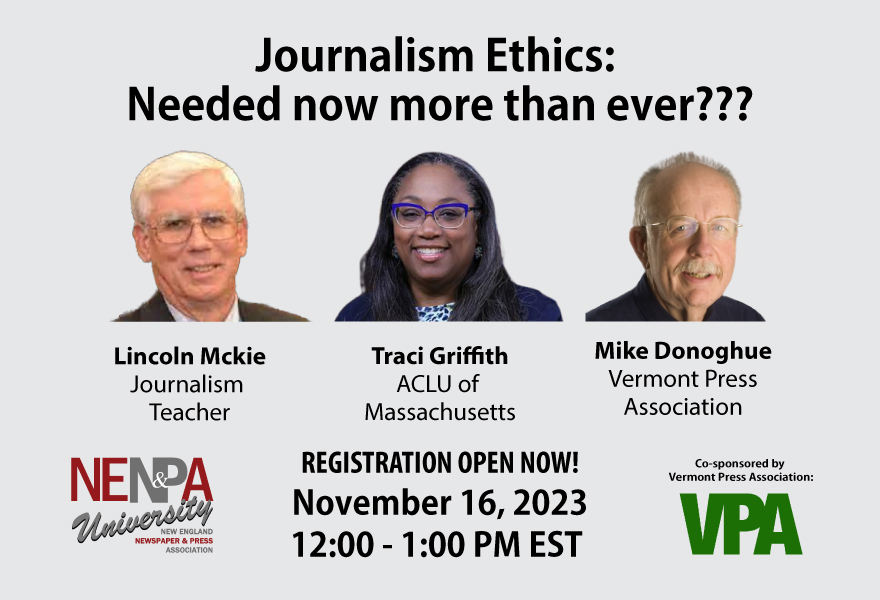
Don’t miss this lunchtime NENPA U Ethics training session on November 16 with leading New England experts!
Journalism ethics have long stood as a cornerstone in our newsrooms. Are they as important and as followed in our newsrooms today? This session will offer opinions, including yours, on that question. Our panelists also will provide their thoughts – and ask for yours – on how to avoid or escape the thorny ethical thickets that often crop up in our newsrooms. We’ll share some anecdotal examples of dealing with touchy issues on deadline and invite you to join us in some exercises on how to handle decisions involving ethics. You’re invited to bring up at this session any difficult ethical cases you’ve faced, to explain how you handled them and whether fallout ensued. Our panelists will weigh in on these cases from their experience during the Q&A at the end of the session.
Presented by Traci Griffith, Racial Justice Program Director for the ACLU of Massachusetts, Mike Donoghue, Executive Director for the Vermont Press Association, and Link McKie, Consultant and Journalism Professor. Please click on each speaker’s name to view their biography.
The session happens on November 16 from 12:00 -1:00 pm and is being held inside the NENPA member community. NENPA member tickets are free, non-member tickets are $15 each. If you have any problems registering or are not getting the free member ticket option please email t.cleary@nenpa.com for assistance.
During the New England Newspaper Conference on October 19, Brian Stelter apologized for starting his address by complaining about his recent interaction with The Des Moines Register. Stelter, the author and media columnist who has worked with The New York Times and CNN, said he wanted conference attendees to know how difficult it is to stop a subscription – and how that affects readers’ perception of their news organizations.
In preparing to cover the presidential campaign in Iowa, Stelter subscribed to The Des Moines Register for a week or two. (A six-month subscription cost $1.) But when he tried to cancel the subscription a week or two later, it turned into an ordeal. You’ve got to call the newspaper, he said – you can’t cancel online. And then he had to talk with a service rep who transferred him to a manager so he could repeat his story that he no longer needed the newspaper. Yes, newspapers want to try to keep subscribers from leaving, Stelter said, but the whole process was miserable. Stopping a Netflix subscription is much easier, he said – and it leaves you with a much better feeling about their company. You’re more likely to subscribe again.
Here’s the thing: Stelter’s a big fan of his local papers in Hunterdon County, N.J., especially for the local-local information that’s not in the big metro papers – things like where to take his kids on weekends, what events have been canceled, what’s happening at local schools. Too often, he said, Facebook is now doing what local papers once did, especially on breaking news – sending text alerts to tell people where the firetrucks are going right now, or where the streets are closed because of a gas main leak. There’s a real opportunity at the neighborhood level, he suggested.
In the Q and A, Stelter kept the discussion on this issue of engagement. Participants agreed that readers want to talk to the paper. When the editor of the Waterbury Republican-American asked readers for their opinion of how the newspaper was doing, 300 people responded, William Pape said. And his newspaper is now inviting readers to submit questions they would like mayoral candidates to answer at an upcoming debate the paper is sponsoring.
Another conference-goer asked Stelter what else newspapers could do to encourage interaction with readers, citing a recent CJR feature, “The Interview: Jeff Jarvis on what the magazine was.” In that interview, Jarvis said that when media moved online, they often just posted content, and let readers comment. They were unwilling to engage readers in a dialogue about the news and their opinions.
Stelter listed several ideas on what news media could do differently to engage readers.
Be reachable. List the reporter’s email address below their byline. Stelter does it himself all the time – bstelter@gmail.com
Teach readers about media literacy – how media do their work. When we teach them what we are (and what we’re not), we help them gain trust. For example, we’re not a community bulletin board: we don’t print anonymous complaints, the way social media sites do. A “Note from the Publisher” can help readers understand our mission.
The battle for trust is a constant battle: you gain a few yards every day, and you lose a few yards when you make mistakes. Asked what media people trust, Stelter pointed to the New York Times – but he admitted they’re in a class by themselves. He applauded Tegna (Gannett’s TV group) for their “Verify” feature. It shows viewers that the TV stations are on their side, Stelter said.
Show people who you are. You’re their neighbors; you live where they do. Add reporters’ emails and their photos. Conduct web chats. Use text messaging to alert people when there’s trouble. Conduct neighborhood chats during local emergencies so people can share where they’re seeing flooding, for example. Use more “push” emails, since readers still welcome relevant content in their inbox.
Build community. Help people overcome social isolation by connecting them to neighbors. Couldn’t newspapers build “neighbors” social platforms for specific sections of their cities and regions? Show them you’re not the big, stand-offish metro paper.
Prevent charges of bias by running longer articles that report on all sides of an issue. Print the full story, giving the broad spectrum of opinions on book banning or gender issues. Don’t cut stories short now that we have space online. “The more people you quote, the more people feel heard,” he said.
Use Facebook, since Facebook is where many people turn to for local news.
Give a free, six-month subscription to new homeowners, one conference-goer suggested. Stelter endorsed that idea.
Recognize that everyone trusts some source for news and information. It’s just a fact that you’ve got to get your information somewhere so you’ve got to trust someone. People who turn to conservative media clearly trust Fox Sean Hannity or Alex Jones. Our job is to get them to trust reality-based media, Stelter said.
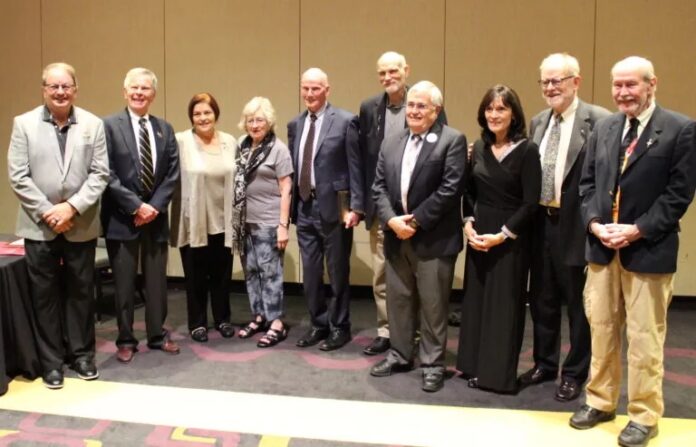
Bill Ketter is joined by previous SPJ honorees during the society’s President’s Award Banquet.
Bill Ketter, CNHI’s senior vice president of news, received SPJ’s highest honor on September 30 in Las Vegas.
The Society of Professional Journalists feted Ketter with the Wells Memorial Key award, recognizing his distinguished career and contributions to the journalism community.
In addition to numerous other state, regional, and national awards, he received the New England Academy of Journalists Yankee Quill Award in 1985 for exceptional career contributions to New England journalism and is a member of the New England Newspaper Hall of Fame.
Past SPJ National President Alex Jones said in a prepared statement, “For decades, Bill Ketter has been one of the nation’s most respected and admired journalists,” calling the award a “fitting tribute by an organization he has served and loved throughout that exemplary career.”
Named for Chester C. Wells, the second president of SPJ, the Wells Memorial Key is awarded to a member “who has performed outstanding service to the Society in the preceding year or through a period of years.”
The honoree has been a member of SPJ for 62 years and served in various leadership roles.
Jones called Ketter “a repository of wisdom and principle and someone I consider to be one of the Foundation’s and the Society’s top and most influential leaders.”
Ketter received the honor at the SPJ 2023 Journalism Conference at the Planet Hollywood resort in Las Vegas during the society’s President’s Award Banquet.
John Foust has conducted training programs for thousands of newspaper advertising professionals. Many ad departments are using his training videos to save time and get quick results from in-house training. Email him for information at john@johnfoust.com.
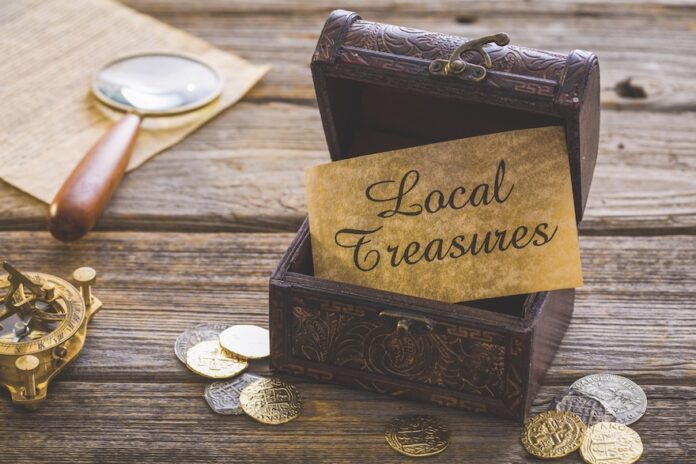
Some years ago, I attended an exhibit of treasure from the Atocha shipwreck which treasure hunter Mel Fisher had located off the coast of Florida. The Atocha was the most famous ship in the Spanish fleet that sank in 1622 in a hurricane near the Florida Keys. The exhibit was at a jewelry store that had made special accommodations for the display. All of the regular merchandise had been stored away to make room for silver bars, gold coins, and jewelry. It was an impressive show, and there was a waiting line outside.
When it was my turn to enter, a representative handed a silver bar to me and asked, “Heavy, isn’t it?” As I carefully moved the bar from hand to hand to test its weight, he mentioned that it was worth thousands of dollars. And although I’ve forgotten the exact amount, it was enough to buy a fancy new car. I told him I was just looking and spent about 30 minutes gazing at display cases and pondering buried treasure. “Just think,” I said to myself, “many years ago, these artifacts were lost at the bottom of the ocean. And here they are today, looking as good as new.”
Lost treasures have fascinated people for centuries. But not all treasures consist of gold and silver. For those of us in the advertising business, some are hidden away in file cabinets and company archives.
Take Jessica, for example. She told me about one of her advertising accounts, a local lumber company that has been in business for many years. “For as long as I can remember,” she said, “the company had run generic ‘look at us, we’re in the lumber business’ ads. All of the ads featured nondescript illustrations of stacks of lumber, with the headline, ‘Three generations of service’ and their logo at the bottom. Since a lot of their customers are commercial building contractors, they saw advertising as just a way to keep their name in front of the public.
“I knew there was a better way, so I did a little research on their advertising history. I looked through a file of their old ads, and it didn’t take long to find a series on woodworking projects. I suggested that they: (1) update their image ads to offer specific discounts to contractors and (2) revive the woodworking idea to differentiate their friendly-neighbor philosophy from the big box store across town.
“It was an easy sale because it was an update of an idea they had previously run. We expanded their advertising to include both approaches – both with the underlying “Three generations of service” theme. The first woodworking ad featured a birdhouse (with building instructions). The second one featured a kids’ playhouse (also with instructions). The next ad spotlighted picnic tables, and it went on from there. The campaign was a real boost to their business, and it added an element of personality.”
Jessica came up with a real winner. And it all started with a treasure hunt for ideas.
(c) Copyright 2023 by John Foust. All rights reserved.
Jim Pumarlo is a former editor of the Red Wing (Minn.) Republican Eagle. He writes, speaks, and provides training on community newsroom success strategies. He is the author of “Journalism Primer: A Guide to Community News Coverage,” “Votes and Quotes: A Guide to Outstanding Election Coverage” and “Bad News and Good Judgment: A Guide to Reporting on Sensitive Issues in Small-Town Newspapers.” He can be reached at www.pumarlo.com and welcomes comments and questions at jim@pumarlo.com.
A divorce is finalized, but it is not recorded in the newspaper until four months later. Someone appears in court for a domestic assault, but the sentence isn’t reported until weeks after the fact.
The subjects naturally raise two questions: What constitutes these items as news? Why is there such a delay in the report?
These instances, and many more, occurred during my tenure as editor of the Red Wing (Minn.) Republican Eagle. Other editors can likely relate.
Our simplest answer to readers is that divorces and court news are public records under Minnesota law. That is probably the case in most jurisdictions. Ambulance runs, marriages and divorces, traffic tickets, court fines – they all fall under the realm of public information and their publication regularly raised the eyebrows of readers, especially of those directly affected.
Individuals often will challenge publication of a specific record and present what they consider justification for withholding publication. Some arguments may have merit.
From our newspaper’s perspective, however, we strived to treat all public records the same. As we explained, it’s difficult to place a newspaper in the position of being judge and jury – trying to determine who has a valid argument for withholding information and who does not.
Yes, individuals may disagree with the fact that newspapers choose to print public records. But editors should expect readers would be much more critical – and legitimately so – if records were selectively published. A policy riddled with double standards is no policy at all.
Any right to publish records has an accompanying responsibility. Readers should expect newsrooms to do everything possible to ensure timely reports.
Public records often are of sensitive nature – a divorce, a bankruptcy, a court sentence. The circumstances can be stressful for individuals and the report of the item draws more attention. Delayed publication can unnecessarily aggravate a situation.
Ensuring punctual reports involves two steps. Newspapers, unfortunately, have varying degrees of control.
First is the release of the information from the appropriate agency. The process often has built-in delays, and it’s something that is out of newspapers’ hands. Newsrooms should work with officials to get the information as soon as possible.
Editors do, however, control how soon the information gets published once received. Most newsrooms can likely improve on the turnaround.
It’s common for readers to ask newspapers why they stand firm on access to and publication of specific public records. It’s much like the proverbial “if you give an inch, they’ll take a mile.” If the press agrees to one concession, all too often an individual or agency will try to stretch the rules. Soon laws are enacted with additional restrictions on what once was routinely public data.
Readers are best served by a full menu of public data rather than a selective serving.
Chapco, Inc. Marking 60 Years of Contribution to Connecticut’s Critical Manufacturing Base
Photo: Joe Santaniello – Middlesex Chamber of Commerce, Senator Norm Needleman (D-CT33), Lauren Weinstein – Chapco’s Chief People Officer, Brian Weinstein – President, Chapco, Senator Richard Blumenthal (D-CT), and Rosalyn Weinstein. Photo Credit Nick Currie, (c) Chapco, Inc.
CHESTER, CT – Senator Richard Blumenthal (D-CT), Connecticut’s 33rd district State Senator Norman Needleman (D-CT 33), and Connec4cut’s Chief Manufacturing Officer, Paul S. Lavoie, gathered to celebrate a significant milestone as Chapco, a prominent manufacturer, commemorated 60 years of precision manufacturing in Middlesex County.
Chapco, established in the mid-1960s by Charlie Hurd and Al Pross, underwent a remarkable transformation under the leadership of Robert (Bob) Weinstein and his son, Brian Weinstein, who currently serves as President. The company began in a small machine shop on Denlar Drive in Chester and has since grown to encompass 70,000 sq M of advanced manufacturing facilities across two campuses in Chester.
Following a festive luncheon on October 11 attended by customers, suppliers, local representatives, and the dedicated Chapco workforce, Senator Blumenthal highlighted the indispensable role played by manufacturers like Chapco in Connecticut’s economy and the nation’s critical defense infrastructure.
Blumenthal emphasized, “Other states may boast natural resources like uranium and gold mines or iconic landmarks such as the Grand Canyon, but in Connecticut, our true strength lies in our ‘really smart’ people. That’s our ‘secret sauce’. Submarines are the backbone of our defense capabilities, and manufacturers like Chapco are instrumental in ensuring their supremacy.”
Chapco proudly aligns with Connecticut’s thriving manufacturing ecosystem. “Our unwavering motto is ‘building partnerships, not just parts,'” expressed Weinstein. With a team of seasoned engineers, production technicians, and assembly personnel, Chapco provides comprehensive end-to-end services, encompassing tes@ng, manufacturing, assembly, packaging, and fulfillment.
Paul Lavoie, Connecticut’s Chief Manufacturing Officer also toured both campuses and witnessed a myriad of products crafted by Chapco, all originating from sheet metal blanks. These products included Integrated UVC’s innovative no-touch air and surface disinfection system, Icleanse’s cell phone UV disinfection devise, Fastcorp Vending’s cutting-edge automated retail solutions for regulated products, Denlar Fire Protection’s integrated fire suppression range hood systems, and TRUEFORM.RUNNER – the treadmill of choice for NFL superstars and NASCAR Race Teams.
Lavoie, who leads the Office of Manufacturing, is dedicated to empowering manufacturers to leverage market opportunities and cement Connecticut’s status as the Silicon Valley of advanced manufacturing. “My mission is to showcase Connecticut,” Lavoie affirmed, “and companies like Chapco make that task much simpler.”
President of Chapco and its collaborative companies, Brian Weinstein emphasized their commitment to excellence, stating, “We’ve always believed in investing in the best technologies and operating 24/7. Our recent $1.6 million investment in a Trumpf Trumatic 6000 fiber laser punch combo underscores our dedication to meeting tight deadlines and ensuring the resilience of U.S. supply chains.”
Chapco’s six decades of unwavering dedication to precision manufacturing epitomize its commitment to advancing the Connecticut manufacturing landscape. As we celebrate their remarkable journey, we look forward to their continued contributions to our vibrant community and the nation.
Congratulations, Chapco, on this significant milestone!
The Donald W. Reynolds Journalism Institute (RJI) at the Missouri School of Journalism has partnered with respected research firm SmithGeiger for a groundbreaking survey to find solutions to burnout in the news industry. The survey takes approximately 15 minutes to complete and is available here.
An estimated 70% of journalists have experienced work-related burnout, with experts saying younger journalists are at higher risk. At a time when new technology, changing revenue models and a crisis of public trust are contributing to a rapid pace of change in journalism, RJI and SmithGeiger seek to gain on-the-ground insights from journalists about the issues that lead some to exit the profession while others thrive.
“The pandemic brought the issue of burnout into focus for a lot of people, but the underlying factors that lead to high stress, exhaustion and trauma have not gone away,” said Randy Picht, executive director of RJI. “Just like a good reporter would do, we wanted to go directly to the source and see what journalists have to say about their work environment.”
The 15-minute online survey, which is anonymous and open to news organizations anywhere in the country through November, is not RJI’s first partnership with SmithGeiger. The partners previously worked together on a national survey to determine the most effective ways to educate the public about COVID-19 vaccines, research that helped lead to a COVID-19 messaging toolkit for local journalists.
This time around, the survey aims to help news leadership focus their resources on effective solutions for burnout. It will gather perspectives across all news mediums and from a diverse range of voices representing a comprehensive cross-section of the industry.
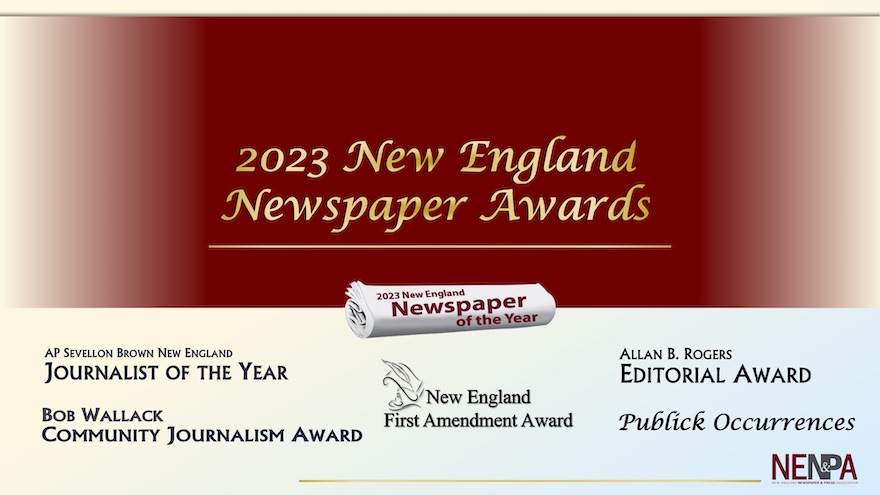
The 2023 presentation of the annual Allan B. Rogers Editorial Award, New England First Amendment Award, AP Sevellon Brown NE Journalist of the Year, Bob Wallack Community Journalism Award, and the New England Newspaper of the Year Awards happened on October 19 during the New England Newspaper Conference.
The 2023 presentation of the annual Publick Occurrences Awards happened on October 19 during the New England Newspaper Conference. 13 publications were recognized for producing the finest work that New England newspapers create each year in individual or team stories, series, spot news coverage, columns, or photojournalism that ran in print and/or online.
Visit the Publick Occurrences Award page for the full list of 2023 winners and the comments read about the winning entries during this video presentation.

 Don’t miss this lunchtime NENPA U Ethics training session on November 16 with leading New England experts!