
 For the latest stop in NENPA’s Newsroom Spotlight series, we traveled to southwestern New Hampshire to visit The Keene Sentinel—the first daily newspaper featured in the series.
Founded in 1799, the independently owned Sentinel has been part of life in Keene and the surrounding region for more than two centuries. Today, a newsroom of about 15 journalists serves readers across roughly 30 communities while navigating many of the same questions facing daily newspapers throughout New England: how to balance breaking news with deeper reporting, grow and retain digital subscribers, use audience data effectively, and decide where increasingly valuable newsroom resources should be spent.
But during NENPA’s visit, what stood out wasn’t simply the Sentinel’s history. It was how deliberately the organization is questioning long-established practices and experimenting with new ones—from the stories it chooses to cover and how reporters spend their time to the way it attracts, understands and retains subscribers.
Executive Editor-Local News Anika Clark describes the Sentinel today as a blend of that history and an organization that knows it must continue to change.
“We have this really storied past, and we’re also trying to evolve for the future. We’re not sitting on our hands.”
That willingness to evolve runs throughout the organization, where Clark works alongside Sean Burke, president and chief operating officer, and Cecily Weisburgh, executive editor-digital, as part of a team working to ensure a newspaper founded in the 18th century remains relevant to audiences in the 21st.
📰 Snapshot
 Founded: 1799
Location: Keene, New Hampshire
Ownership: Independent, locally owned
Publication: Daily newspaper with continuously updated digital coverage
Communities Served: Approximately 30
Staff: About 37 employees companywide; approximately 15 in the newsroom
Print Circulation: Approximately 2,000 daily; 2,500–3,000 on weekends
Digital Subscribers: Approximately 1,300
Primary Focus: Local news, public affairs, breaking news, enterprise reporting, sports and community information
Additional Products: The Business Journal of Greater Keene, Brattleboro and Peterborough, ELF — Enjoy Life to the Fullest, events and other specialty products
Reader Revenue: More than half of overall revenue
✍️ Editorial Approach: Listening and Responding

For a newspaper with more than two centuries of history, tradition matters at The Keene Sentinel—but it doesn’t automatically determine what the newsroom does today.
That is particularly evident in the way the Sentinel listens to its audience.
The newsroom has conducted formal listening sessions and reader surveys and gathers feedback through newsletters, email and social media. It has also become more willing to engage directly with readers who question its coverage.
Clark said those conversations can help explain journalistic decisions, but they can also expose practices worth reconsidering.
“We haven’t done a great job as an industry explaining why we do the things that we do,” she said.
Sometimes a reader’s question even becomes the next story. Editors monitor comments, messages and other feedback for questions that the newsroom can go out and answer.
The approach extends to the Sentinel’s public safety and criminal justice coverage.
The newsroom has significantly raised the threshold for reporting alleged crimes. It no longer routinely publishes police logs or every indictment and has moved away from routine mugshot publication. Editors consider the seriousness and community impact of an incident and whether the Sentinel is prepared to follow a case through its eventual resolution before reporting an initial allegation.
The changes grew in part from professional development and work with outside journalism experts, including Kelly McBride of the Poynter Institute.
The goal is not simply to cover less, but to be more intentional about what information is most useful and consequential to the community.
🏘️ Audience & Community Engagement
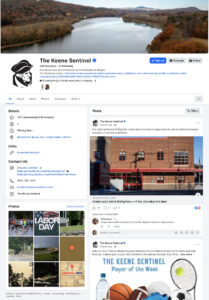
The Sentinel’s relationship with its community is rooted partly in its longevity and local ownership.
Clark said independence has become increasingly meaningful not only to readers but to journalists considering joining the newsroom. Younger job candidates in particular ask about ownership, and the Sentinel emphasizes its independent status during recruitment.
Burke sees another element behind the relationship the newspaper has built over generations.
“We don’t forget that we’re a neighbor first.”
That philosophy can show up in small ways. When the Sentinel plans an event, for example, it considers what other community organizations are doing and tries not to schedule against them unnecessarily.
The community, in turn, has shown a notable willingness to engage with the newspaper.
A recent Pulse Research survey generated roughly 800 responses, far more than the approximately 200 Burke said had been expected. The newsroom has also held community listening sessions and was preparing another in partnership with the Granite State News Collaborative at the time of NENPA’s visit.
Social media provides another active feedback channel. Facebook remains particularly robust, although moderating discussion requires substantial attention. Instagram is generating more conversation, and the Sentinel expanded onto TikTok earlier this year.
For the newsroom, the goal isn’t simply to push journalism onto additional platforms. It is to shorten the distance between the Sentinel and the people it serves.
✅ What’s Working: Breaking, Trending and Enterprise
Every morning, the Sentinel’s newsroom considers a deceptively simple question:
What are people talking about?
That question is at the heart of a workflow change that expanded the newspaper’s traditional breaking-news rotation to include breaking and trending news.
At the Sentinel, “trending” doesn’t necessarily mean something going viral online. It means identifying subjects that people in the community are already discussing—even when those subjects don’t fit neatly within a traditional beat.
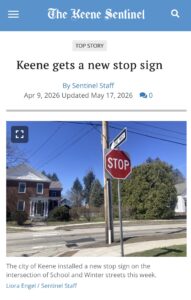
It could be a business opening or closing, a missing dog that traveled an extraordinary distance or even a change involving a stop sign.
The stop-sign story became something of a newsroom case study. Some commenters questioned why the Sentinel would devote coverage to it. But the audience numbers told a different story.
“The numbers don’t lie,” Burke said. “People cared about the stop sign.”
A digital and audience team now meets as part of the morning newsroom routine to identify these opportunities and decide what deserves attention. The newsroom is also learning to match the amount and format of coverage to the way readers consume it. A useful trending story might be relatively short and produced quickly rather than treated like a traditional enterprise piece.
Burke believes the approach has brought the newspaper closer to its audience.
“It feels more relevant to me,” he said. “It feels obviously more topical and just closer to the community.”
Protecting the Deeper Work

At the same time, the Sentinel doesn’t want greater attention to breaking and trending news to come at the expense of enterprise reporting.
An earlier workflow tied reporters’ enterprise days to the breaking-news rotation: if nothing broke, the reporter could work on a deeper project.
In practice, the two priorities competed with each other.
The newsroom has since separated them. Reporters now rotate through dedicated enterprise days every other week, when they are protected from routine assignments and can concentrate on deeper reporting. The assistant news editor helps coordinate those projects and provide structure and accountability.
Ironically, Clark said, strengthening the breaking-and-trending operation has helped create more room for enterprise journalism because the newsroom has greater capacity to handle daily coverage without automatically disrupting longer-term work.
For other small newsrooms, the lesson is significant: enterprise reporting needs its own protected workflow rather than being the work reporters get to when daily news leaves enough time.
💰 Revenue & Sustainability
 The Sentinel is managing two realities simultaneously: print remains an important part of the business, while digital represents much of its opportunity for growth.
Reader revenue now accounts for more than half of overall revenue, and Burke talks frequently about increasing the “value equation” associated with a subscription.
The company has also diversified its products and revenue sources. In addition to the daily newspaper, it publishes The Business Journal of Greater Keene, Brattleboro and Peterborough and the lifestyle publication ELF — Enjoy Life to the Fullest. Events, digital advertising, digital marketing services and philanthropy all contribute to the mix.
Burke identified fundraising, digital advertising, digital subscriptions and events as areas showing growth.
Philanthropic support is directed primarily toward the newsroom through fiscal sponsorship with Report for America. Previous initiatives have included support for State House coverage and health reporting developed after extensive community outreach.
Getting a Subscriber Is Only the Beginning
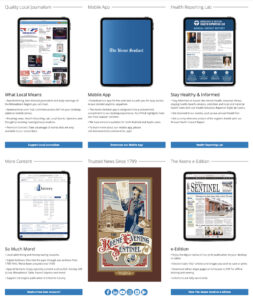
Some of the Sentinel’s most interesting work is happening around digital subscriptions.
The organization is experimenting with a dynamic paywall that responds to reader behavior rather than applying the same rule to everyone.
The system can consider factors such as what registered users read, how frequently they visit and how recently they have engaged. A highly engaged reader who regularly consumes enterprise journalism may encounter a paywall sooner than an occasional visitor who is unlikely to subscribe.
Marketing messages can then be tailored to different audience segments.
Burke said the dynamic paywall generated more than 60 new subscribers during its first two months, outperforming the Sentinel’s previous approach.
But acquisition has exposed another challenge: retention.
The Sentinel found that many people who subscribed at promotional prices left when those rates expired. Even gradually increasing prices didn’t eliminate the problem.
One current experiment is a $3.99-per-month digital price locked for three years, initially being tested as a win-back offer to former subscribers.
The Sentinel is also combining reader-behavior data with its marketing-automation system to work toward what Burke calls lifecycle marketing.
Eventually, a subscriber whose reading suddenly declines could automatically receive story recommendations based on past interests. Someone who contacts customer service with a problem could receive a follow-up asking whether it was resolved. Different readers could follow different engagement paths based on their relationship with the Sentinel.
“This is a small daily newspaper,” Burke said, “and we’re doing some, I think, pretty sophisticated things.”
From Subscribers to Members
The Sentinel is also developing a membership concept built around life in the Keene region.
Instead of a traditional newspaper membership program with different paid tiers, the current concept would make subscribers members and create partnerships with other community institutions and businesses.
Burke envisions relationships with arts organizations, theaters, recreational facilities and local businesses whose audiences overlap with the Sentinel’s. Members could receive benefits or experiences while participating organizations cross-promote one another.
The larger idea is to make the Sentinel subscription part of the broader experience of living in the region.
Looking further ahead, Burke is also interested in niche subscriptions. A sports-only product, for example, could appeal to parents intensely interested in local high school sports during the years their children are participating.
Some of those ideas are ahead of what the Sentinel’s current technology can easily accommodate, but Burke sees considerable potential in giving readers more ways to enter—and remain in—the Sentinel’s ecosystem.
🤔 Learning as an Organizational Strategy

One of the most distinctive things about The Keene Sentinel is how deliberately it looks outside its own newsroom for ideas.
The organization has participated in Table Stakes, the Meta Accelerator, solutions journalism programs, API training and other industry cohorts and workshops. At the time of NENPA’s visit, staff members were participating in additional programs involving journalism funding and artificial intelligence.
For the Sentinel, these aren’t simply résumé-building professional development opportunities. Leaders repeatedly pointed to operational changes that grew directly from what staff learned.
Clark described Table Stakes as foundational to the newsroom’s use of audience metrics.
“Our upward trajectory after Table Stakes was huge. I don’t think we could have done this without Table Stakes.”
The programs also connected Sentinel staff with journalists, coaches and experts outside southwestern New Hampshire.
Weisburgh said that helped the newsroom move from sometimes “feeling like an island” to being connected with peers confronting similar problems elsewhere.
As a relatively small organization, the Sentinel cannot participate in everything. Burke said the key is being selective—and then committing once the decision is made.
“If we’re going to do something, let’s do it right.”
Learning also flows in the other direction.
Clark said early-career journalists arrive with technology and multimedia skills that veteran journalists may not have learned—and with a willingness to ask a valuable question:
Why do you do it that way?
Sometimes explaining an established practice reinforces why it remains important. Other times, having to articulate the reasoning behind it reveals that the practice may no longer make sense.
Those conversations have also encouraged the newsroom to put more of its policies into writing so they can be applied consistently internally and explained more transparently to readers.
At the Sentinel, professional development isn’t simply about teaching younger journalists how things have always been done. It’s also allowing them to challenge whether those things should still be done that way.
⚙️ Operations & Workflow
The Sentinel has made significant operational changes outside the newsroom as well.
Printing has been outsourced to the Berkshire Eagle in Pittsfield, Massachusetts, after the Sentinel lost press staff and faced the difficulty of recruiting replacements. Burke said the arrangement has provided strong print quality and favorable economics.
Home delivery has also moved away from newspaper carriers.
The Sentinel now relies largely on the U.S. Postal Service, with an exceptional dispatch arrangement that allows newspapers to be delivered directly to local post offices in the morning for same-day delivery. The Keene Post Office has also classified the newspaper as a package, giving it priority within the postal operation.
The transition hasn’t been flawless, and Burke said subscription churn has been somewhat higher since the change, although he cannot attribute that solely to postal delivery.
Financially, however, the model removes many fixed delivery costs. The Sentinel no longer has to maintain the same infrastructure of district managers, carriers and associated expenses. As print volume declines, delivery costs can decline more directly with it.
For Burke, that flexibility is part of the larger strategy: stabilize and efficiently manage the print business while creating room to invest in digital growth.
🤖 AI & Experimentation
The Sentinel is experimenting with artificial intelligence, but with clear boundaries.
One current use involves submitted community news. ChatGPT can help turn lengthy submissions into briefs, which are then reviewed by an editor. The newspaper discloses the practice and does not apply the same process to reporter-generated journalism.
More recently, the Sentinel participated in NENPA’s Google News Initiative AI Growth Lab, which allowed the team to explore Google AI tools and consider practical applications within the newsroom. Following the training, staff began experimenting with NotebookLM and other Google AI tools, particularly for working with large amounts of source material.
Weisburgh said the team quickly saw the potential. After one of the Growth Lab sessions, she introduced NotebookLM to an editor working on a story involving a lengthy court case. The editor used it to navigate the source documents and locate relevant information, significantly reducing the time the process would otherwise have required.
The controlled environment is particularly important to the newsroom. Weisburgh said staff members are interested in AI applications that can make journalists more efficient while allowing them to know exactly what source material the system is using.
There are other applications the Sentinel isn’t ready to embrace, including AI-generated podcasts and videos.
The question isn’t simply what AI is capable of doing. It is where technology can responsibly increase the newsroom’s capacity without replacing the reporting, verification and judgment at the heart of the work.
🏆 NENPA Recognition
The Keene Sentinel has a long history of recognition in NENPA’s New England Better Newspaper Competition. In the most recent contest, the Sentinel received honors across editorial, multimedia and digital categories.
Among them, Sophia Keshmiri earned First Place for Climate Change or Weather Reporting for her year-long coverage of a family recovering after losing its home in a severe storm. The Sentinel also received recognition for crime and courts reporting, sports, multimedia coverage, its website and other community journalism.
The range of recognition reflects the breadth of work produced by a newsroom balancing the demands of daily coverage with the deeper reporting it is intentionally working to protect.
⚠️ Challenges
For Clark, one of the most persistent challenges is recruitment.
Even with a newsroom larger than many similarly sized newspapers, losing a single person has an immediate impact.
“We’re small and mighty,” she said.
Finding the right person matters just as much as filling the opening, making recruitment both important and time-consuming. The Sentinel relies on freelancers when short-staffed and emphasizes independent ownership and newsroom culture when recruiting.
Another challenge is deciding what not to do.
Town meeting coverage illustrates the problem. The Sentinel serves roughly 30 communities, making comprehensive annual town meeting and election coverage an enormous undertaking.
The journalism is important, particularly to longtime readers, but some of it performs poorly with digital audiences, and the sheer volume can crowd out other reporting opportunities.
The newsroom has tried different approaches—reducing coverage of uncontested races, asking communities to provide results and experimenting with more thematic reporting—but Clark said it remains an unresolved challenge.
It is a problem many regional news organizations know well: how do you maintain meaningful coverage across numerous communities without spreading a finite newsroom too thin?
💡 Lessons for Other Newsrooms
Several ideas from The Keene Sentinel stand out as particularly transferable:
- Separate breaking/trending and enterprise workflows. Don’t make deeper journalism dependent on whether daily news happens to be quiet.
- Listen, then respond. Audience engagement can inform coverage, generate story ideas and expose newsroom practices worth reconsidering.
- Use data to inform editorial judgment, not replace it. Metrics are one signal alongside community knowledge and journalistic judgment.
- Think beyond subscriber acquisition. Retention, engagement and the overall value of the relationship deserve as much attention as getting someone through the paywall.
- Make professional development operational. Training becomes most valuable when ideas come back into the newsroom and change how work gets done.
- Question inherited practices. A newer employee asking “Why do we do it that way?” can be an asset.
- Give yourself permission to stop. Not every traditional coverage practice—or new business idea—continues to justify the resources it consumes.
🔮 Looking Ahead
 For a newspaper that has existed since 1799, The Keene Sentinel spends a surprising amount of time thinking about what it hasn’t tried yet.
The organization is working to stabilize its print business while growing digital subscriptions, advertising, events and philanthropy. It is experimenting with dynamic paywalls, lifecycle marketing and membership while exploring niche subscription products and new ways to connect readers with the broader Keene community.
Inside the newsroom, the same willingness to experiment is shaping how journalists respond to breaking news, identify what audiences are talking about, protect time for enterprise reporting and use emerging technology.
Not every experiment will work. The Sentinel’s leaders are remarkably comfortable acknowledging that.
What matters is continuing to test, measure, listen and learn.
For an institution whose history stretches back more than two centuries, perhaps the most interesting thing about The Keene Sentinel isn’t how much of its past it has preserved.
It’s how willing the organization remains to ask whether the way it did something yesterday is still the best way to do it tomorrow.