Pick your cliche…
“The best ideas are often the simplest ones.”
“Sometimes it’s hardest to see things that are right in front of you.”
“The shortest distance between two points is a straight line.”
All three and many more could be teased from advice shared October 10 by New England Newspaper Fall Conference keynote Nicco Mele.
The author, professor, publisher, political consultant, Harvard Business Review contributor, and alumni of an Esquire Magazine “Best and Brightest” in America designation promised a “super practical” dialog that appeared to resonate with the 100-plus attendees to last weeks conference.
While a LOT of ground around reader engagement was covered by Mele, the meat of his message centers on the great potential simple e-mails could play as print publications cast for and hope to re- engage their audiences and – dare we suggest – attract print subscribers.
Based on his fast-paced presentation, it may not be as much of an “old is new again” situation as it is using purposefully simple and well timed e-mail messages to slowly but surely establish or reestablish consumer relationships – with at least the added benefit of enticing significantly more web/social traffic.
Having admittedly spent “the last few years publishing research on monetizing news,” Mele arrived at the New England Newspaper Fall Conference held at the AC Hotel in Worcester, MA ready to share some of his most important findings.
Driving Eyes
Mele said the “single hardest thing in the news business is getting people to the website.” But at the same time, he was happy to report that local papers appear to have “a competitive advantage,” saying smaller regional and community publications already tend to possess the “original inbound internet marketing apparatus.”
He said unfortunately, most consumers and potential readers will not pay for locally generated news content “if they don’t build a habit around your paper.” Mele suggested papers might nudge local audiences to slowly modify news consumption habits by developing and serving audience around targeted content – and then funneling users into “habitual paying customers.”
Having accomplished it himself, Mele admitted the task remains “very difficult.” That’s why Mele said he loves e-mail. “Social audiences don’t belong to you – and don’t have a relationship to them,” Mele warned. “But if you capture e-mail, you have a connection forever. You can monetize their attention. You can assign lifetime value, and budget around that when you have e-mail addresses.”
When it comes to best utilizing and building your e-mail list Mele says:
? Encourage monthly reader panels that you pay to help build a “data model” of your consumers.
? With e-mail, you can track data and talk to your audience constantly. And metrics on habit are highly valuable – how often a recipient opens your emails can help you decide what kind of product to build.
? Surprisingly, e-mail outreach messages work best when they are simple – so they should mainly contain text, not images or a lot of ads.
? Production energy should be on the quality of writing
? It should be targeted for delivery the same time every day or week
? Strive for consistency over the long haul. “It’s not like selling an ad and you’re done,” he cautioned those eyeing an e-mail engagement launch.
? However, a successful e-mail product has great potential to help papers learn the numbers, specific interests, and passions of their audience – and to build on that data.
Beware The ‘Bounce’
When it comes to methods for acquiring e-mails, Mele finds events provide engagement opportunities – and a good source e-mail traffic capture. He said since e-mail bounce rates are very high and vary widely (50-90%) -obtaining e-mail addresses at every event is crucial.
Another key element: Mele says your e-mails need to have a human name in the delivery. “They want something that feels like a local columnist,” he said. “Mobile [users] are very intimate – so your e-mail needs to have a ‘dear mom’ quality to it.”
For those who can follow his advice, Mele insists that “e-mail is the best local strategy you can have.”
“Strong editorial products will have largest CPM, source of digital subscriptions, and driver of site traffic,” he added.
“Nothing else I’ve ever done on the internet has delivered like e-mail has,” Mele concluded, so “if you have them, engage them, and you will eventually convert them to subscribers.”
Attendee Reactions
Following the talk, Waterbury Republican-American Managing Editor Anne Karolyi said she found Mele’s professed love of e-mail outreach interesting because her publication recently launched a daily e-mail blast, and it is “one of the most common ways that people use to access our website.”
“People seem to like that,” Karioli said. She also agreed with Mele that complete separation between departments like advertising and editorial can be maintained while working together, sharing information and ideas..
“There are ways of dealing with the larger business issues involving your paper without completely breaking down that wall,” she said. “I’ve always believed that was possible – and I would rather protect our integrity while finding ways to make money because I need to make sure my reporters can eat.”
Peter Haggerty President and Publisher, Daily Times Chronicle, Inc. Woburn said he was receptive to Mele’s advice on how to help increase “digital side revenue.”
Haggerty said, “We’re losing so much revenue on the print side, that it’s important for us to learn how to replace some of it.” His company is already weighing a number of things that Mele suggested including e-mail outreach and events, as well as the right way to meter on-line readership.
“While we have our websites, the revenue stream from them has been stagnant,” he added. “As [Mele] said, we need to create some kind of customized product to hit that target audience by e-mail in the hope it will drive some to subscribe, or create more revenue.”
Closing Tip & Resources
Regarding email and other reader engagement tools, Mele suggested the site newsletterguide.org – aimed at building “quality newsletter products for those who know nothing about it.” He said the site offers everything from workflow tools for smaller publications, to free mobile-friendly templates. Check it out!
DOWNLOAD POWERPOINT OF KEYNOTE
PHOTO GALLERY KEYNOTE & AWARDS LUNCHEON
By John Voket eBulletin Contributor
John Voket is an Associate Editor at The Newtown Bee in Connecticut, Director of Public Affairs for Connecticut’s Connoisseur Media radio stations, and 2018-19 President of NENPA.












From NBA to Trump to our ears and eyes, how free speech works
Gene Policinski is president and chief operating officer of the Freedom Forum Institute. Email him at
gpolicinski@freedomforum.org
and follow him on Twitter at @genefac.
Let’s chat for just a moment about free speech.
Many of us have been talking about that very subject recently, from NBA stars and league executives to Chinese government officials, from President Trump to journalists and members of Congress.
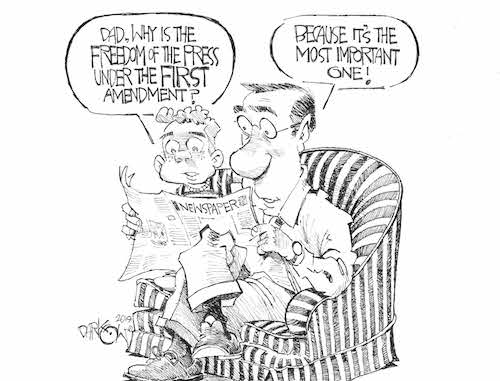
Some ground rules for our conversation: The First Amendment protects us from government attempts to control what we say, or from punishment simply for having said it. Freedom of speech — one of five freedoms in the amendment — offers no protection from private companies or individuals who don’t like what we say or hold other views.
The First Amendment only applies in the United States. Other nations may have rules or laws that in some fashion say they protect or really do protect freedom of speech, but none has quite the same strong constitutional protection that we have in the U.S.
And even after 220-plus years, we’re still working out how First Amendment freedoms apply here to everyday situations. Let’s continue the conversation with some real-life examples.
The National Basketball Association has been working for several decades to build its audience in China, where it’s reported more people watch NBA games on TV than do people in this country. A carefully crafted combination of sports and marketing took a real hit in a matter of days recently, after a Houston Rockets executive tweeted an innocuous message of support for protesters in Hong Kong — who it’s worth noting, were protesting in part any attempt by Chinese officials to limit their free speech. The tweet: “Fight for freedom. Stand with Hong Kong.”
Chinese state television stopped broadcasting and streaming the Rockets’ games. Pre-season game broadcasts of several other NBA teams were dropped. Government-controlled Chinese companies dropped their NBA-related sponsorships. Banners touting NBA stars and events were torn down from buildings. And state-owned news media called on NBA players and executives to be more “respectful” of that nation’s internal policies and to consider how “rioters” in Hong Kong pose a threat to life and property there.
China makes no pretense of protecting free speech when it involves the government’s policies there — so yet another lesson: While our freedom of speech is protected from our government, it affords no such defense against other governments.
President Trump this week threatened this week to sue CNN, following release of “undercover” video by the self-styled conservative media criticism operation called “Project Veritas,” which purports to demonstrate bias against him by CNN.
One hurdle such a lawsuit will face is that the First Amendment’s provision for free speech and free press don’t have a “fairness” requirement. While our laws do allow challenges to speech that is immediately threatening, or is libelous, there’s no such provision for requiring anyone — from a cable network to any one of us — to be nice or “fair” when speaking about a politician. The First Amendment does provide that Trump or any other political officeholder can use his or her own free speech rights — in his case, a Twitter account with a massive following — to counter such alleged bias.
Moving from the courtroom to Congress, there are suggestions of future laws to prevent hateful speech, speech that glorifies violence, to ban so-called “deep fake” videos (which use new technology to falsify video images and scenes) or to filter out what someone would determine are false and misleading statements about political candidates. Most, if not all, of those efforts start with good intentions: to make our society a more civil, honorable place.
But on the pragmatic level, each runs up against a free-speech concept strongly held in place so far by the U.S. Supreme Court: That such social issues and values involving free expression should be settled by public debate and discussion, not by court or legislative decision.
Yes, such debates and discussions may well have a price or penalty for participation — starting with no guarantee of civility or fair play. NBA superstar LeBron James — despite a reputation for speaking out in defense of those challenging authority — nonetheless faced a Twitter firestorm for comments he made that many saw as critical of the original Hong Kong tweet, though he denies that intent. The exchanges between Trump and his critics carry a special vitriol, which damages his reputation with some and damages his critics’ standings with others.
In the end, we all may need to see, hear or read ideas that offend, anger or even sicken us — across the widest possible spectrum of views if only, as one Supreme Court justice once wrote, to be better prepared to argue against them.
To speak frankly, that’s how free speech works.