
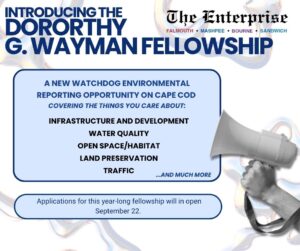
 The Enterprise Newspapers has announced the Dorothy G. Wayman Fellowship, a new full-time, paid fellowship dedicated to watchdog coverage of development and overdevelopment across Cape Cod’s Upper Cape towns.
The 12-month fellowship will place an early-career journalist on a dedicated beat covering development in the Cape Cod region, specifically Falmouth, Sandwich, Mashpee and Bourne, and its effects on traffic, water quality, open space and habitat preservation, drilling into the heart of issues reshaping the region faster than most local newsrooms currently have the capacity to cover.
“This fellowship will deliver something crucial that our readers asked us for directly throughout our recent community listening sessions: news on what’s being built in town, and deep dives into how it will impact residents, from water quality and sewer capacity to traffic and parking,” Director of Audience Development and Mashpee Enterprise editor Calli Remillard said. “Overdevelopment is a real problem on Cape Cod. There is only so much land here, and making sure that what is left is protected—our open space, preservation areas and watersheds—is a critical issue among residents, but the information isn’t always accessible or easy to understand. This role will bridge that gap.”
The fellowship is structured as a teaching-newsroom program, pairing full-time reporting with a defined curriculum in regulatory literacy, public-records proficiency, accountability reporting and environmental data analysis. The yearlong program is built around a defined, quarterly-benchmarked curriculum—clear reporting milestones, structured mentorship and regular progress reviews—designed to produce sustained, rigorous coverage rather than one-off stories.
The Dorothy G. Wayman Fellow will sit inside the rooms where these decisions get made—planning boards, conservation commissions, Cape Cod Commission hearings—tracking projects from initial filing through final approval, asking the questions those review processes are supposed to answer but often don’t get asked or answered publicly. This work will dive deep, pulling engineering and environmental reports apart line by line to determine what a wastewater system is actually rated to handle, what a septic upgrade does or doesn’t solve, and how much runoff a site can absorb before it becomes someone else’s problem downstream. The fellow’s job is to go deeper than the headlines a new development generates, talking directly to scientists, engineers, and environmental experts to understand what’s really in the reports filed alongside every major project and following the slower-moving story underneath all of it: how continued building on already-strained land compounds with coastal erosion over time, turning today’s approved project into tomorrow’s harder-to-reverse damage. It’s accountability journalism built to answer the “why” behind the problems residents already feel every year.
The position is in-person and full-time, with a weekly stipend. The fellowship includes funds earmarked for professional development and a dedicated reporting budget, and comes with an additional monthly stipend to support the fellow’s relocation to Cape Cod and mitigate high costs of securing local housing.
Applications open September 22, 2026, with the fellow beginning work June 1, 2027. Journalism organizations, educators, and networks are encouraged to share this opportunity with early-career reporters, recent journalism graduates, and members interested in environmental and accountability reporting.
Full details and the application will be available at https://www.capenews.net/site/